By CARROLL McCUNE
In 1907, the Lima & Toledo Traction Company began construction on the world’s longest reinforced concrete bridge in its time.
One hundred and sixty men worked for a year and a half on the 1,220-foot span. It took 440,000 feet of lumber to fabricate the forms for the twelve 100-foot-wide concrete arches. Its construction required 16,000 cubic yards of cement and 240 tons of steel. The hollow arches were filled with 8,000 cubic yards of earth. The piers, almost entirely above water, had to be pinned with steel rods to the bedrock below the Maumee River near Waterville. It was built by the National Bridge Company of Indianapolis, Indiana, with Gaylord Thompson as the chief engineer.
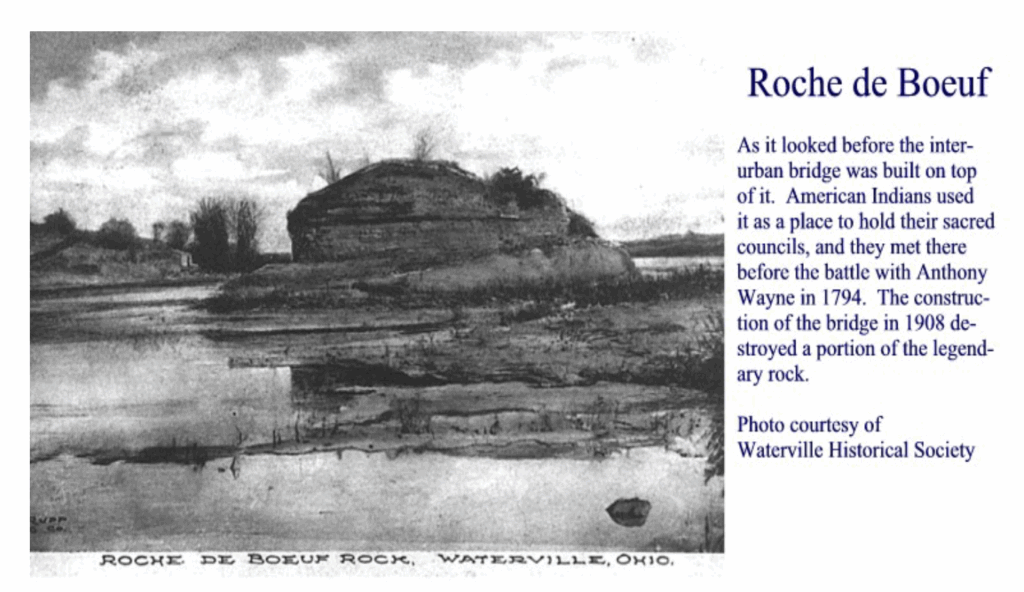
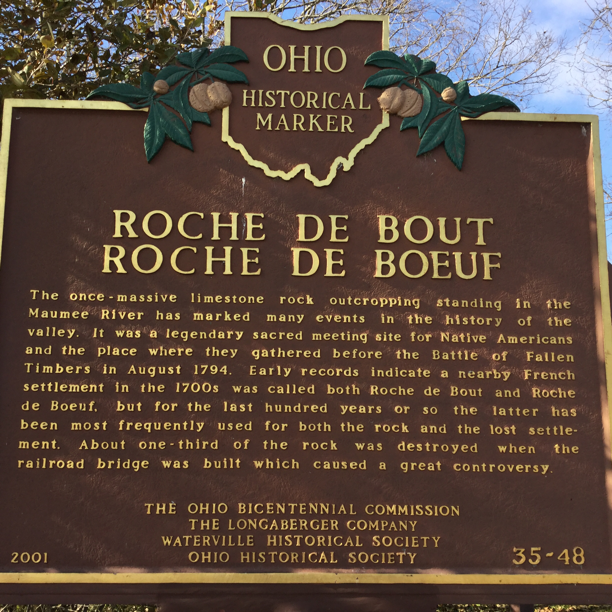
While the design of the bridge was considered an engineering marvel, its placement over the top of a limestone outcropping in the Maumee River, which had been designated a historic site, sparked outrage in the citizens of Waterville. Named “Roche de Boeuf” (Buffalo Rock) by early French trappers, the huge rock outcropping had been used for ages as a meeting place among Native American tribes in the region. Called the “Peace Grounds” by the original inhabitants, both natives and Americans used the site to plot war. In 1794, General Anthony Wayne led a retaliatory expedition against an Indian confederacy in the region. He and his officers waded out to the rock to strategize for what would be known as the Battle of Fallen Timbers that took place about five miles downstream.
Lieutenant William Clark (of Lewis & Clark fame), who had been traveling with Wayne’s army, observed the rock in a particularly scenic bend in the river and wrote, “We behold one of the most beautiful landscapes ever painted.”
When the construction company announced its plan to blast off the upper third of the Indian rock and run their railway right over the top of it, locals considered it a desecration of a treasured natural landmark. They formed a committee to oppose this route for the trolley line. John Lansing Pray (grandson of Waterville founder John Pray) led the effort to block construction of the bridge over Roche de Boeuf. He wanted the track line rerouted.
Excerpt from the Wakeman Archive, Waterville, Ohio
The Roche de Boeuf bridge, sometimes known from Waterville as the Trolley Bridge, was used by the Lima Toledo Traction Company and claimed to make it from Waterville to Toledo in 20 minutes. It was built by the National Bridge Company of Indianapolis, Indiana.The company promised that they would not damage or destroy the rock known as Roche de Boeuf, sacred to the Native Americans. Clarence Dodd owned the Rock by riparian right and deeded the company a right-of-way across his property. As the bridge was being built it was apparent that the rock was being damaged. In fact, almost one third of the rock was blown away to create a support for one of the bridge piers.
The people were up in arms but what could they do. The deed was done.
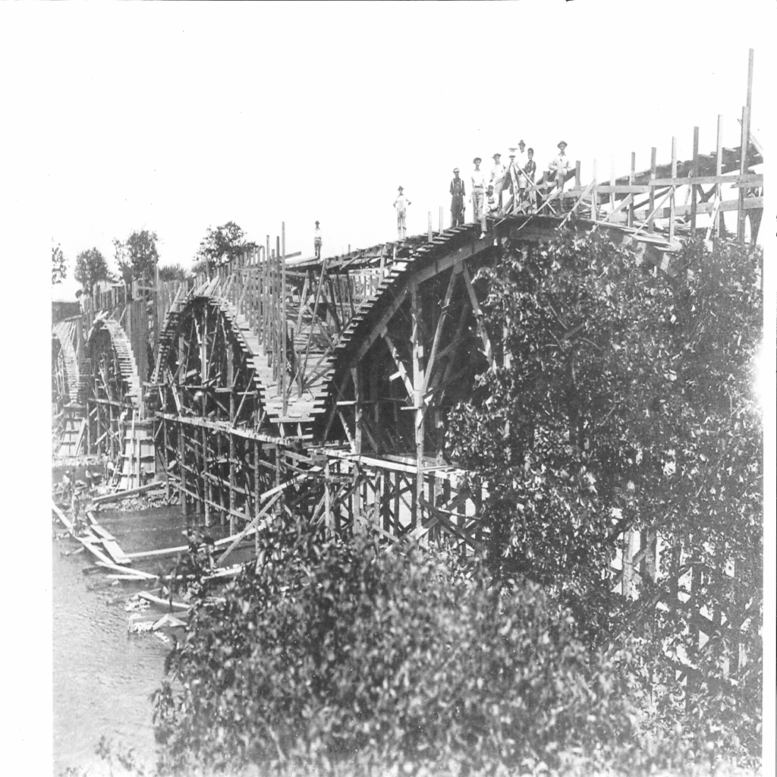
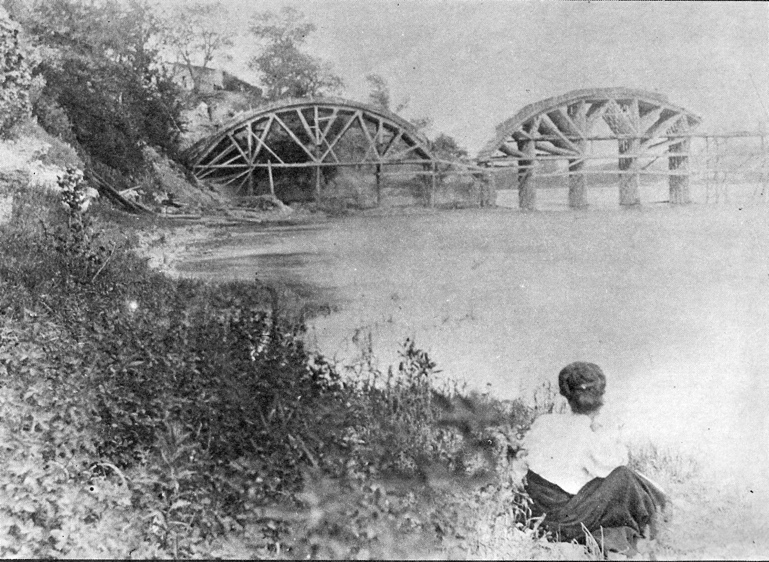
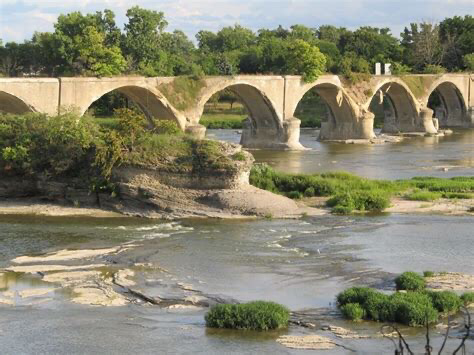
It was a beautiful bridge built with a “Roman Aqueduct” design, 1220 feet in length with 12 arches spanning the Maumee River. The arches, ranging 70-90 feet in length, were dirt filled and 45 feet above the water at lowest level. This was done with wooden forms as shown in the picture taken by John Findlay Torrence (Tory) Isham, son of John George and Sarah Cooper Isham, who lived nearby. He was an amateur photographer, farmer and former teacher at Neowash School on Neowash Road. He was also a surveyor possibly under local surveyor Charles Shoemaker. He worked as a surveyor in several northwestern states for the Great Northern Railroad Line from 1881 to 1891. He became interested in home photography around 1900, taking many photos of local scenes that interested him. These photos were taken on glass negatives, which were developed and printed in his home darkroom. Some of his photographs are of the bridge at Roche de Boeuf being built. The Wakeman Archives has on display the camera and his mounting equipment that was used in taking pictures of this bridge.
The construction company had assured Pray’s committee that the rock would not be damaged in order to get them to sign off on the build. The National Bridge Company said, “We’re going to be six feet away—you don’t have to worry. In fact, that rock will be a focal point and people will enjoy riding out and looking at it for historical value.” But the concerned Waterville citizens were double-crossed when the construction company blasted and leveled the rock according to their original plan. The Toledo News Bee described the desecration as a “triumph of commercialism.”
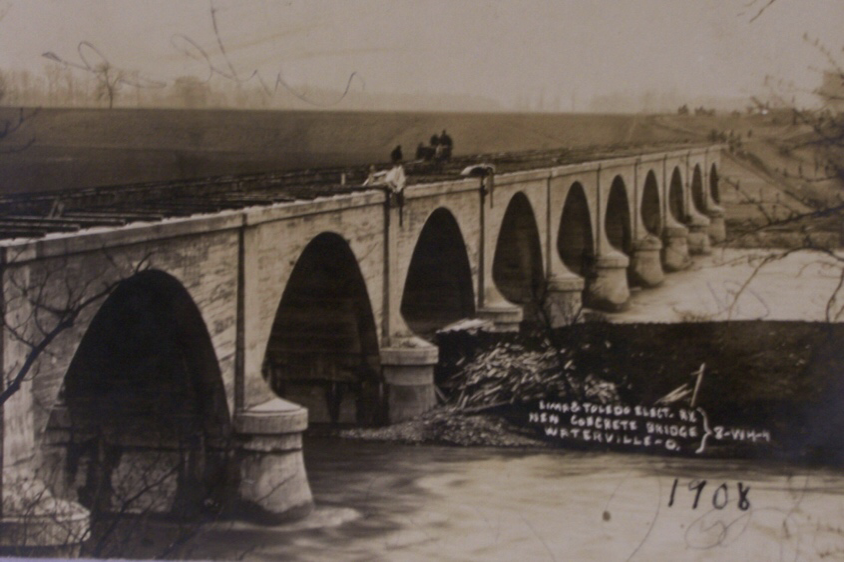
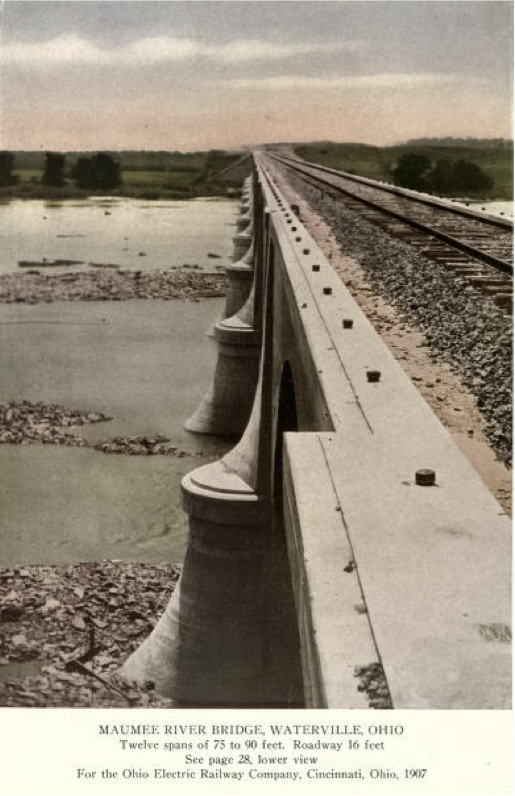
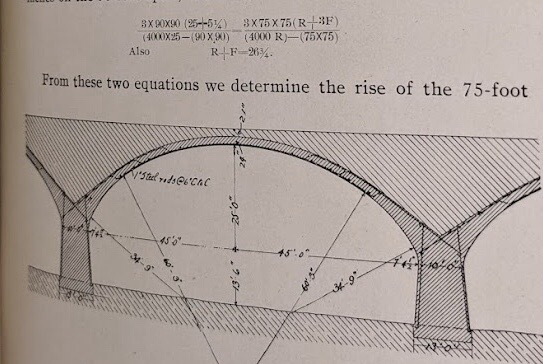
The National Bridge Company designed the Interurban using the patented Luten arch system. The secret of the bridge’s beauty lies in its Romanesque contours, but the secret of its strength and endurance is its Luten arches. Designed by Daniel B. Luten, the arch improves spandrel strength through the strategic use of reinforced steel bars where needed to address the tension of the load upon the bridge. Between the years 1901 and 1906, Luten designed, contracted, and erected approximately 500 concrete bridges with the Luten Bridge Company.
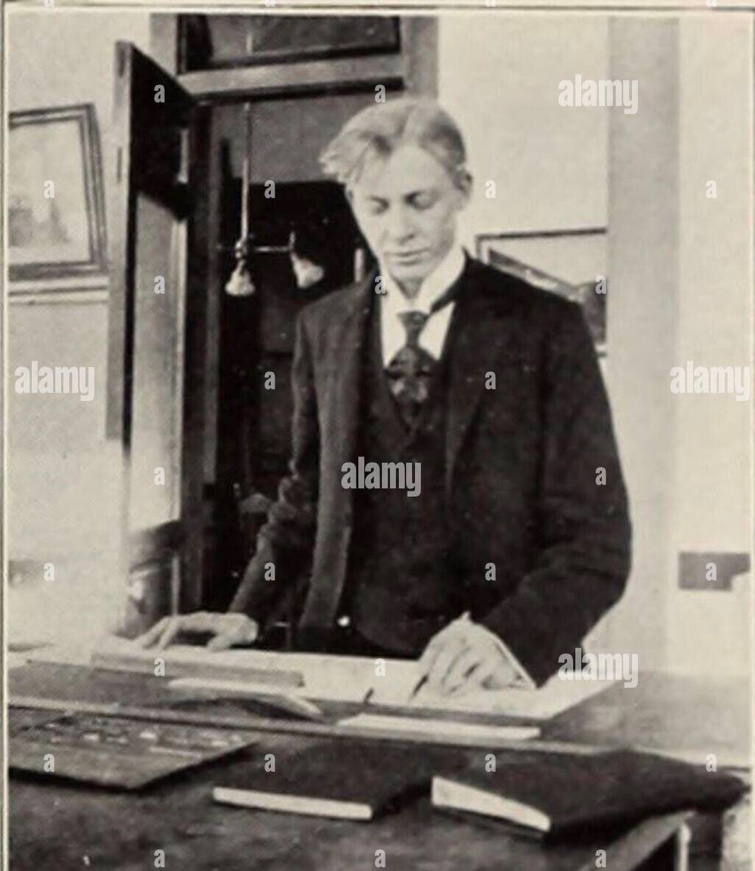
“Bridges built of Concrete will endure as monuments for all time. It is of the utmost importance therefore that they be so built as to be above criticism by coming generations.”
Daniel B. Luten
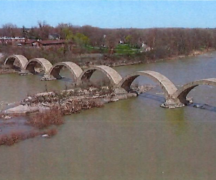
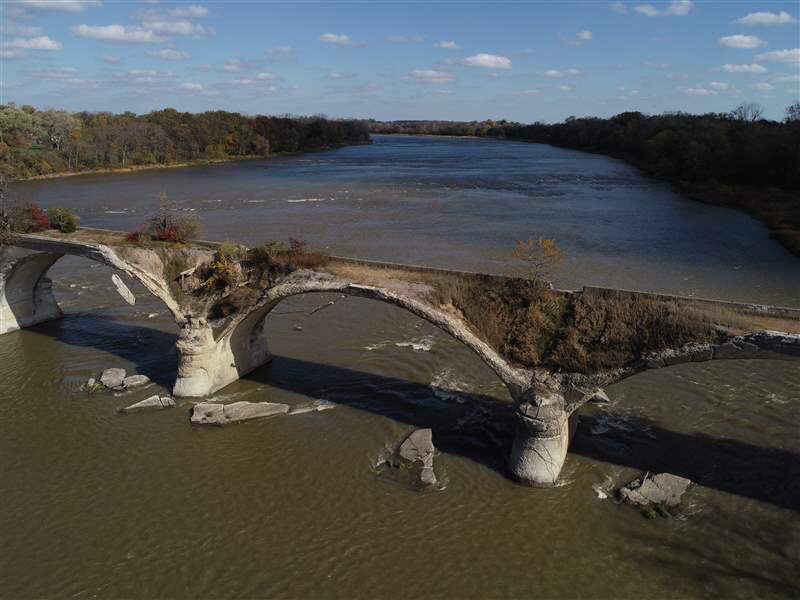
The coming generations would witness the abandonment of the trolley bridge and inevitable erosion of the concrete arches, while the beauty of the decaying structure would remain “above criticism.” Like ancient ruins, the bridge is more beautiful in decay than when newly built because its designer paid homage to the forms of classical architecture that have delighted viewers throughout the ages.
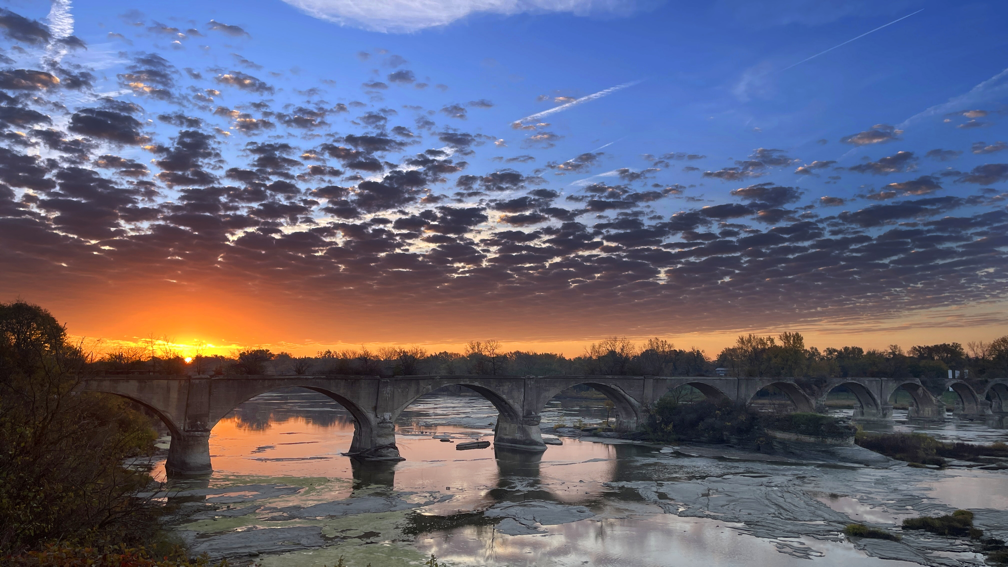
Today, this melding of nature and architecture has become a magnet to artists and photographers, a picturesque attraction to tourists, and a place of meditation and renewal for local residents. It gives the community its unique character and is a source of collective pride among its people.
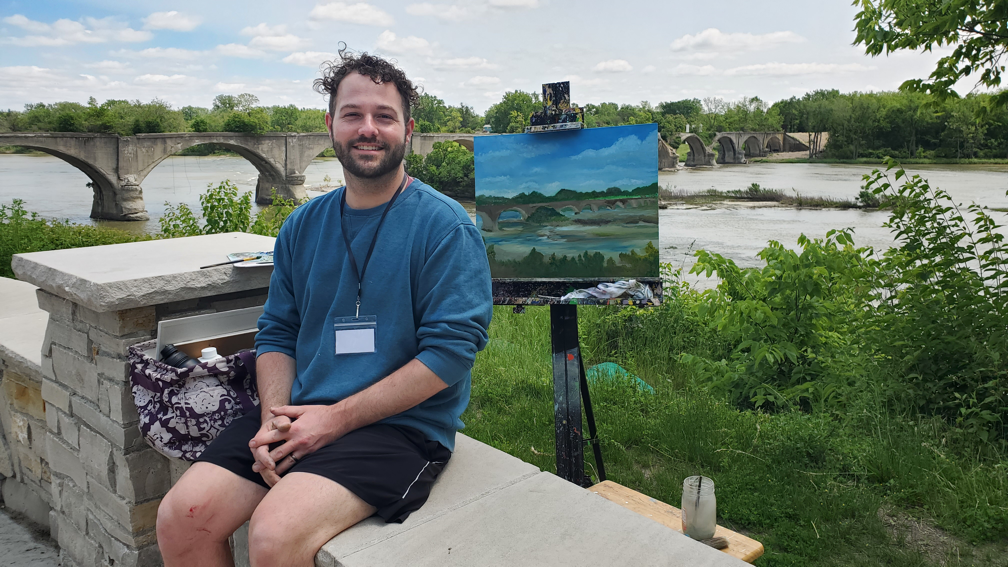
“The area of the Interurban Bridge at Roche de Boeuf has always held meaning for me. My family lived on South River Rd. in Waterville the first year we moved to Ohio. We would ride our bikes and take in the scenery, enjoying the peaceful atmosphere. We later moved to Whitehouse, but I stil find myself going back there for solitude, or for events like the Jim White Memorial Paint Out. Roche de Boeuf is what makes Waterville so special. I think of the bridge as the symbol of the area. I decided to paint the bridge for the plein air event because I knew there was discussion of it being demolished and I wanted to have my own documented memory of it before it was gone.
Steve Gill
“My favorite part about painting that day was the local residents coming up to me to tell me their memories of the location. I heard stories of a mother coming to visit the spot because it was her late son’s favorite place, and even an old gentleman reflecting on his time with the bridge in the 1970’s. Historic places like this not only served a purpose, but also hold personal memories and stories to tell for so many local residents.”
*****
*****
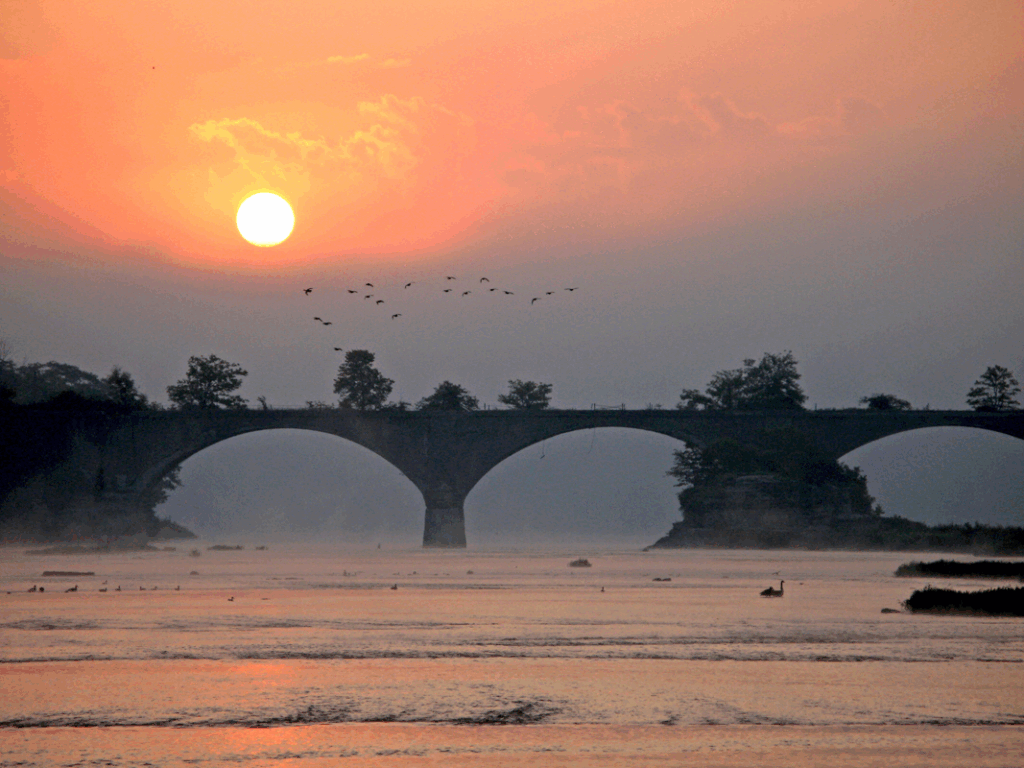
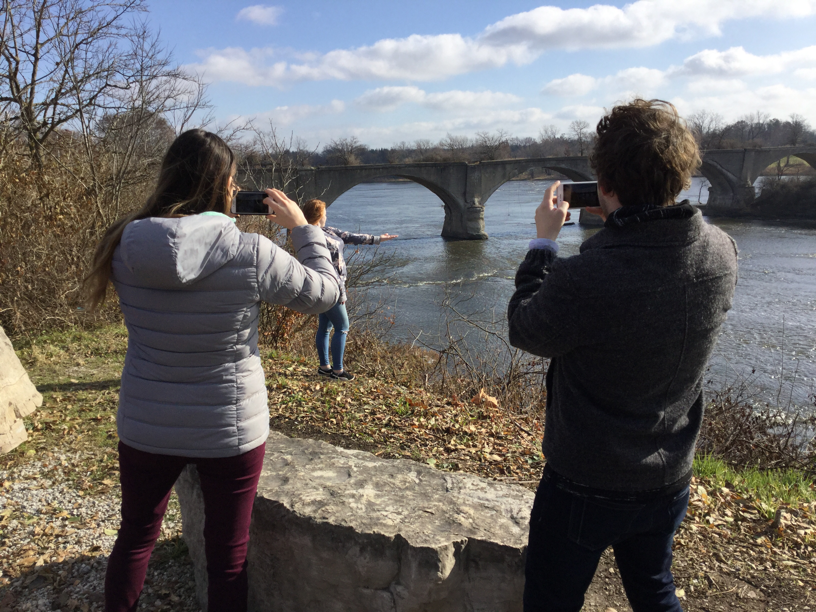
“For decades I had passed by without ever knowing it was there. When I first discovered it, I was captivated, but before that, I was struck dumb. I couldn’t believe that anything with that much architectural impact was in my backyard. I was just amazed at its lines, its beauty, and its simplicity…The scene never tires me. I’ve crossed that river so many times, looking at it from both sides, and nearly falling in with all my gear, just trying to get a variety of vantage points.”
Mark Hamann
*****
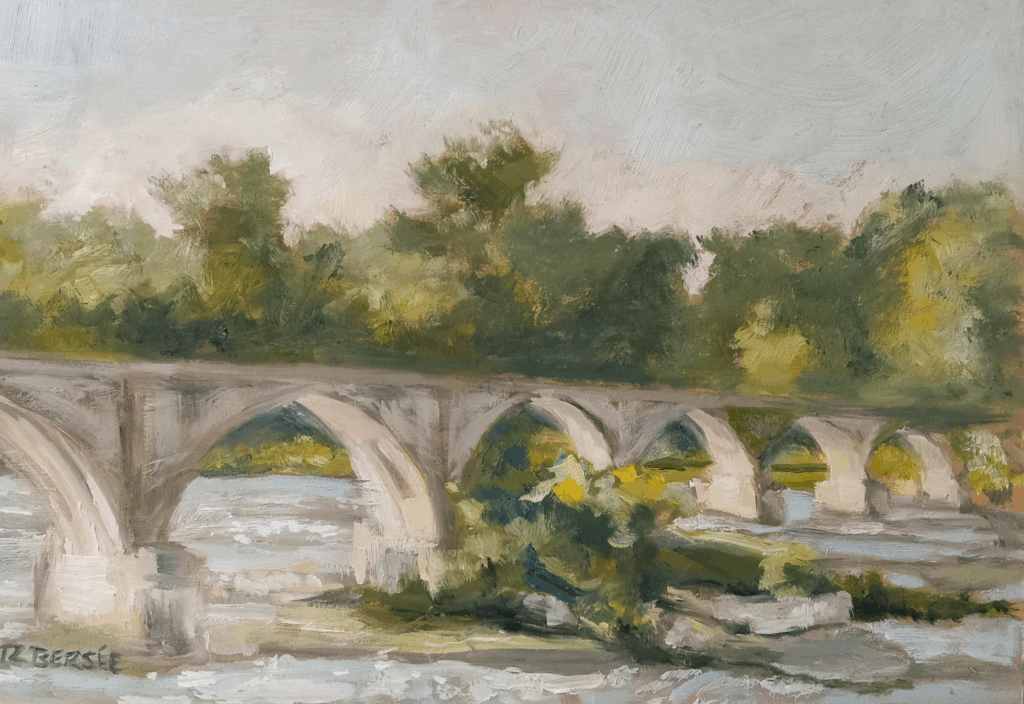
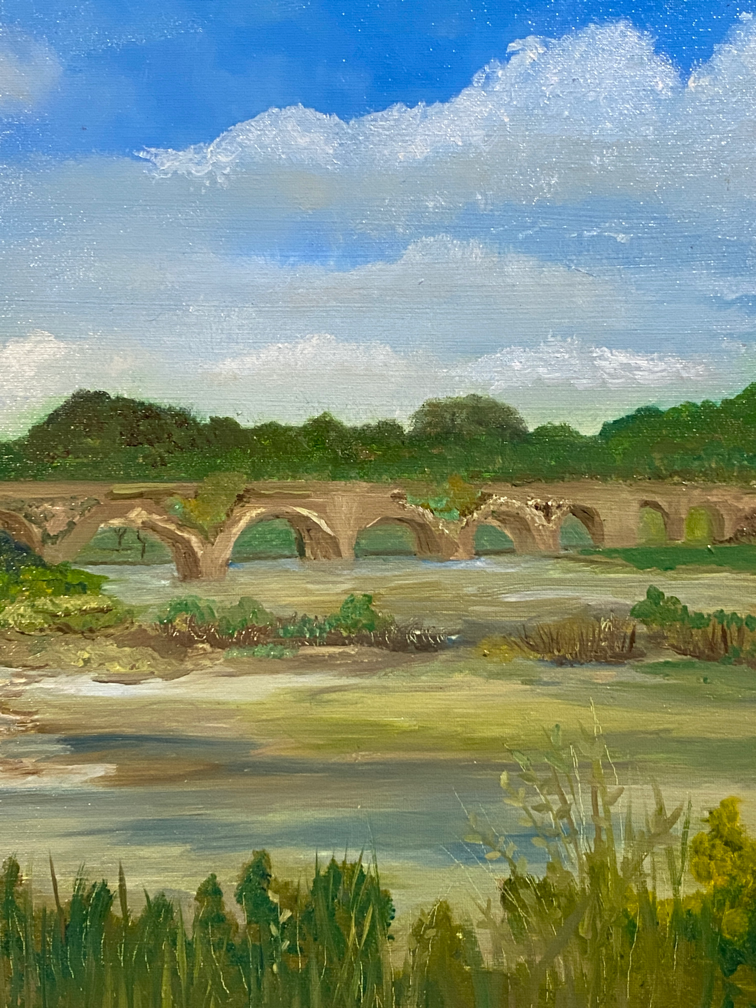
A design of the bridge is the logo of the Village of Waterville. Prints of an earlier pastel painting of the scene by professional artist Teri Utz Bersée were licensed to the Waterville Chamber of Commerce in 2006 to benefit their scholarship program. The artist’s impressionistic artwork above was created during the 2024 Jim White Memorial Paint Out.
“The history of this scene—its classic bridge design, the deceit felt by both Native Americans and Waterville citizens regarding its construction, the natural beauty of both rock and river, and its iconic lifelong impact—make for a quintessensial landscape.”
Teri Utz Bersée.
*****
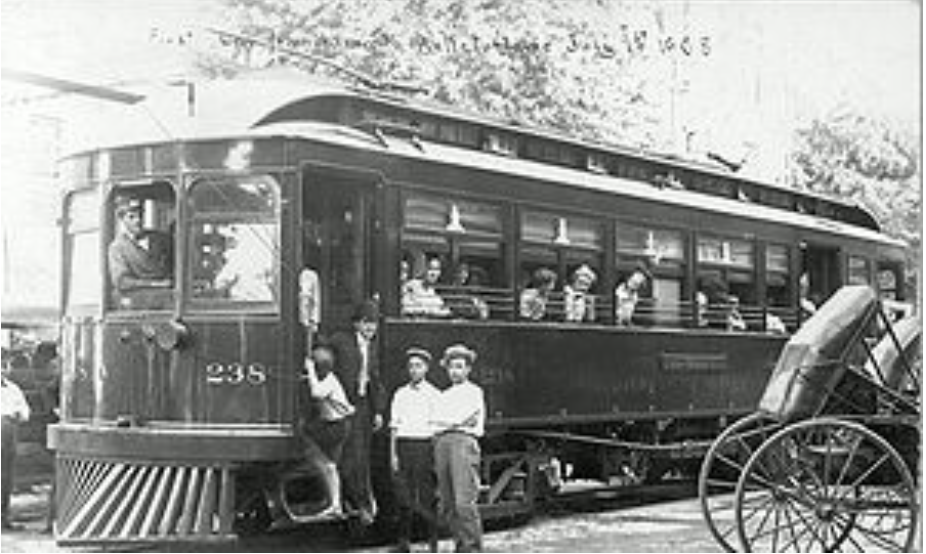
Service on the Ohio Electric Interurban line began in 1908, running a 72-mile route from Lima to Lake Erie at Toledo three times a day. The trolley was fast and luxurious, boasting leather seats with head rests and a closed-off smoking section. Freight cars offered overnight delivery of newspapers, milk cans and other staples to stores along the route.
Nicknamed The “Red Devil,” the lightweight aluminum trolley that sped over its track once raced an airplane, clocking in at 97-miles per hour. The Red Devil won the race.
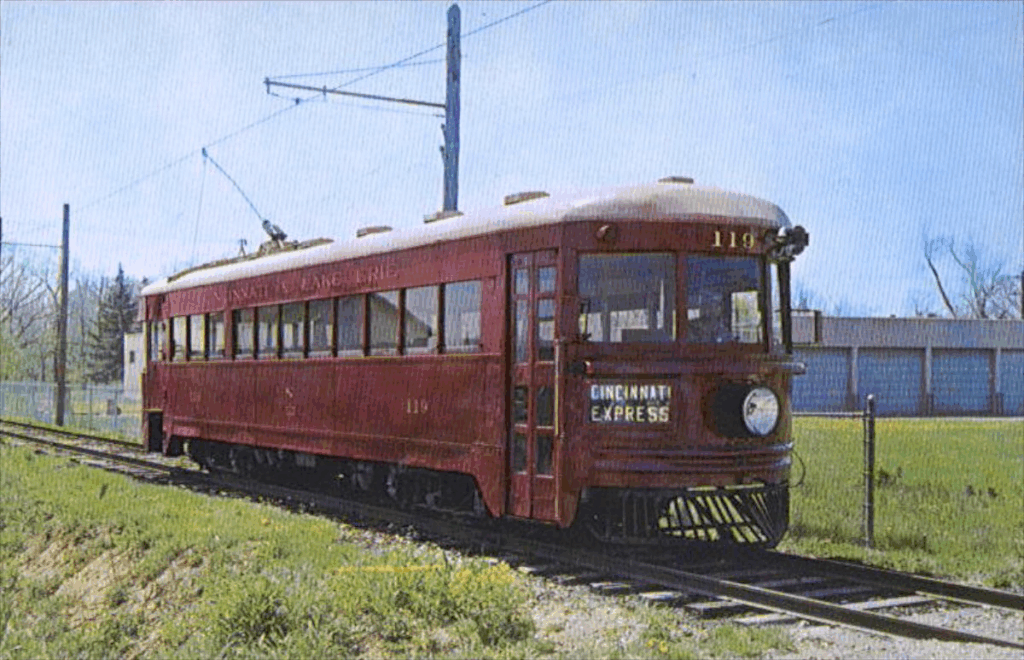
Nicknamed The “Red Devil,” the lightweight aluminum trolley that sped over its track once raced an airplane, clocking in at 97-miles per hour. The Red Devil won the race. Image from www.dailyyonder.com. Story from Ohio Trolley Trails, by Harry Christiansen.
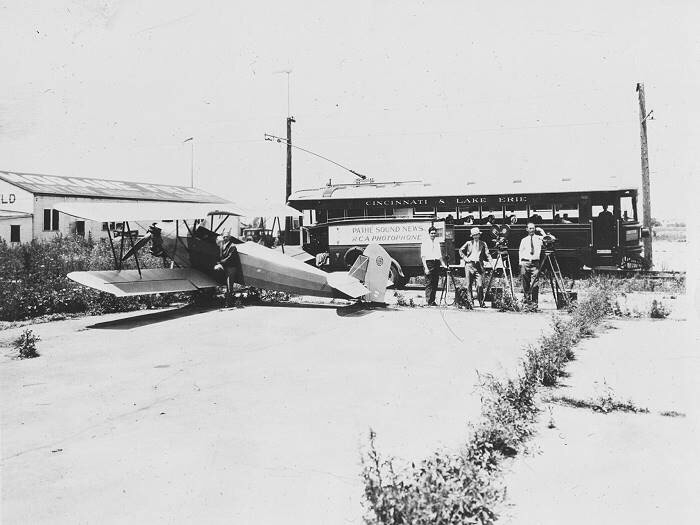
“The Cincinnati & Lake Erie Red Devil, a low-slung, high-speed, fancy passenger car, preceded by the shrill sound of its air horn, pulled out on its last run…to oblivion.”
From Ohio Trolley Trails, by Harry Christiansen.
*****
The CH&D combined with the Indiana, Columbus and Eastern Traction Co. to create the C&LE, Cincinnati & Lake Erie line. The 217-mile Toledo-Cincinnati main line was the longest through trolley run in the US for many years.
The Great Depression and the rise of point-to-point truck transportation as well as development of new highway systems took its toll on the Interurban railway. It ceased operations in 1939, passing into obsolescence in only three decades.
In 1941, the Route #64 wagon bridge at Waterville collapsed. The Interurban Electric Bridge was acquired by the Ohio Highway Department and the old track bed resurfaced to accommodate auto traffic until 1948.

The following is an excerpt from documents at the Wakeman Center, Waterville, by Midge Campbell and from Olde Waterville by June Huffman. Posted by Phyllis Witzler.
Two independent milk haulers, Thomas Riegel and Thomas of Millersville, started across the bridge from the Wood County side with their heavily loaded truck on July 24,1941, and broke through to the bed of the Maumee River. Miraculously, they suffered only minor injuries.
Spectators reported that the river ran white with four tons of spilled and ruptured milk cans. Telephone lines and Waterville Gas and Oil lines had crossed the bridge and were pulled down. Waterville residents were actually glad the bridge collapsed so that their constant demands for a new bridge would now be answered.
During that summer, drivers were able to ford the river at low water areas. Painted steel oil drums were placed as markers for the ford route south of Granger Island. However, as Fate would have it, World War II was declared in December following the attack on Pearl Harbor. All steel went into the war effort. A new bridge would have to wait.
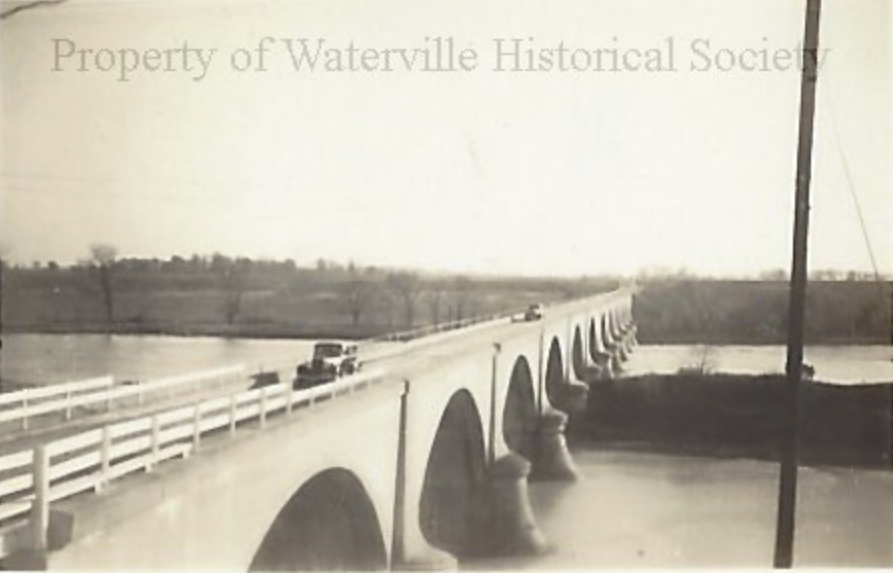
New approaches were installed to the abandoned electric trolley bridge at Roche de Boeuf and for the next seven years it was used as a “temporary” crossing. Waterville merchants were so glad for Wood County customers to again be able to patronize their stores. They planned a week of celebration when it opened. But drivers trying to pass each other on the high narrow bridge would find it a harrowing experience, particularly when the wind was blowing hard.
The old trolley bridge serviced automobile traffic from 1941 to 1948.
In 1972, the abandoned Electric Bridge, called Ohio’s most pictured white elephant, was placed on the National Register of Historic Places by the National Park Service of the US Department the Interior. This designation prevented the Ohio Highway Department, which still owned the structure, from blasting it out of the river.
US Code Title 23/ Chapter 1/ § 144 states that “Any State that intends to demolish a historic bridge for a replacement project with funds made available to carry out this section shall first make the historic bridge available for donation to a State, locality, or responsible private entity if the State, locality, or responsible private entity enters into an agreement (A) to maintain the bridge and the features that give the historic bridge its historic significance; and (B) to assume all future legal and financial responsibility for the historic bridge, which may include an agreement to hold the State transportation department harmless in any liability action.”
Subsequently, the Roche de Boeuf Historical Society was formed in 1973 by Waterville administrator John Hayes in an effort to preserve the bridge. The society, which was a consortium of local garden clubs, included 400 members. It persuaded the Ohio Highway Department to agree to restore the bridge to safe pedestrian and bicycle use. They wanted to transfer the title to the Ohio Historical Society and have the site maintained by the Toledo Metropark District. However, it was not successful in this effort because neither organization could afford the cost of demolition in the event that the bridge, ultimately, needed to be removed. The society disbanded in 1983.
In the same year, the bridge, the rock, and nearby Indian, Butler and Missionary Islands came under the protection of the Ohio Department of Natural Resources, Division of Wildlife. This section of the Maumee River (from the US Route 24 bridge west of Defiance to the US Route 20/State Route 25 bridge at Perrysburg/Maumee), is 53 miles long. Because of its historic and cultural significance, it was designated a State Scenic River.
But the bridge has remained the property of the Ohio Department of Transportation to the present day. In 1983, ODOT declared the bridge unsafe for motorized traffic allowing it to continue to deteriorate by natural forces.
The irony of the storied history of the bridge is that early twentieth century local residents vehemently opposed its construction as a descecration of a cultural heritage site and for ruining the view of the river, while contemporary citizens decry its demolition for the same reasons.
In the 1980s and ’90s, artistic renditions of the site by both amateur and noted professional artists proliferated and a whole school of plein air painters in the Maumee River scenic corridor developed. Prominent among them was the late Jim White of Maumee, Ohio. The beautiful and highly accomplished painting below captures the enduring strength of the bridge in its winter serenity
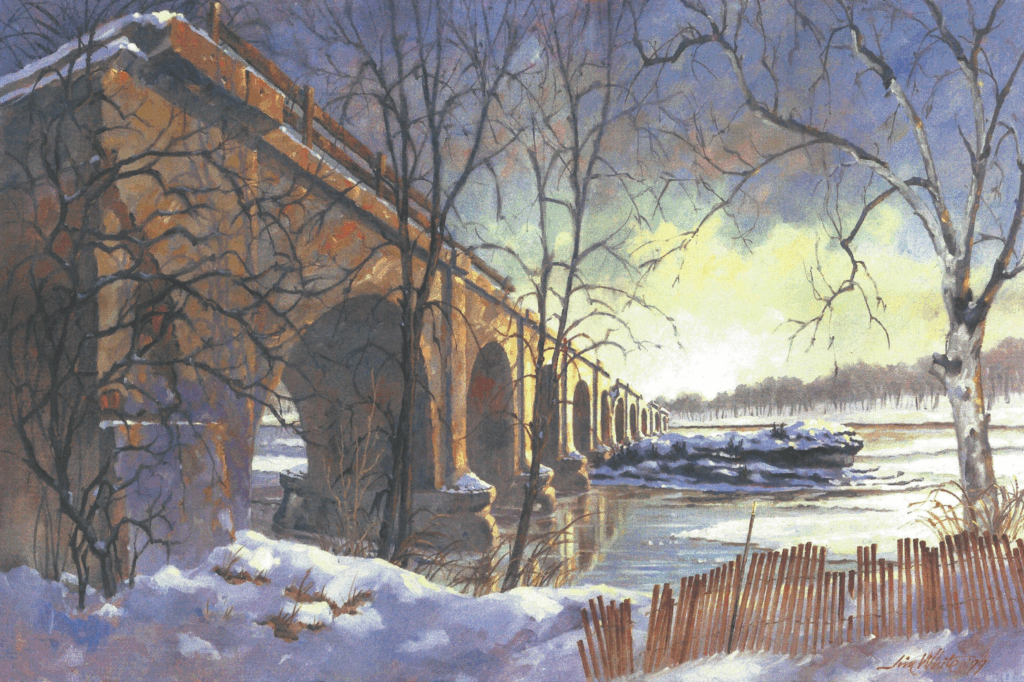
The Anthony Wayne Art & About event for plein air artists has been taking place for twelve years in the Village of Waterville and in 2017 was renamed Art & About: The Jim White Memorial Paint Out. Jim White, a commercial artist by trade, had always participated in this event. Jim enjoyed creating landscapes and portraits in both oil paint and charcoal. During the paint out, he often encouraged on-looking children to take his brush and add some color to his painting.
Commentary by Lisa Exner, Anthony Wayne Area Arts Commission.
*****
The current controversy concerning the fate of the bridge began in 2017 when the Waterville Village administrator, James M. Bagdonas, sent a letter to ODOT passing on a complaint he received that “large pieces of concrete hanging by corroded reinforced steel posed a danger for river users on the water below.”
In 2019, ODOT conducted an exhaustive study on the structural deficiencies of the bridge and published a brochure outlining various alternatives to addressing the concern over public safety from total demolition to various types of rehabilitation. On November 20, 2019, ODOT held a public meeting at the Waterville Elementary School requesting input from local residents.
It is NOT a bridge. It is a kind of historic monument. It should not be any concern of the Department of Transportation. Were it a bridge, it would be unsafe. But as a historic monument, it is a work of art and a part of the artistic landscape of NW Ohio, my home for 70 years. You [ODOT] have no need to take down the old bridge and I don’t think you have the right to do so.”
Anonymous public comment on the proposed demolition of the bridge.
The following stakeholders were also consulted: federally recognized American Tribes, the Ohio Department of Natural Resources, the State Historic Preservation Office, Toledo Metroparks, local governments, local emergency services, local school districts, and adjacent property owners.
A chart of alternative actions considered the following options: 1) no build, 2) by- pass/rerouting, 3) rehabilitation/removal and rebuild at a cost a $14,900,000, 4) mothballing, 5) removal at a cost of $2,200,000, 5) rehabilitate one span/remove remaining spans at a cost of $3,900,000, 6) remove one span/no rehabilitation to remaining spans, and 7) remove all but one span with no rehabilitation.
In June 2019, ODOT recommended the complete removal of the structure because funding the repair, rebuild, and rehabilitation options were much more costly. Then, to avoid legal liability, should anyone be harmed by falling debris, the State tried to sell the structure.
In 2021, “Extensive outreach was made to various historic and tribal groups and to public entities to secure a buyer for the property. As no entity stepped forward, the structure and property were offered at public auction on June 30, 2021. The initial successful bidder failed to follow through with the terms of sale. A second bidder also failed to follow through with the terms of sale. ODOT then made the decision to move forward with demolition of the structure.” (From ODOT projects webpage) It was slated for the fall of 2024.
Unlike ODOT’s technical images, artists and photographers envision something more poetic and visually compelling in the death throes of the iconic bridge.

Chunks of concrete often fall from the bridge, but the river is usually too shallow at this point for paddlers to pass under the spandrels. Concern over their safety is unwarranted. No one has ever been harmed by the bridge’s deteriorating structure. Constructing a portage around the bridge would be considerably less expensive than ODOT’s 2025 estimate of $4,050,000 to demolish it. If left alone, freezing and thawing, floods, and ice jams will inevitably destroy it in some future generation—preserving enjoyment of this singular vista until then.
A feat of engineering in its own time, a local history artifact today, the Interurban bridge is an object of man-made beauty crumbling gracefully into this scenic bend of the Maumee River.
There’s still time to save the bridge. The following is an article by Jan Larson McLaughlin posted in the BG Independent News on April 7, 2025:
“The Ohio Department of Transportation and the City of Waterville have agreed to delay a project that would have removed the Roche de Boeuf Interurban Bridge structure over the Maumee River.
“After receiving requests from local residents to continue to explore alternatives other than removal, the city approached the state to request a delay of the project while the city forms an exploratory committee to determine whether additional options are available, including renewed interest in a public entity assuming ownership of the structure.
“The city appreciates the consideration the state gave toward our request to pause the project while the community develops different potential opportunities for this structure,” said Timothy G. Pedro, mayor of Waterville.
“ODOT recognizes the history of the structure and its significance to the Waterville community,” ODOT District Deputy Director Pat McCalley said. “ODOT will serve on the city’s exploratory committee as a member and a technical advisor while they pursue their effort.”
….ODOT officials say that they remain focused on honoring the structure and preserving the Roche de Boeuf rock and its historical significance which predates the local Battle of Fallen Timbers in 1794.
In conclusion, history, art, and the landscape intersect profoundly at Roche de Boeuf. It is truly an emblematic place with intrinsic meaning that has been memorialized by many artists and photographers. It awakens in the mind’s eye of every viewer a rare harmony of the built and natural environment as well as yearning for what has been cast-off.
“Peace and serenity are what has always drawn me to the bridge. It’s a gem in our own backyard. It’s hard to beat watching an early morning sunrise on the bridge with all the trimmings of nature surrounding you with a breathtaking display. It’s a great reminder of all the many things in life that are free and just exist out there for us to enjoy.”
Jack Schultz