
By JAN McLAUGHLIN
BG Independent News
The “Big Beautiful Bill” is creating some ugly outcomes for Americans who have lost access to SNAP food benefits. Across the nation, more than 3.5 million people no longer receive the food assistance, as states implement new eligibility requirements and stricter application processes.
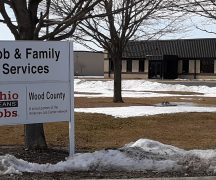
In Wood County, the number of people getting SNAP assistance has dipped from 7,400 at this time last year to 7,033 now, according to Rebeka Shiffert, administrator of income maintenance at the Wood County Department of Job and Family Services.
The cuts are evident not only in the number of people served, but also in the amount they receive.
Last year at this time, the average SNAP allotment in Wood County was $367 a month, compared to $335 a month now, Shiffert said.
Meanwhile, grocery prices continue to climb, eating up those allotments faster.
Wood County’s SNAP program is seeing more employed people applying for the food assistance, and hearing more about the costs of food, Shiffert said.
“There is some concern out there with grocery prices,” she said.
And there are more frequent reporting requirements and documentation for clients and for staff. While some of the requirements may be onerous for recipients, Shiffert said the staff at Wood County Job and Family Services can help.
“This could be difficult for the average individual to navigate,” she said. “We are always willing to help. We don’t want them to hit roadblocks.”
However, much of the documentation is done electronically, and securing an appointment to speak with a human being can be difficult. But Shiffert said that clients can request face-to-face assistance helping to navigate the system.
To meet work requirements, assistance is available for training, resume writing and job searches, she added.
Last year’s Big Beautiful Bill is projected to cut $186 billion in federal spending on SNAP over the next decade. In addition to the funding cuts, the new law changed eligibility criteria, raising the age limit for work requirements from 54 to 64 and increasing the amount of documentation required to enroll.
Since then, every state has seen a decline in people enrolled in SNAP, led by Arizona, where participation has fallen by 51%. Those who are still eligible are receiving lower benefits and often facing longer reauthorization times.
U.S. Agriculture Secretary Brooke Rollins has attributed the lower SNAP caseloads to the better economy, increasing wages and decreasing fraud in the program.
But others blame the drop in SNAP recipients to rule changes, tightening of eligibility, and stricter time limits. Recipients now have to prove they are working 20 hours a week or 80 hours a month to receive benefits – with frequent documentation.
The new rules greatly increase the paperwork burden, since each month individuals have to document their hours, and then the state has to certify it.
At the same time, states now face fiscal penalties if they don’t lower their payment error rates. That means more paperwork at the state level, where many departments are already understaffed.
According to a PBS interview with Harvard professor of public health policy Sara Naomi Bleich, when a person is applying for the first time or recertifying their work to comply with the time limit, there is a 30-day deadline. Even if an eligible person submits all the required information on time, if the state does not process it by the deadline, that person is automatically removed and has to start the process all over again.
“SNAP caseloads are going down, but they’re decreasing for the wrong reasons. They’re not decreasing because all of a sudden we have a much stronger economy,” Bleich said. “They’re decreasing because what we’re seeing is that eligible people are leaving the program because it’s become too difficult to document and to maintain their eligibility. And that is deeply concerning.”
The paperwork can also be a challenge for those processing SNAP requests, making it more difficult to process paperwork on time. And if it’s not processed on time, within that 30-day requirement, people are falling off the program.
“They are doubling our workload,” but providing no additional funding for that, Wood County Job and Family Services Director Dave Wigent said last year when the changes were announced. Instead, penalties will be implemented for agencies getting behind in the workload, he said.
To politicians who say the system is rife with fraud and recipients need to work for their benefits, Wigent said well over 60% of local SNAP recipients are employed, with some having multiple jobs as they try to escape the cycle.
“The lower wage jobs keep them in the program,” Wigent said.
Shiffert stressed that people who think they might qualify for SNAP should seek help at Wood County Job and Family Services.
“If anybody needs help, I would encourage them to come here,” she said.