By JAN McLAUGHLIN
BG Independent News
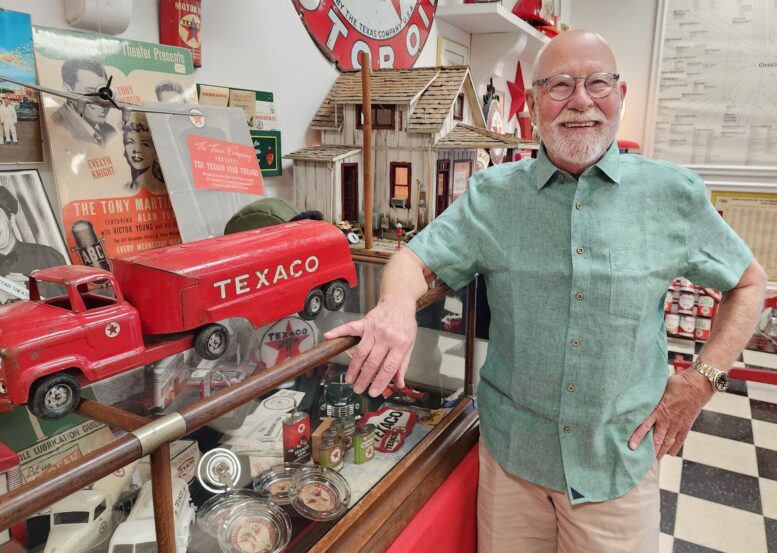
Jeff Snook swears he’s not a flashy guy. He’s just got a soft spot for vintage sports cars with sleek lines and the promise of speed.
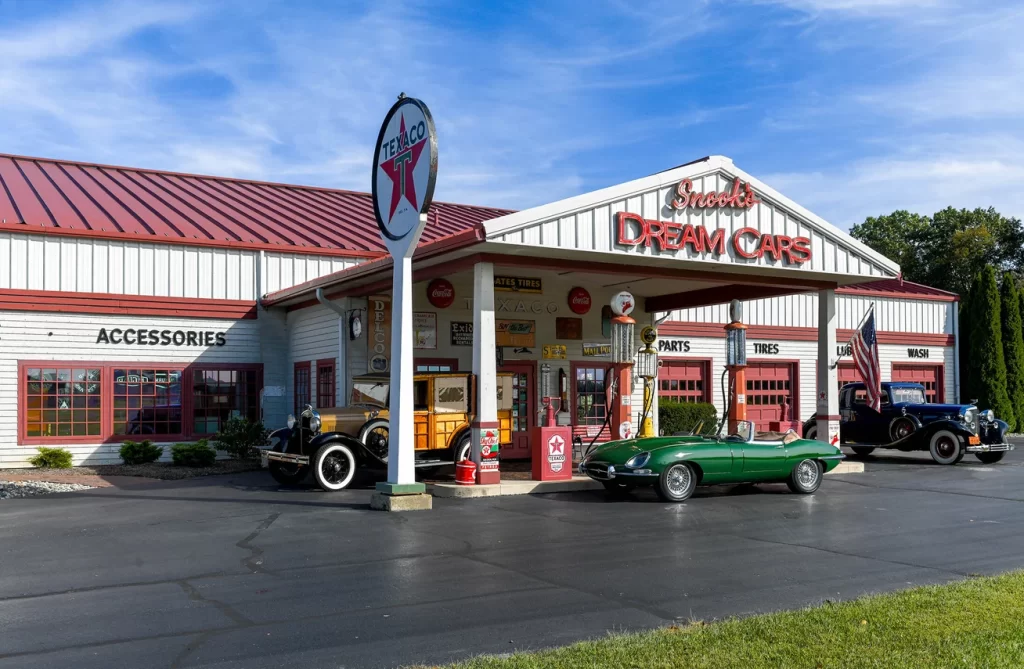
For 25 years, Snook has shared his enthusiasm for historic cars with visitors from every state and several countries spread across the globe. But at the end of this month, the museum he created with his dad – Snook’s Dream Cars – will close up shop in Bowling Green.
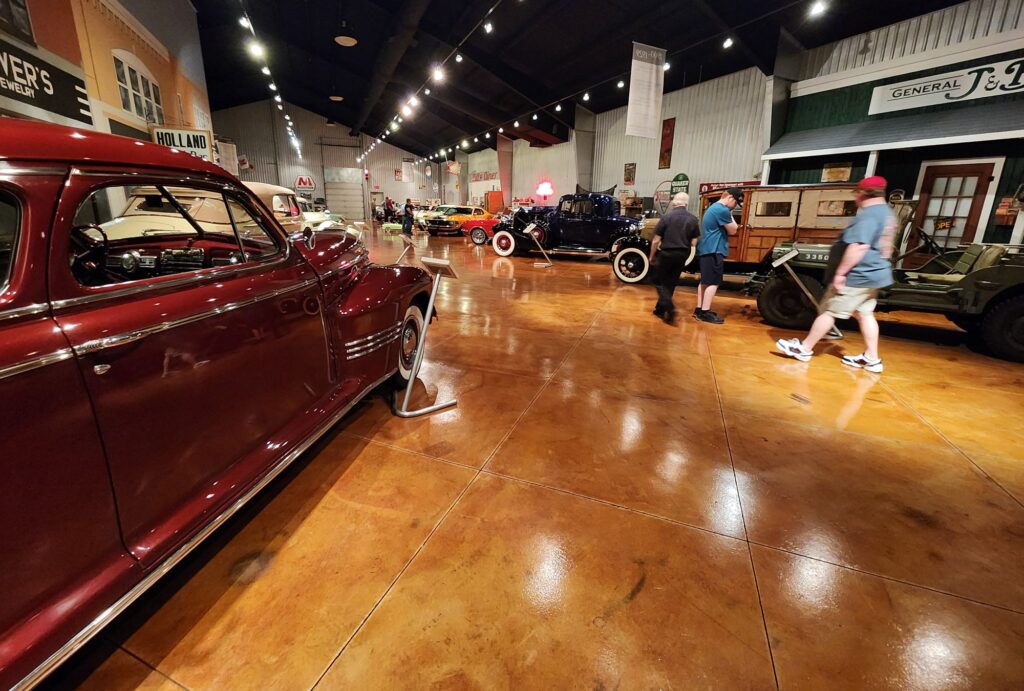
That means he will be parting ways with his car collection stretching from the 1930s to 1970s. Unlike most auto museums, all the 15 cars on display are kept in running condition – with Snook deciding daily which one he wants to take for a spin around town.
His father, Bill Snook, who died in 2013, was the first car enthusiast in the family. As a teenager, he worked at a gas station in the mid-1930s, saving up $50 to buy a Model A Ford.
“It was the first car in the Snook family,” his son said.
His dad later bought a 1936 Auburn that waited at home for him when he enlisted in the military. But the car had to be sold prior to him returning home.
“He lost a poker game and wired his dad to sell the Auburn to pay off his debts,” Jeff Snook said.
After World War II, his dad bought a 1941 Pontiac Streamliner.
“That’s the car I came home from the hospital in,” Snook said, noting that his museum has one on the showroom floor.
Bill passed on his enthusiasm for autos to his son, with Jeff’s first car in 1963 being a 1929 Model A Ford – not a classic, “just an old used car.”
“I was a hit in high school. I enjoyed the notoriety,” Snook said.
Later in college, Snook purchased an MG sports car.
“I courted my wife with that car,” he recalled.
The father-son team moved to Bowling Green in 1969 to manage and ultimately own Green Manufacturing. Meanwhile, Bill began amassing a collection of auto memorabilia. He would travel across the country and return with “a trunk full of junk” – but along the way he would also find the fender he needed to finish a remodel.
When the Snooks sold Green Manufacturing, they refocused their energies on creating a museum, car restoration shop and separate storage facility.
Committed to making it a living museum, the collection includes operational coupes, convertibles, sedans, roadsters and race cars, made by Cadillac, Ford, Chevrolet, Pontiac, Packard, Kaiser, Willys, Jaguar, Triumph, MG, Datsun, and Alfa Romeo.
“I can’t just let a car sit. They go to hell, just like our bodies,” Jeff Snook said.
While Snook loves driving, racing and collecting cars – he quickly discovered he wasn’t crazy about refurbishing them.
The cars are babied by mechanic Terry Stetler, who keeps the museum collection running, and who repairs collector cars dropped off in the maintenance bays.
“Things will break, and they do so at unexpected times,” Snook said. Such was the case with the 1957 Chevy that he drove home for lunch recently. As he backed out of his driveway, the brakes failed and the car rolled out into West Wooster Street.
“It’s back running,” with Stetler fixing the brakes, Snook said.
Stetler has been an “important part of this adventure,” Snook said.
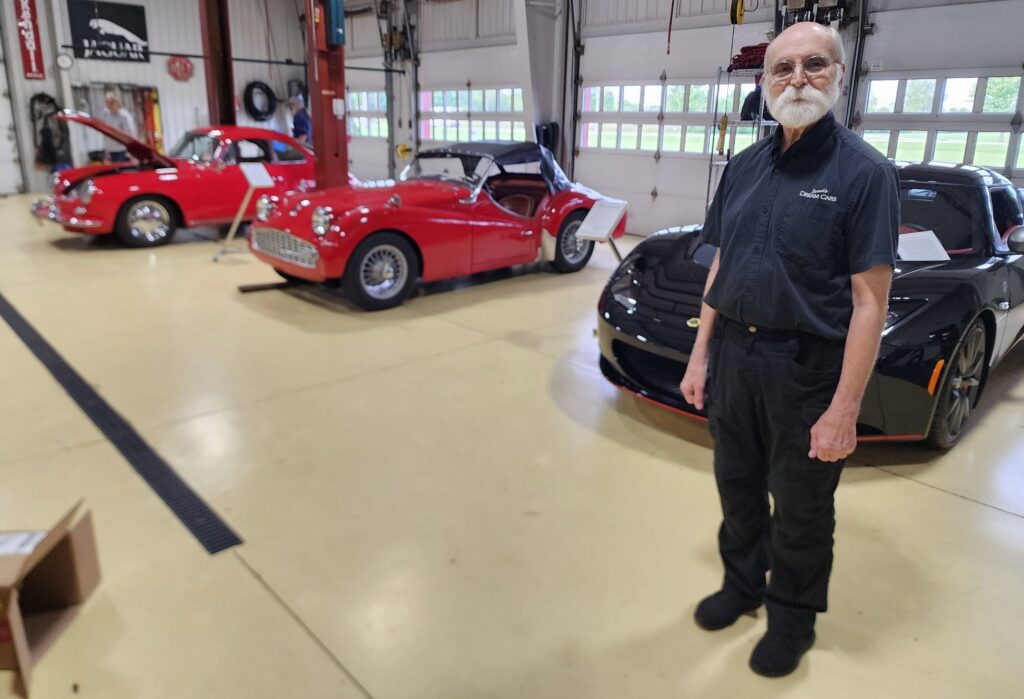
“I was a little kid who took all my toys apart to find out how they worked,” Stetler said. “I made my hobby my job. I love working on everything with wheels on it – that isn’t too new.”
The showroom has historic backdrops of Bowling Green dating back to the 1930s, with tunes like “Boogie Woogie Bugle Boy” serenading visitors. As he walked through the car collection, Stetler rattled off information on each classic, restored to original colors and conditions.
- His favorite – the 1940 Packard. “This car can still go 60 mph on the highway,” he said.
- The 1933 Cadillac with V8 engine and rumble seats – “this thing’s a monster.”
- The Mustang, “the car that saved Ford in the 60s,” he said. It took GM two years to respond to the Mustang with its Camaro. “People still love these cars.”
- The rare 1954 Kaiser Darrin, with only 435 made, featuring a fiberglass body and sliding pocket doors.
- A 1971 Datsun that “put the first nail in the coffin of British sports cars.”
- A 1964 Jaguar, which was the preferred car for criminals in Britain since police vehicles couldn’t catch them.
- A 1952 MG TD, the first sports car that sold well in America. “They’re nice for a country road, but they’re just too slow for me,” Stetler said.
- The 1959 Alfa Romeo Giulietta Spider. “I love the way it drives.”
“I realize I can go pretty full-nerd in here,” Stetler said, apologizing for being long-winded.
As Snook devised his plan for closing the museum and selling his cars, he initially agonized over which cars to keep.
“You lay awake at night,” he said. First he contemplated keeping five, then three, then none, before settling on one – his 1964 Porsche 356.
He considered a Jaguar, but said his Jags have the “thickest maintenance folders.”
His “everyday” car is a 2014 Porsche with 71,000 miles on it.
The one car that Snook never got his hands on was a Ferrari Dino from the early 1970s. He and Stetler checked out a couple of them, but they were pretty pricey.
“Now these cars are worth four times what they were selling for,” he said.
The one sports car Snook was never interested in was a Corvette.
“They are too flashy. I don’t think of myself as a flashy guy,” he said. “Plus, they are getting harder and harder to get out of.”
Snook’s 30 years of racing are also over, but they were a blast while they lasted, he said.
“It’s the most fun a guy can have with his clothes on,” he said. On the wall of the museum are aerial photos of the road courses he raced on in Georgia, Florida, New York, California, Wisconsin and Virginia.
“The speedometer basically stopped working,” he said, on the brief stretches of straight roadway followed by sharp curves. He recalled one race in Florida, where his wife, Lee Anne, pointed out a car flipping in the distance.
Snook’s dad broke it to Lee Anne – “That’s your husband.”
He has photos of his smashed vehicles, followed by photos of the cars resurrected by Stetler.
Lee Anne, a writer, had a story published about her husband’s devotion to vintage cars. The story concluded that his love for her and his cars was evenly split 50-50, her husband said with a smile.
“The cars are part of my life, and so is she,” Snook said.
Lee Anne, however, will remain while the cars are being sold in an online auction on Hagerty Marketplace, link below:
Snook said selling the cars on a no reserve auction means he won’t know till the very end what the cars will go for. “That was a little gutsy,” he said.
Next spring, he plans to sell the memorabilia at the museum through Whalen Auctions, and later, he will sell the museum and warehouse behind it.
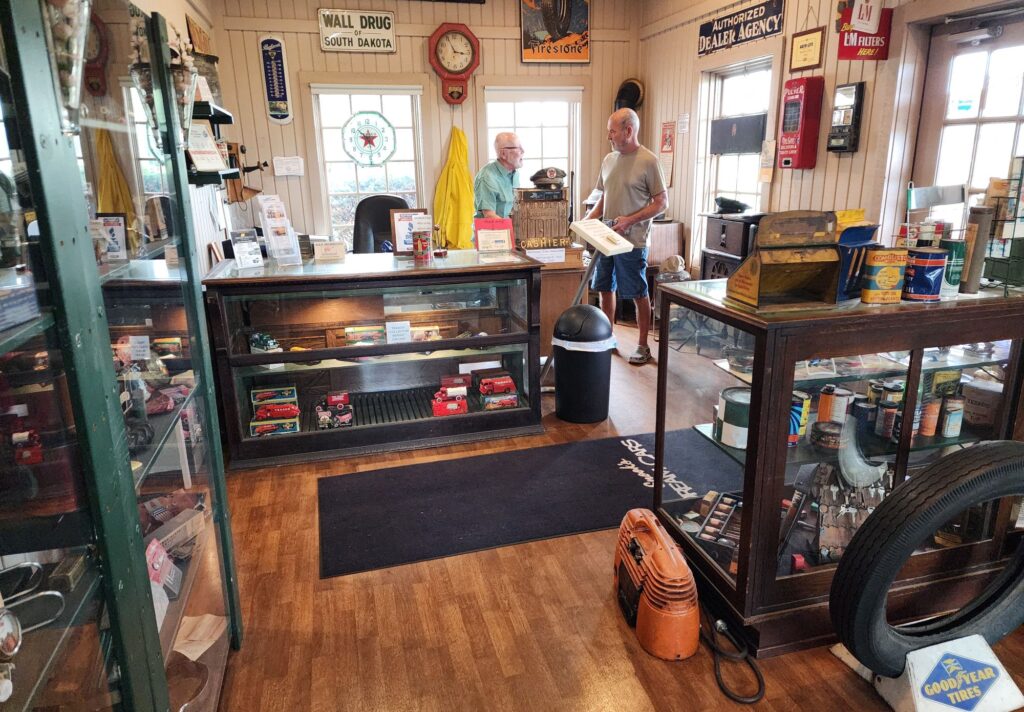
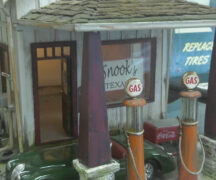
His dad’s memorabilia collection includes a treasure trove of vintage items from Texaco gas stations, a 1920 cash register, pinball machines, a jukebox, model cars, toy cars, die-cast banks, signs, advertising items, oil cans, period auto accessories, coin-operated machines and pedal cars.
A few times since deciding to close the museum, Snook has been hit by the realization that new owners will be driving his dream cars.
“But I’m focused on the plan. I’m not looking back,” he said.
And for the next week, he will be appreciating the present, as the announcement of the museum closing has brought a resurgence of visitors to Snook’s Dream Cars. On Friday, old history buffs, car enthusiasts and entire families stopped by to tour the museum.
“I love it when I see younger people here,” Snook said. “It’s a good way to go out.”