By JAN McLAUGHLIN
BG Independent News
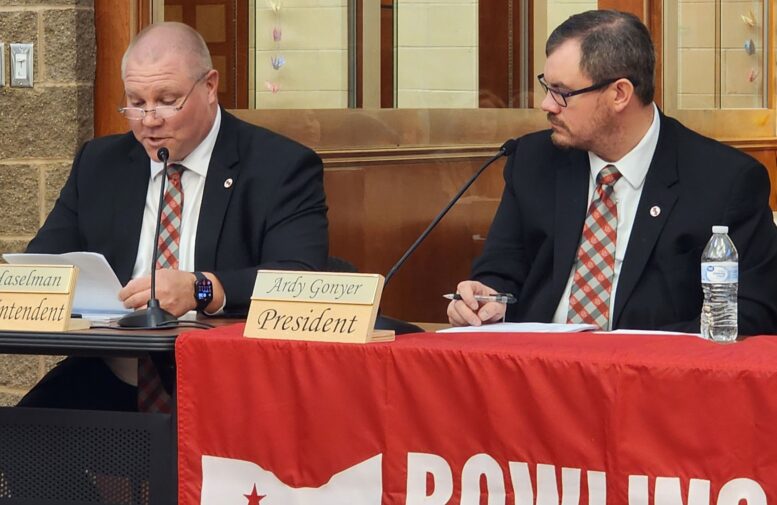
As the new high school takes shape next door, Bowling Green Superintendent Ted Haselman reported Tuesday evening that information gathered about the future of the district’s elementary schools will be discussed next month.
“Nothing has been decided,” Haselman said after the board meeting Tuesday. “But we want to be as transparent and open as we can be.”
The board decided earlier this year to hire a design firm to gather input and study options for the district’s elementary buildings.
DLR Group – the same firm that designed the new high school currently under construction – was selected as the top firm to handle the elementary master planning services. The study will likely last 15 to 16 months, and require many meetings with the community, school staff and district administration team.
Next month’s presentation, at the Nov. 10 school board meeting, will be conducted by DLR to show the information gathered thus far from focus groups, staff and community.
“This is a step in the process,” Haselman said. “So we find the best path forward into the future.”
District leaders have talked with city officials about possible future uses for the sites that currently house Conneaut and Kenwood elementaries – in case those properties will no longer be used by the district. In the past, when those properties were discussed, citizens wanted to know how they would be used in the future.
“We’re just trying to be proactive,” Haselman said.
School leaders have also been in conversation with the BG Economic Development Office about available locations for one or more new elementary buildings, the superintendent said. There is some space left at the high school – middle school complex, but it is not yet known if it’s enough for one or two elementary buildings.
In preparation for meeting elementary needs, the board voted this past summer in favor of a resolution to participate in the Ohio Facilities Construction Commission Expedited Local Partnership Program (ELPP.)
Haselman said this action now will help guarantee a state’s share of the building projects for whenever the elementary plans are finalized. He and Treasurer Matt Feasel predicted a similar share of the project as the state funding for the new high school – at 17%.
The discussion of Bowling Green’s aging elementary schools is not new. After initial assessments of the district’s aging elementary schools, the state determined that two of the three buildings are not worth renovations.
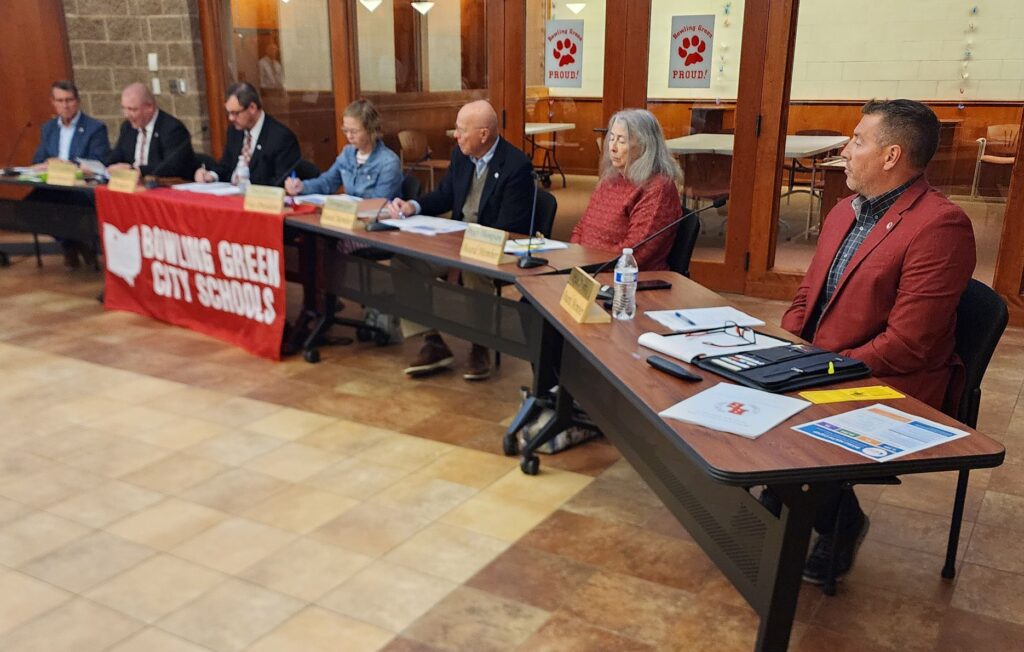
While board members have stressed they don’t want to rush the process, they also don’t want to stall studying the options.
The architectural firm has been hired to:
- Assess existing facilities.
- Assist the board in determining the scope of any potential projects.
- Prepare estimates of costs for all the options.
- Provide feasibility studies of potential sites for new buildings.
- Provide necessary graphics to serve as informational tools for a potential bond issue.
- Attend community meetings to present information and provide technical assistance.
Gonyer said earlier this year that the district has much to do before picking the best plan and asking the voters to support it. As was done for the high school project, planning for the elementaries will involve input from community members, teachers and support staff.
The district has struggled to find a solution to its aging elementaries that voters will support.
A study of the three elementaries – Conneaut, Crim and Kenwood – done years ago by the Ohio Facilities Construction Commission, came to the conclusion that the Conneaut and Kenwood buildings were not worth the district sinking any more money into. The Crim building, which has gone through extensive renovations, was determined to be salvageable.
Unlike the architectural study for the new high school, this examination of the elementaries has far more moving pieces. The options could include one new unified elementary, building two new K-5 elementaries, or building two new elementaries – one for K-2 students and another for grades 3-5.
With each of these options, the study will look at construction costs, operations considerations, and the educational advantages of each.
Recognizing that these are tough times for tax levies in Ohio, Gonyer said earlier this year that delaying dealing with the elementaries will only add to the costs. Nine years ago, when the district proposed a plan for a new high school and a consolidated elementary, voters rejected the dual project that came with a $70 million price tag.
That delay ultimately led to the district passing a bond issue for $72 million just for the high school.
“The longer we wait, the more expensive it will be,” Gonyer said.
The 2023 facility master plan for the entire district made some recommendations for the elementary schools.
Conneaut, Crim and Kenwood elementaries were built in the 1950s and 1960s – and 75 years later, they are not able to accommodate the district’s vision for future-ready learning due to space limitations, according to the report.
The teachers and staff in the buildings work diligently to retrofit existing infrastructure, making space for teachers and staff and creatively repurposing existing spaces to better support students. The presence of portable classrooms on the Conneaut campus has posed additional challenges to program accessibility and teacher collaboration.
Beyond the outdated infrastructure, technology and systems, the physical layouts of the buildings do not accommodate desired teaching and learning, according to the report.
The report suggested that more comprehensive efforts – such as the planning for the new high school – should be extended to the elementary schools.
The master plan considered different scenarios for the elementaries that provide opportunities for expanded district resources, equality of resources to all students, and support of the families the district serves. The three options noted were:
- To foster equitable experiences and ensure no student or educator is limited by outdated facilities, consider the replacement of all three school buildings at their current sites to keep neighborhood schools.
- With a new recent addition, Crim Elementary could potentially accommodate district offices, pre-kindergarten students, and serve as an autism center. This transition could yield cost savings by relocating district offices to a district-owned facility, while expanding resources for district families. The replacement of Kenwood and Conneaut, along with the inclusion of students from Crim, would be under consideration.
- Build a single unifying elementary. Although this deviates from the idea of individual neighborhood schools, it ensures equal access to resources. This approach would potentially reduce maintenance costs, but it raises concerns about managing a single elementary with more than 1,000 students. Strategies creating smaller cohorts within a unified school could emulate the neighborhood concept while maintaining efficiency.
Haselman at Tuesday’s meeting also reported on the construction progress for the new high school, which was recently toured by high school staff.
“It’s rewarding to see the progress take shape,” he said, adding later that the project continues to be “on budget and on time.”
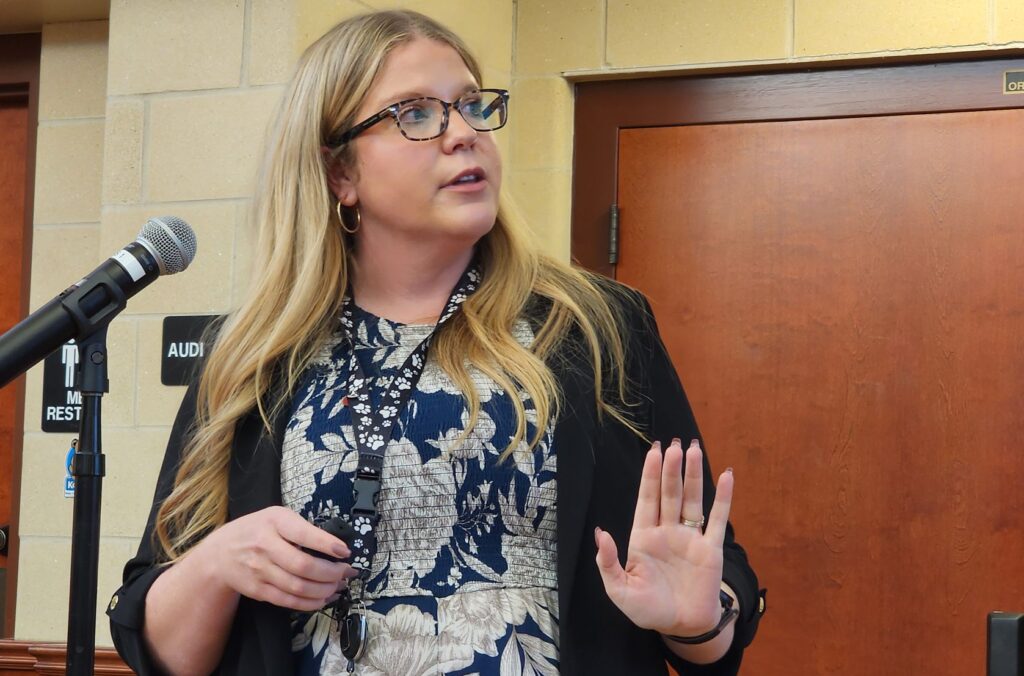
In other business at Tuesday’s meeting, the board heard from Rachel Newell, the district’s executive director of teaching and learning, who presented a more in depth look at the district’s most recent state report card, which ranked BG City Schools at 4.5 out of 5 stars.
Newell went into detail about the categories students were rated on, comparisons to previous years, and ideas to do better in the future.
Haselman praised the most recent ranking and noted the efforts to improve.
“I look forward to seeing the strategies take shape,” he said.
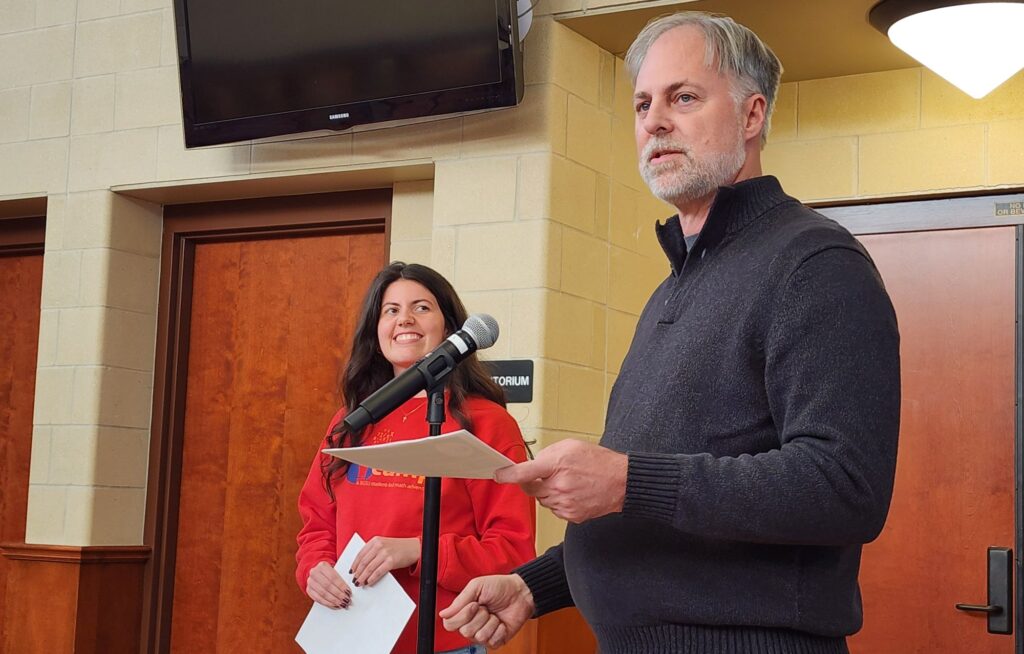
Also at the meeting, Dr. Gabriel Matney and BGSU math student Hannah Wheeler gave a presentation to the board about BGSU Math Enrichment Camps. The camps have been offered in 36 districts, including Bowling Green, in pre-kindergarten through grade 12.
The program engages students in problem solving mathematics – often different from traditional math classrooms. And it gives BGSU students experience managing PK-12 students, who end up enjoying math more after the camps, Matney said.
“I feel like we’re doing something right,” he said.
In other business:
- Treasurer Matt Feasel reported the district received its property tax revenue two months late, and it was a “little less” than expected. Investment income is also a little lower than predicted, and income tax revenue should be allocated at the end of the month.
- The board agreed to purchase one new school bus, costing $144,840.
- The board accepted donations from community members totaling $14,395. The gifts were earmarked for the district’s band program, high school cross country, high school STEAM Club, gifted students program, school lunches, 5th grade camp, Bobcat Basics, school supplies, plus prom and homecoming dresses.