
By TOM GERROW
BG Independent News
Real-world forensic evidence rarely looks like what you might see on TV. The expert on Law & Order who testifies and points to the suspect with near-certain confidence? Doesn’t happen.
“If anybody watches the crime shows, you’ll see a database and it’s like a 99.5% match,” said Dr. Jamie Spaulding, an assistant professor in the newly formed Department of Forensic Science at BGSU. “We don’t have those. That’d be cool, but we don’t have those at all.”
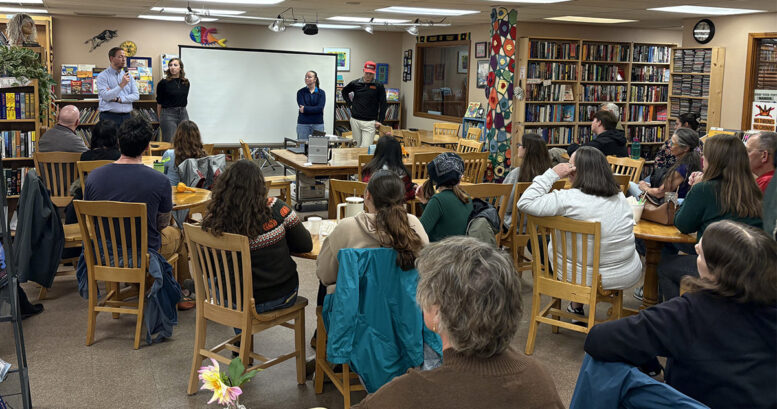
The topic was “Novel Items, Novel Evidence, and Comprehensive Outcomes in Forensic Science” at the most recent Science Café at BG’s Grounds for Thought. The session was presented by Spaulding, and he was accompanied by a panel of BGSU forensic students.
“We tend to do things across different disciplines of forensic science, looking at the different synergies,” Spaulding said. “A lot of what we’ve done historically has been subjective, relying on an examiner.”
Some of Spaulding’s research focuses on trying to improve the accuracy of objective forensic methods.
“That is one of the things that we have to speak to when our evidence comes into the court,” Spaulding said.
“So how we do this every day is an examiner is going to take these samples, put them under a microscope, line up these features, and then really make a one-to-one comparison,” he said. “Did this recovered sample from my crime scene originate from my gun? And that’s all based on their experience, examinations, and observations. So, I didn’t say any numbers. That’s a really big subjective interpretation.”
Courts can be skeptical of these judgements. Backing them up with numbers, by applying algorithms to better understand the various probabilities involved, can help reduce the uncertainty.
“Algorithms are good because they can give us numbers,” Spaulding said. “Algorithms are bad because they’re only as good as the people that design them, myself included.”
When trying to distinguish between matching and non-matching samples, for example, some models will work better than others. But determining which model and which result to trust is the tricky part.
“What if we could combine them?” Spaulding asked, referring to the algorithms. “That was the big question here.”
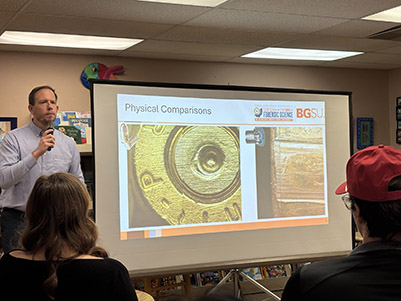
“So I have an example case where we ran it on all the different algorithms,” Spaulding said. “And the question is, are these from the same gun or not. So let’s say an examiner reaches a conclusion, says it’s an identification. We run it through four computer models, and it gives us these scores. So we’ve got two scores which favor an exclusion and two scores which favor an identification.”
“So who do you trust – the computer or the examiner?” Spaulding asked.
Spaulding’s goal was to see if the algorithms could be combined in a meaningful way to improve the results. And as it turned out, they could. Combining the algorithm’s performance distributions indicated that there was a 95% probability that it was the same gun.
“So that examiner giving that identification, saying they are associated to that same firearm, is now backed up, not with ambiguous or uninformative information, but quite strong information,” Spaulding said.
“So can we help provide some support, look at this so it’s more reliable for the court?” Spaulding said. “That’s one of the efforts that we have ongoing.”
Much of this forensic work takes place under the auspices of the Ohio Attorney General’s Center for the Future of Forensic Science at BGSU. The Center’s goal is to support research that advances forensic science and to educate the next generation of forensic scientists.
“Looking at innovative recovery efforts, we’ve got several students looking at how we can get better and more types of evidence from our crime scenes,” Spaulding said.
3D-printed Firearms
Bailey Barret, a senior in the forensic drug analysis program who plans to join the center’s master’s program, discussed some of the issues 3D printing poses for forensic examiners.
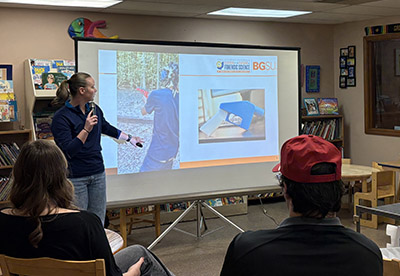
“3D printing of firearms has become more and more of a problematic realm for forensic scientists as folks can create what we’ve coined ghost guns,” Barret said. “So they do not have a serial number. There is no license to essentially trace it back.”
Barret pointed out that most 3D printed firearms tend to disintegrate when they eject a standard round of ammunition and thus don’t leave behind the characteristic traces associated with standard firearm analysis.
“Traditional methods don’t work,” Barret said. “Now, we need to evolve.”
Since these plastic firearms fracture into pieces when used, Barret decided to focus on analyzing the polymer fragments that might be left behind at a crime scene.
“Each one of those polymers will have characteristic markers,” she said.
Preliminary data using gas chromatography, a lab technique to separate and identify chemical components, has shown that there are distinctive patterns, both similarities and differences, in the polymer samples.
“So we want to take those differences and really capitalize on that and determine whether or not we can distinguish one polymer from another,” Barret said.
The ultimate goal is to be able to link a polymer fragment found at a crime scene to a specific printer, and then to a firearm, and create a complete and comprehensive story about the crime that occurred.
Spaulding noted that there are no current methods to do this, so Barret is working at the leading edge of scientific work on the subject.
Restoring Fingerprints
Fingerprints age relatively quickly. Made primarily of water, they evaporate over time and after about 30 days have deteriorated substantially. This is an issue for examiners, where lab turnaround times are frequently longer than 30 days and a print from a cold case could be far older.
Spaulding has been working on a rehydration method to restore older fingerprints. Rehydration can be effective in restoring old prints, but Spaulding wondered if amino acids and lipids present in fingerprints might also help restore and improve print quality. These amino acids and lipids are non-hygroscopic, meaning they don’t readily absorb water from their environment.
Ren Matheny, a forensics student assisting Spaulding in this work, discussed mapping the salts – potassium, calcium chloride, magnesium, and sodium – present in fingerprints from sweat and sebaceous secretions.
These salts have a property called deliquescence, which allows them to absorb water from the surrounding air and turn into a liquid solution.
“So this property allows them to not only rehydrate and put themselves into solution, but also those amino acids and lipids,” Matheny said. “And when we are able to introduce a lot of moisture, these salts absorb it, and then rehydrate everything around them, reforming those [fingerprint] ridges.”
To optimize the rehydration process, the salts need to be mapped and quantified.
“The hypothesis I have that I’m hoping Ren can prove is that these [salts] absorb that moisture from the air and they deliquesce, or absorb that water, and then use the other elements, those lipids and those amino acids, as a skeleton to rehydrate those ridges,” Spaulding said.
“And that would be really, really nice because then we can recover high-quality prints,” he said.
Automotive Vinyl Wraps
Caleb Edwards-Dugan’s is in the forensic master’s program, and has been researching automotive vinyl wrap, specifically polyvinyl chloride. “That’s one of the most common and cheapest polymers that you can get,” he said, adding that the automotive vinyl wrap market has grown significantly.
What happens if a wrapped car leaves evidence at a crime scene?
“This is currently a critical research need under OSAC, which is the Organization of Scientific Area Committees for Forensic Science,” Edwards-Dugan said. “It is classified as level one, so little to no relevant research has been done and there are no standard methods of analysis or comparison.”
That is a problem, and Edwards-Dugan and Spaulding are working on a foundational level to examine and classify vinyl wraps from various manufacturers with different colors and surface finishes. They used two forms of vibrational spectroscopy – FTIR and Raman – to analyze the molecular composition of the samples and then applied statistical models to further refine and classify their results.
This work was published in Forensic Chemistry in July 2026.
“We’re seeing a theme in our goal,” Spaulding said. “We want to take evidence recovered from that crime scene and make associations that are scientifically backed and justified using instruments common to a forensic lab. So in this paper, that’s what we did.”
They had 293 different samples from different rolls of vinyl wrap from different manufacturers.
“With these techniques, we only have one undifferentiated sample, which means with these three techniques, we can tell 292 of those apart,” Spaulding said.
Even more impressive, Spaulding added, is that many of these rolls are from the same manufacturer with the same color and finish.
Not that it’s necessarily easy to differentiate these similar samples: “In terms of the math, yeah, we’re going to do a lot of math to kind of prove that and back it up,” Spaulding said.
Spaulding discussed other projects at the Center for the Future of Forensic Science. These included physical fits (torn edges of material, for example), lighting dynamics in firearm comparisons, and trace DNA recovery and significance on firearms.
Spaulding noted that in forensics, no finding is 99.9% certain – that only happens on TV.
“So we’re dealing in uncertainty all the time,” Spaulding said. “And it’s a challenge, right? Because we’re never certain.”
