
By JAN McLAUGHLIN
BG Independent News
While literal sunshine seems rather short lately, figuratively, the sun is shining on Bowling Green. In the past four days, the city and the university leadership approved a joint solar project to be located on acreage at the Wood County Regional Airport.
On Friday, the Bowling Green State University Board of Trustees voted to enter an agreement with the City of Bowling Green to lease undeveloped land for a solar field. And on Monday evening, City Council voted to authorize development of a solar generation project and gave the utility director the go-ahead to negotiate an agreement for the project.
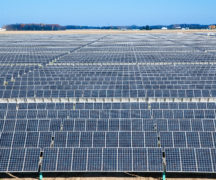
The BGSU Trustees said the partnership advances the university’s commitment to supporting sustainable practices. The board authorized a strategic partnership between BGSU and the city of Bowling Green to lease roughly 82 acres of vacant campus land for the development of a large-scale, 10-megawatt solar array project to enhance the city’s energy grid.
The acreage is located west of Interstate 75, north of land used for the airport off East Poe Road, and south of Newton Road. The solar panels will be 10 feet tall, and made of anti-glare panels that rotate with the sun – making them compatible with the airport, according to university officials.
Under the agreement, the lease will run for an initial period of 25 years at $800 per acre, with rent increases every five years. The city will then have the option for two additional five-year renewals after the initial lease period.
The targeted completion date for the ground-based solar array project is slated for June 2027.
Over the past two years, the city has been evaluating the feasibility of developing a locally sited solar photovoltaic generation project. The project is anticipated to be approximately 10-12 megawatts in size and operate as part of the city’s overall energy portfolio.
The solar generation is expected to complement existing energy supply resources and provide strategic benefits, particularly in managing system peak demand and reducing transmission and capacity costs.
The project also provides an opportunity to replace energy previously supplied by the JV6 wind turbine project, which accounted for approximately 4.0 MW of wind capacity prior to its retirement last year.
Last month, the BG Board of Public Utilities voted to authorize Utilities Director Brian O’Connell to lease approximately 80 acres and select a solar development partner for the project which will operate behind the meter for the city. That means all the 10 to 12 MW of electricity generated on the acreage will go to Bowling Green – powering an estimated 2,000 households in the city.
The utilities board voted more than two years ago to authorize the city to pursue another solar field site, in addition to the 165-acre solar field on Carter Road that generates 20 MW, which the city shares with other communities.
Initially, city officials planned a possible solar field on acreage the city already owned near the county landfill. However, that plan fell apart when Plain Township officials passed an ordinance banning solar fields, explained Jim Odneal, the city’s assistant utilities director.
So the search began again, and this time some local partners voiced interest in leasing farmland to the city for the project.
Those partners are BGSU and an affiliate of Principle Business Enterprises, which plans to lease 20 acres at the southeast corner of Devil’s Hole Road and I-75.
These properties are strategically located adjacent to the city’s electric distribution system, which helps minimize interconnection complexity and associated costs.
BGSU and Principle Business Enterprises will continue to own the land. The developer will own and operate the solar arrays, which will be purchased locally from First Solar. And the City of Bowling Green will buy all the power generated at the two fields. The cost is expected to range between 5 cents and 7 cents per kilowatt hour, Odneal said.
The new solar project is expected to help in managing system peak demand and reducing transmission and capacity costs, Odneal explained.