By JAN McLAUGHLIN
BG Independent News
Across the nation, voters have watched powerlessly as politicians have drawn new gerrymandered district maps.
Bowling Green is trying a new approach. Faced with the need to create new City Council ward maps, city officials are asking citizens to help draw the lines.
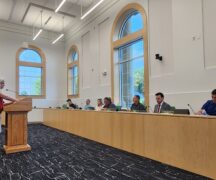
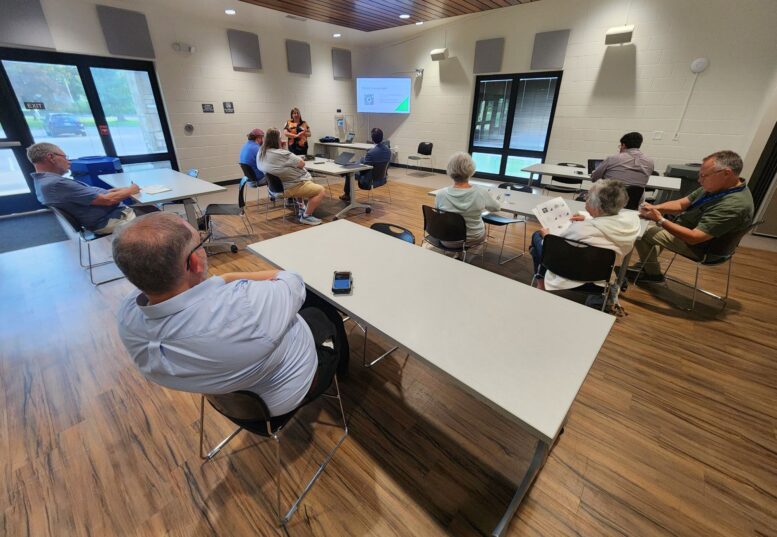
“That’s a refreshing change,” Third Ward resident Michael Richter said Monday as he sat in on the first of two public meetings on the redistricting. “Sometimes we hear about government pushing maps on people.”
That’s why Bowling Green is trying a different tack.
“We don’t want anyone picking their own voters,” said At-Large BG City Council member Katelyn Elliott.
While there is no requirement for public meetings to be held on the redistricting, BG City Council is requesting public input in this process.
The last time Bowling Green City Council drew new lines for its four wards was in 2002, following a long drawn out battle from BGSU students seeking fair representation.
Twenty-four years later, the ward maps have remained the same while the populations have shifted. The ward representation on City Council is now lopsided, with the most populous ward having 2,235 more residents than the least populous with 6,790 residents.
The task of finding a more even distribution of the population now rests with BG City Council – which is asking for public input.
The U.S. Supreme Court has ruled that state and local districts must be “substantially equal” with the population difference between the largest and smallest districts being no more than 10% of the average district population. The total deviation in Bowling Green is hovering near 29%.
Bowling Green isn’t alone in its delayed redistricting efforts. Wards often naturally fall out of compliance because of local population shifts.
The League of Women Voters in Ohio recently reached out to council members in Bowling Green about the disproportionate representation.
Now council members are in a time crunch to draw new wards so they are in effect by next year’s elections. City Council must pass an ordinance that is effective 150 days before the next municipal primary election. The new ward map must be forwarded to the Wood County Board of Elections by early December.
Community members have been encouraged to attend one of two public forums to learn more about the purpose of redistricting, discuss communities of interest, and receive assistance with creating maps. The next forum is set for Saturday, Sept. 19, from 9 to 10:30 a.m. at the Simpson Garden Park Building Meeting Room, 1291 Conneaut Ave., Bowling Green.
Community members may also suggest their own ward maps for consideration – but they must be submitted by 11:59 p.m. on Saturday.
Ward maps can be created using the Dave’s Redistricting website, allowing users to suggest boundaries and provide input on what communities of interest should be kept together. A community of interest is an area whose residents share common neighborhood, economic, educational, transportation, cultural or other community interests. Information on map creation and submission can be found here https://www.bgohio.gov/721/City-Ward-Redistricting.
The new wards must have nearly equal population totals to each other, must not discriminate or otherwise violate the Voting Rights Act of 1965, and must be composed of adjacent and compact territory.
City Council will then hold another public meeting on Sept. 21, at 6 p.m., in council chambers to consider all the submitted maps and narrow the field to three finalists. The public will have an additional opportunity to provide feedback on those maps before council selects a map on Oct. 5. The public will be invited to provide feedback for the finalist maps by emailing their City Council representatives, whose contact information can be found here: https://www.bgohio.gov/460/City-Council.
The final map will be introduced and given its first reading on Oct. 5, at the regular meeting of City Council. The second and third readings will be on Oct. 21 and Nov. 2, with a vote to be taken on Nov. 2.
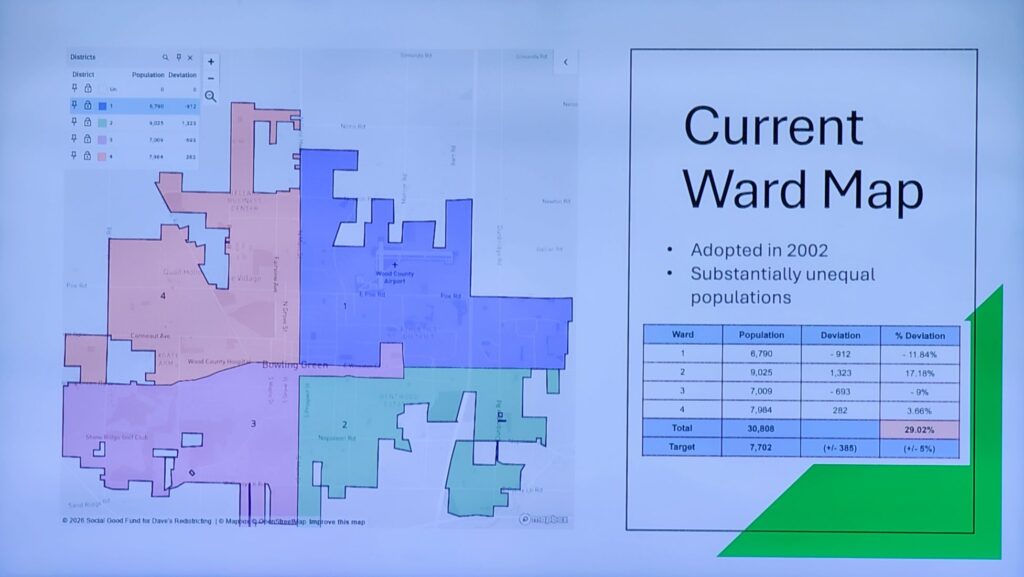
Bowling Green City Council is currently made up of three at-large members – Mark Hollenbaugh, Jeff Dennis and Katelyn Elliott – who represent the entire city, and four ward members who represent their wards. The ward lines basically run along the community’s main thoroughfares – Main Street and Wooster Street – except for a conspicuous swath the shape of a hockey stick along East Wooster Street that shifted over to the Third Ward in the last redistricting.
The first ward, represented by council member Jordan Musgrave, sits northeast of the intersection of North Main and East Wooster. The second ward, represented by Joel O’Dorisio, is located southeast of South Main and East Wooster. These two wards include the bulk of BGSU students in the community.
While there were some concerns that the student population count was shorted in the 2020 census because BGSU students went home during the Covid pandemic, Elliott pointed out that the census asked students to identify where they would be living if not for the pandemic.
On the west side of the city, the third ward, represented by Kathleen Dennis, sits primarily southwest of South Main and West Wooster. And the fourth ward, represented by Bill Herald, is northwest of North Main and West Wooster.
According to the numbers from the 2020 census, the city’s second and fourth wards have too many residents compared to the first and third wards. The city’s total population of 30,808 should be divided into roughly 7,702 per ward. That would put the city in compliance with a target deviation of approximately 5%.
But the current lines divide the population as follows:
- First Ward: 6,790 residents, which is an 11.8% deviation.
- Second Ward: 9,025 residents, which is a 17% deviation.
- Third Ward: 7,009 residents, which is a 9% deviation.
- Fourth Ward: 7,984 residents, which is a 3.6% deviation.
The only elections that will be impacted by the new lines are the four ward council member races.
In the 1990s, a lawsuit was filed against the city by a Bowling Green State University student challenging the constitutionality of the city’s ward system. The lawsuit was filed through Student Legal Services.
When the student who filed the lawsuit graduated, the city tried to end the case because the plaintiff no longer lived in Bowling Green. But another student picked up the fight, and the District Court allowed the case to continue.
The fact that much of the BGSU student population is not year-round is irrelevant. As is the fact that the number of students who vote locally is much lower than the other wards in the city. All that counts is the number of residents present when the census was conducted.
In 2002, the U.S. Court of Appeals for the Sixth District ruled in favor of the students that the wards needed to be redistricted.
But as with elected governmental bodies that change often, the need for cities to redistrict every decade based on the latest U.S. Census often gets forgotten as newly elected members take over for previous council members.
When the city charter was updated in 2018, Hollenbaugh proposed a method to address the redistricting issue. However, the proposal didn’t get enough support from the charter review committee to proceed.
This time around, council will work to create a mechanism to make sure ward lines are redrawn when necessary after census updates, Dennis said.
In Ohio, municipalities typically must redistrict either following the decennial census, or when the number of voting wards or total seats on council changes. Municipalities can also redistrict at any time if the city wards do not have substantially equal populations.
Some of the redistricting considerations discussed at Monday’s public meeting included acknowledgement that the third and fourth wards are growing with the addition of new housing developments and apartment complexes, and recognition that the numbers may change greatly by time the 2030 census is completed.
For questions or comments, contact Katelyn Elliott, Council Member At-Large, at kelliott@bgohio.gov; Jeff Dennis, Council President Pro Tem, Member At-Large, at jdennis@bgohio.gov; or Mark Hollenbaugh, Council President, Member At-Large at mhollenbaugh@bgohio.gov.