By JULIE CARLE
BG Independent News
A community mosaic is made up of many individual pieces, each with its own color, character and story. When those pieces come together, they create something much larger than themselves. It is a fitting metaphor for the spirit behind the Bowling Green Community Foundation’s Liberty Tree Mosaic Mural — and for the Bowling Green Arts Council’s role in helping bring the project to completion.
The mural, developed as part of the community’s commemoration of America’s 250th anniversary, represents a collaboration involving the Bowling Green Community Foundation, the Bowling Green Arts Council and the City of Bowling Green.
Central to the project was the community’s involvement. More than 500 people contributed their creativity by painting individual tiles. Then, members of the Arts Council took on the important behind-the-scenes role: assembling those pieces into one cohesive work of public art.
For Mary Dennis, president of the Bowling Green Arts Council, the opportunity to participate was a natural fit.
The project came together after David Maurer, vice president of the community foundation and the project organizer, approached the Arts Council while exploring ideas for a public art project that could be completed relatively quickly in time for the nation’s 250th anniversary. The BG Community Foundation with support from the Greater Toledo Community Foundation had funding it wanted to put toward the effort, and Maurer eventually decided the mosaic mural.
Initially, the Arts Council hoped to participate more directly in the community painting events. Scheduling and coordination made that difficult; so, rather than step away from the project, the organization offered another kind of help.
“We said we’d really like to still be involved somehow,” Dennis recalled. When Maurer explained that help would be needed putting the mural together, she knew the Arts Council could contribute.
And there was plenty to do.
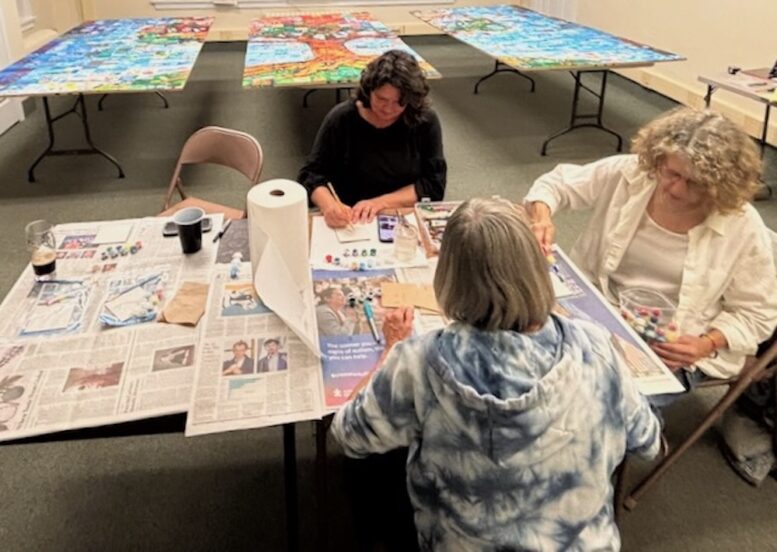
The mosaic kit included predesigned tiles and approximately 600 tiles that would be painted by community members. The arts council’s job was to bring the two together, arranging the tiles and deciding where the different colors should go to create the unified Liberty Tree design.
The process started with creating and numbering a grid to help identify each tile’s location in the design. Next, they created the perimeter using some of the darker colored tiles before using the blue tones and lighter colors to create “a nice contrast against the tree,” explained arts council member Linda Shetzer. “We incorporated some reds and greens that kind of flow together, finding a balance between not being too perfect but not being too chaotic either.”
The tree’s trunk included many of the pieces supplied with the kit, while much of the blue, green and red sections of the overall design came from local participants.
Dennis particularly appreciates that distinction.
“You can kind of tell,” she explained, noting the difference between the standardized pieces and those painted by local people. “The handmade tiles bring individual character to the overall design.”
For her, that is precisely what makes the project meaningful.
“Each tile is an individual little painting, but when assembled, the pieces create something beautiful — much like a community itself,” Dennis said.
“There are so many different people in a community and we’re all a little bit different,” she said. “But when you come together, we have this beautiful, beautiful community.”
That philosophy also guided the practical work of assembling the mural.
The arts council discovered that approximately 20 additional tiles were needed to complete the design. Maurer ordered blank tiles so the missing pieces could be painted to fill the remaining spaces. Dennis and other board members planned a painting gathering to finish those tiles before completing the assembly.
Once all the pieces were in place, the mural received a protective varnish, following the recommendation of the kit’s manufacturer. The finished work is installed in the Bowling Green City Building for public display, with the official unveiling on Monday, Nov. 16 at 6:30 p.m.
For the Arts Council, the project is about more than helping assemble a mural. It reflects the organization’s broader commitment to making art a visible and accessible part of everyday life in Bowling Green, explained Jacqui Nathan, a member of the Arts Council
“This is going to be on public view, and it’s going to be a way to let people know that we exist and we are engaged in the community,” Nathan said.
In fact, the council recently has been involved in several public art initiatives, including the downtown alley murals and the Harmony sculpture by Ian Dawson in the City Building. It was also involved with the recent project to bring artwork to downtown traffic signal boxes, in collaboration with the city and the BGSU Saturday Art Program. Children’s artwork was reproduced as vinyl wraps for eight traffic signal boxes.
Dennis believes public art contributes something important to the character and vitality of a community.
“It brings joy to everybody’s life,” she said. She described the experience of walking downtown, enjoying a cup of coffee and encountering the murals and other artwork along the way. “Public art brightens people’s days, improves the appearance of the community and gives people another reason to spend time downtown.”
The Liberty Tree Mosaic Mural is another opportunity to accomplish that goal while giving residents a sense of ownership in something they helped create. It also demonstrates the value of collaboration.
For the arts council, which has worked through several periods of starting, stopping and rebuilding over the years, opportunities like this are especially rewarding.
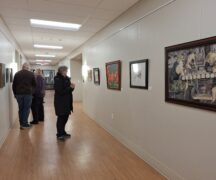
Dennis said the arts council’s most significant contribution to Bowling Green has been its presence and efforts to provide artists with opportunities to exhibit their work. That includes emerging artists, young people and hobbyists who might not otherwise have the opportunity to display their creations.
The council continues to look for ways to expand its reach, increase membership and make art more accessible. Its public art partnerships are an important part of that effort, she said.