By JAN McLAUGHLIN
BG Independent News
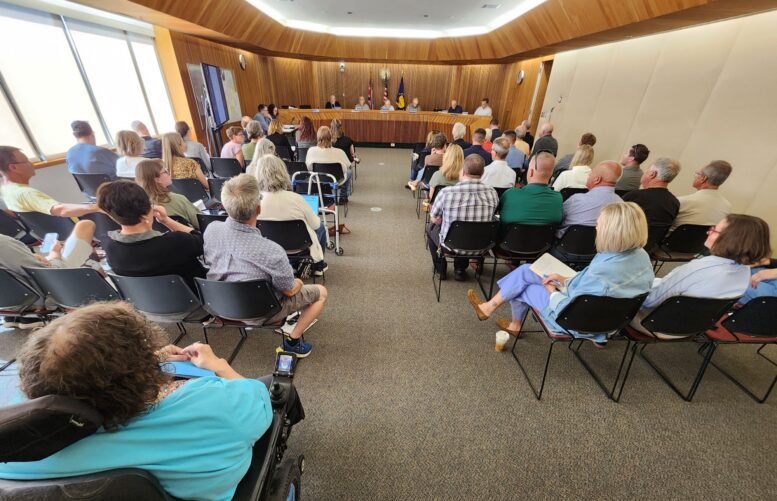
By a vote of 6-2, the Wood County Planning Commission recommended Tuesday evening that 13 parcels surrounding the Meta data center project in Middleton Township be rezoned to M-1 industrial.
The 32 acres are already owned by Meta, and the homes on them have already been razed. The zoning request will now go to Middleton Township officials, who have the final say.
A spokesperson for the zoning petitioner said Meta would like consistent zoning for all its property purchased for the data center. That statement did not sit well with neighboring landowners whose previously consistent lives have been turned upside down by the data center.
The request was filed by Liames LLC, the same firm that filed to rezone the acreage on which the Meta data center is being constructed, bordered on the south by Ohio 582, on the west by Ohio 25, and on the east by Mercer Road.
The application cited the purpose of the zoning change from residential and agricultural to allow for “construction logistics.”
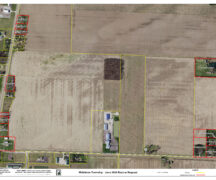
The acreage is all north of Route 582, with eight parcels lining the east side of Route 25, previously sites to homes and a strip of motel rooms/apartments. The five other parcels sit along the west side of Mercer Road, and previously had homes on them.
James Sverchek, an engineer working on behalf of Liames, told the planning commission that Liames would like zoning consistency in the data center property, which he estimated at 550 acres. Sverchek said no permanent structures were planned on the acreage along the edge of the development. However, it may be used for construction equipment staging or landscaping buffers.
Unlike a previous planning commission meeting this year, in which the communication between the board and the local residents got quite heated over the zoning for Meta, Tuesday’s meeting was calm and respectful.
“It’s wonderful that Meta wants consistency,” Bowling Green resident John Zanfardino said to the planning commission. Rather than continuing to grant Meta’s requests, local officials should consider the nearby residents’ quality of life, well water safety, and property values, he suggested.
Patricia Fugee, who lives on the north edge of the Meta property, on Dowling Road near Mercer Road, said her life has been grossly disrupted by the project.
“I’m one of those devastated citizens,” Fugee said.
Though she predicted the zoning would ultimately be approved, she asked that it be slowed until Meta gives some answers about the overall scope of their plans in Middleton Township.
“We need more information about what the master plan is,” she said.
Fugee said a water testing firm connected with the gas-fired power plant being built for the data center was recently at her home to get baseline information on her well water.
“We were told our property is probably next,” she said, questioning what that means.
Beth Cole, another neighbor on Dowling Road, described herself as an “angry resident.”
“I despise having Meta as my neighbor,” Cole said. She misses the farmland, and abhors the constant traffic and the loud construction.
The idea that Meta needs more land for parking of construction equipment is “obscene,” she said.
“What am I facing in the next year as they continue to develop,” Cole said. “Where do I go to ask questions?”
A couple members of the county planning commission also voiced their concerns about the rezoning.
Brendyn George spoke about the uptick in Ohio farmland being taken out of production.
“My vote is not to give agriculture up to anything else,” George said.
Matthew Tewers also objected. “By granting this, it gives them more area they can lay down closer to agricultural and residential,” he said.
George and Tewers voted against recommending the zoning change. Voting in favor were Ted Bowlus, John Musteric, Jeff Schaller and LaHote.
LaHote said that while he is sensitive to the loss of farmland, the properties in question already had houses on them – before they were torn down.
“Saying ‘no’ would not preserve any farmland,” he said.
LaHote also explained the limitations of the planning commission to get exact information about what is planned for the property. Rezoning acreage does not mean the owner has to commit to a particular use of the land – other than it must end up as one of several uses allowed under a particular zoning classification.
The planning commission also heard from two other citizens with concerns about the gas-fired power plant being constructed next to the data center to power the project.
Leatra Harper, of Bowling Green, encouraged the board to not give in to the “land grab” by big tech. “Don’t give them what they want incrementally,” she said.
Harper criticized the lack of transparency surrounding the Apollo power plant, which was fast-tracked through the approval process of the Ohio Power Siting Board.
Dave Steiner, director of the Wood County Planning Commission, also read aloud an email from another citizen asking that any more rezoning be put on pause until Meta reveals the full scope of its plans in Middleton Township.
While zoning change requests in cities and villages are decided by municipal bodies, the process in unincorporated areas (townships) goes through an extra step.
The requests are first filed with the township where they are located, which then sends them to the county planning commission. The planning commission listens to testimony and votes to recommend approval or rejection by the township.
The power rests with the township. The request next goes to the township zoning commission, which makes a recommendation to the township trustees – who rule in favor or against the change.
After the township trustees make a final decision on the zoning request, those opposing the change have 30 days to circulate a petition to put the issue up for a public vote in the next general election.