
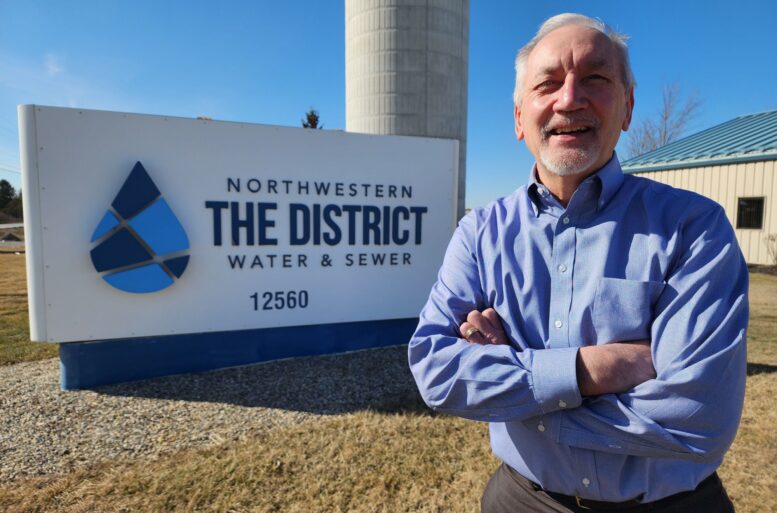
By JAN McLAUGHLIN
BG Independent News
Much of Jerry Greiner’s work over the last 37 years goes unseen – buried underground. But the results can be seen when customers turn on their faucets and flush their toilets.
As Greiner prepares to retire after being the only director of the Northwestern Water and Sewer District, he leaves knowing his efforts have resulted in residents having access to clean water that doesn’t smell like sulfur, and access to lines that keep sewage out of waterways.
Greiner, who had previously worked in banking, was hired by the Wood County Commissioners in 1988 to manage the county’s sanitary engineer’s office. Four years later, the Northwestern Water and Sewer District was created, and by 1993 the district was in operation.
It started small, serving a few thousand customers.
Since then, it has continued to stretch water and sewer services to more than 20,000 customers across Wood County and to neighboring counties of Hancock, Henry, Lucas and Sandusky. In Wood County alone, district services now reach 14 municipalities and 24 townships.
The district now has 79 employees, manages $230 million in assets, distributes 6.5 million gallons of water daily through nearly 500 miles of waterlines, and handles 900,000 gallons of wastewater daily.
None of this came without a fight – from jurisdictions that didn’t want to lose customers and from potential customers who were certain their homes weren’t leaking sewage into public waterways. The first battle came in a lawsuit filed by the City of Toledo over the formation of the district.
The district began modestly as the brainchild of then county commissioners Leonard Stevens, Alvie Perkins and Marilyn Baker – who saw the need for an entity to provide water and sewer services as a function of economic growth and human health.
While other areas bickered over water and sewer jurisdictions, Wood County officials found a way to bypass the infighting. They realized water and sewer services were the lifeblood of economic development.
“They have significant impacts on where companies decide to locate and where people decide to live,” Greiner said.
Greiner still remembers Wood County Common Pleas Judge Charles Kurfess comparing the formation of a water and sewer district to the merging of school districts.
“No one really likes the idea, but everyone benefits in the long run,” Greiner recalled Kurfess saying.
The benefits were seen in fewer annexation battles in the Perrysburg Township and Lake Township areas. Since the district served those areas, economic development sites did not have to be annexed to municipalities to get water and sewer services.
“We learned to operate like a business, instead of a government entity,” Greiner said. That meant navigating partnerships with four counties, countless elected officials, and over 75 employees.
The district also established uniform rates, and responded to residents or businesses that petitioned for services. And when the Ohio Environmental Protection Agency issued orders for sanitary sewers to prevent ongoing pollution of ditches and streams from faulty septic systems, the district worked to come up with solutions.
“Obviously, it’s rewarding to see growth in things you think create a good, honest public good,” Greiner said.
In some rural areas, the district faced strong opposition to EPA orders for sewers.
“It’s always contentious,” he said. “People don’t like to be ordered. They don’t feel their system is part of the problem.”
In areas where communities couldn’t afford the extension of water lines, the district has located watersheds, where residents can fill up jugs of clean district water. There are currently 14 watersheds spread throughout the county.
“It’s a different way to deliver water, not through a pipe,” Greiner said.
Whenever possible, the district worked to get grants to help make projects more affordable for property owners. Most recently, grants helped to pay for the sewer system extended to the unincorporated community of Dunbridge, and helped to fund inspections of water service lines that may still contain lead.
As Greiner nears his last day as director, he takes pride in the professionalism of the district team. When Greiner first started, “there was one guy with one license—and he got fired fairly quickly.” Now, licenses line the hallway, a testament to the staff’s commitment to training and growth.
“Things run smoothly most days—but when they don’t, someone’s here to make sure issues get resolved quickly and the public isn’t affected,” he said.
An unforgettable moment for Greiner hit around 3 a.m. on Aug. 1, 2014, when he got a phone call about the algal blooms found in Toledo’s water intake.
“We spent long hours here, even though we weren’t at direct risk – just making sure everything was right for our customers,” Greiner said.
“None of us had dealt with algal blooms,” he said, recalling spending the weekend at the district office with officials from the county emergency management and health department.
To get people through the three days of uncertainty about the water quality, the district provided free water at its watersheds, and got truckloads of bottled water from southern Ohio to hand out here for free.
“It was a great effort,” Greiner said.
Among many milestones, two district projects stand out to Greiner. The Lake Township expansion in 1995 brought thousands more households into the system, and the transfer of Toledo customers was an ambitious undertaking that reshaped daily operations and billing across regions. Both were complex and ultimately transformative for the district.
In 2023, the district was recognized as Wood County’s Corporate Citizen of the Year during the annual meeting of the Wood County Development Commission.
In accepting the award, Greiner said his vision for the district’s legacy is pretty simple.
“We want their water to flow every time they turn on the faucet,” he said. “We are responsible for every drop.”
As a government entity, the water and sewer district doesn’t get much attention, he said. “And when we do, it’s usually bad.”
But nearly four decades in business, the district has had a pivotal role in bringing millions of dollars in investments and thousands of jobs to Wood County.
“We try to make this a better place to live and work,” Greiner said.
Companies like First Solar, the CSX rail hub, UPS, Home Depot distribution center and NSG glass plant all rely on the district to deliver clean water and take away wastewater.
“We are responsive and active partners in economic development,” Greiner said, oftentimes investing in oversized water and sewer lines in preparation for future growth.
As he presented the award to Greiner, Wade Gottschalk, executive director of the Wood County Economic Development Commission, noted the role played by the water and sewer district.
“The award recognizes the achievements of the district and its vital role in economic development in Wood County,” Gottschalk said. “Their cooperation in building solid, reliable infrastructure in Wood County and our region has led to the growth of so many businesses and industries.”
Greiner has no plans for his retirement, other than doing volunteer work and spending time with his family. He has been approached about doing consultant work, but has made no commitments.
Replacing him as district director is Douglas Stephens, who brings 24 years of experience in the water and wastewater sector, most recently serving as the director of the department of public utilities for the City of Toledo.