
By JULIE CARLE
BG Independent News
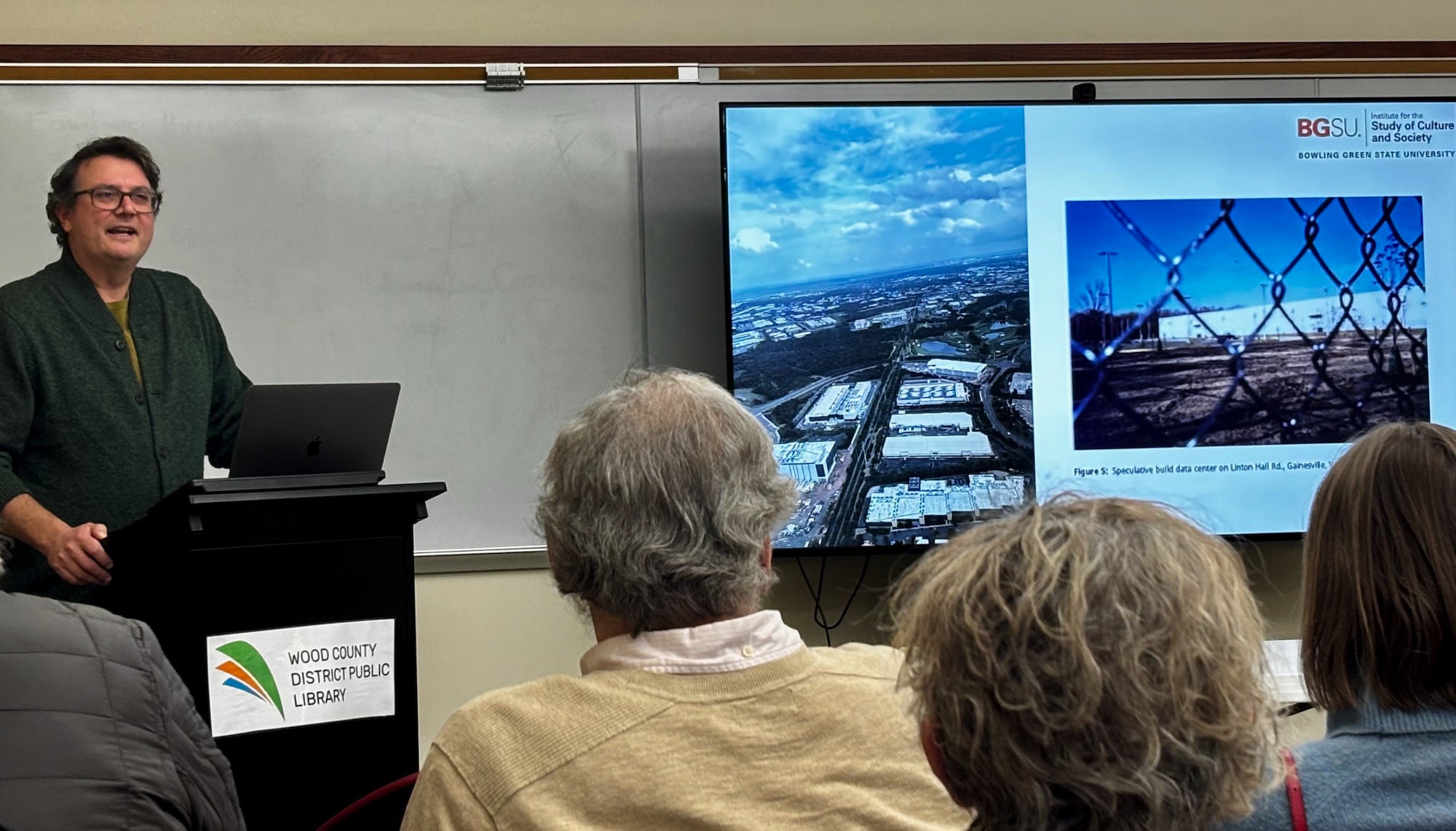
“Server farms don’t just store data. They shape the geographies of our lives,” said Dr. Clayton Rosati during an Institute for the Study of Culture and Society (ICS) presentation in November.
During the talk, Rosati, a Bowling Green State University geography professor whose research intersects geography, media and infrastructures, discussed the societal and environmental impacts of server farms—also known as data centers—at a time when machine learning and the artificial intelligence (AI) economy are growing exponentially.
The infrastructures of AI’s data centers have a massive physical footprint that have active roles in transforming communities, but not for the better.
Rosati’s data center research started more than 25 years ago with an in-depth study of data center development in Northern Virginia, which he called “the internet capital of the world.” He detailed how data center proliferation consumed vast amounts of electricity, water and land that led to significant changes in the landscape.
Between 2014 and 2024, data center load growth tripled, and by 2028, they could consume 12% of U.S. electricity, he said, citing data from the U.S. Geological Survey (USGS).
As markets such as Northern Virginia became saturated, the geographical spread of data centers moved into new regions including the Midwest in search of land and resources. The expansion prompted Rosati to include the Middleton Township Meta data center into his research.
One of his goals is to create a “community playbook” to increase effective democratic participation in the production of AI technologies and their geographies of infrastructure, resources, and labor.
“The data centers are just one piece of a much bigger problem. They are a viewfinder for us, in a sense, into a bigger problem or a set of bigger problems in our society,” he said. “They are a symptom of larger systemic issues related to resource extraction and corporate control. We need to be able to see the forest and the trees in order to be able to rise to the challenges that they present to us.”
Among the social consequences that often occur with developing data centers are the erasure of historical sites—such as Black and Indigenous communities, conflicts over zoning and resources, and the limited long-term economic benefits for communities that frequently provide substantial tax incentives to the corporations.
The economic benefits promised by data center developers are often misleading, Rosati said. “They create a surge of temporary construction jobs but few permanent positions.”

Rosati’s conclusion called for community organizing and building diverse coalitions to ensure democratic control over local development. He urged a shift from a “Not in My Backyard” (NIMBY) perspective to a broader call for a “right to the city” and more democratic control over these types of developments.
“If infrastructure shapes who we are, then people should have a democratic right to control that infrastructure,” he said. “It’s not just whether we want a data center in our backyard, but what kind of city we want, for what kind of society we want.”
Thinking beyond localized opposition and joining forces with diverse and unexpected coalitions could be a crucial strategy for resisting unwanted development and demanding corporate and governmental transparency, he suggested.
“I think there are all sorts of ways that we can imagine building coalitions that maybe we didn’t imagine or that our algorithms didn’t imagine,” he said. “If we’re going to organize around not having something, we might also think about organizing around having something.”
Rosati’s talk, held as a public forum at the Wood County District Public Library, aligned with the mission of ICS: to engage the BGSU campus and surrounding communities in conversations about important issues in our community and society.
“This talk is an invitation to critical inquiry and dialogue about the ways we are affected by and can navigate the challenges and implications of this rapidly growing technology,” said ICS Director Valeria Grinburg Pla.