By JAN McLAUGHLIN
BG Independent News
Ohio native sons Thomas Edison and the Wright Brothers are household names. But what about Weston Green, the inventor of Cheez-its in 1921 in Dayton? And the reported debut of the first hamburgers – fried up in 1885 at the Erie County Fair by Frank and Charles Menches of Canton?
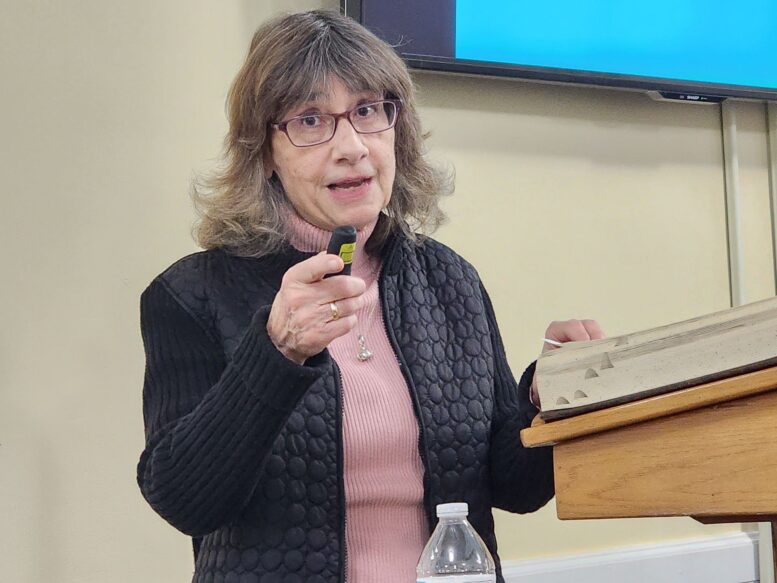
As part of America’s 250th anniversary celebration, the Wood County Museum last month hosted a speaker well versed in Ohio inventors. She referenced many of the well known – and lesser known entrepreneurs.
“Practically all the great inventors over the years have been laughed at,” said Bette Lou Higgins, of Eden Valley Enterprises, an educational and cultural organization that developed living history programs beginning in the 1970s.
It’s usually after many unsuccessful attempts when the right formula for an invention is happened upon, Higgins said.
That’s what happened to Ohio inventions of crayons, traffic signals, astronaut suits, Quaker Oats, frozen Stouffer meals, Lifesavers and chewing gum.
“Investors keep bringing new things into our lives,” Higgins said. “Usually they get the last laugh.”
Following are some of the successful inventions Ohioans can boast about.
Founded in 1877 by Henry Parsons Crowell in Ravenna, Ohio, the Quaker Oats Co. was the first to trademark a breakfast cereal, featuring the “man in Quaker garb” to represent integrity and purity.
Stouffer’s – now a giant in frozen food dinners – began in 1922 as a stand-up milk counter in Cleveland, owned and operated by Abraham and Lena Stouffer. Lena’s homemade apple pie is given credit for the company’s instant success.
Oftentimes, the inventor is overshadowed by the invention. For example, few likely know the name of Ohio native Charles Strosacker – but they no doubt have used his invention, Saran Wrap, to seal up leftovers.
The Americanized name of “Chef Boyardee” was born when the head chef at the Plaza Hotel in New York City left his post in 1924 to open an Italian restaurant in Cleveland. It wasn’t long before customers began asking Chef Boiardi for his spaghetti sauce, which he began to distribute in milk bottles. Later, during World War II, the U.S. military commissioned the company for the production of army rations, requiring the canned spaghetti factory to run 24 hours a day. At its peak, the company employed approximately 5,000 workers and produced 250,000 cans per day.
Ohioan Edwin Beeman became the Chewing Gum King after introducing Beeman’s Pepsin Chewing Gum. A specialist in digestive disorders, Beeman discovered that pepsin, an extract from hog stomachs, could provide relief from indigestion. The Beeman Chemical Co. first sold pepsin in powder form but sales were lacking. In 1890 the company’s bookkeeper, Nellie Horton, suggested that Beeman add pepsin to chewing gum. The following month, Beeman’s Pepsin Gum debuted, but sales were disappointing, perhaps because Beeman opted to put a picture of a pig on the wrapper. Horton soon convinced Beeman that a different (pig-free) logo would help and, once that change was implemented, the product took off.
“People are still chewing their gum today,” Higgins said.
Ohio was also the birthplace to some very young entrepreneurs.
At the age of 12 in 1975, Rebecca Schroeder of Toledo was granted her first patent. Her invention was the brainchild of her sitting in her family’s car as her mom did the shopping. Rebecca would try to work on her homework, but had to stop as it became dark outside.
So she dreamed up the idea for glow in the dark paint “Glow Sheets” – a backing sheet of paper with phosphorescent lines that could be placed under writing paper that would allow her to write even with no other light available. She was granted a U.S. patent and NASA showed an interest in the invention.
Schroeder went on to receive a total of 10 patents for this product; the first for the original idea, and nine more for improvements. Her “Glow Sheet” was used by nurses working in hospitals at night so they did not have to wake patients by turning on lights. Sailors in the Navy used the invention at night on ship decks. She sold her inventions through the company she created called B.J. Products, in Toledo.
Liz Gray, of West Union, became an inventor at 11 years old, when she created the “flipomatic” music stand. The invention allowed her to use her feet on music stand pedals to turn the pages as she continued playing her saxophone, Higgins said.
Ohio native, Dayton Clarence Miller was an early experimenter with X-rays, and in 1895 made some of the first photographic images of concealed objects, including a bullet within a man’s limb.
Many Ohio inventors got their start with bicycles and advanced to motor vehicles. In the 1890s, cars ran on electricity and steam – and rarely reached speeds over 20 mph, Higgins said.
Barney Oldfield, born in Wauseon in 1878, began racing bicycles and switched over to auto racing in 1902. He was the first man to drive a car at 60 mph on a circular track.
“He always wanted to go fast,” Higgins said.
Another Ohio inventor wanted to make driving safer. When Ford Motor Co. was founded in 1903, it was not uncommon for bicycles, animal-drawn carts, and motor vehicles to share the same thoroughfares with pedestrians. Crashes frequently occurred. After witnessing a collision between an automobile and a horse-drawn carriage, Garrett Morgan was convinced that something should be done to improve traffic safety – so in 1923 he created the traffic signal. Earlier, during World War I, Morgan received a patent for his version of a gas mask.
In 1934, Russell Colley helped pioneering pilot Wiley Post reach the jet stream and break new altitude records. Using his wife’s sewer machine, Colley designed a pressurized suit. In the 1940s, Colley helped design the Goodrich pressure suit for the U.S. Army Air Force, which was reportedly inspired by the segments of a tomato worm Colley observed in his garden. Later, he led the design of the space suits used by the Mercury astronauts, and became known as the “Father of the Spacesuit.”
Following are some other Ohio inventors:
- Charles Kettering – Along with a team of workers, Kettering invented the first automobile self-starter in 1911. Before this, drivers would have to crank the engine by hand before entering the automobile. Kettering held more than 300 patents, including one for an electric cash register.
- An early mechanical cash register was invented by James Ritty, the owner of a saloon in Dayton, who believed his employees were embezzling by pocketing cash from customers or from the store’s cash box.
- Murray Spangler – a janitor from Canton, in 1907, invented the vacuum cleaner. A relative of Spangler’s, W.H. Hoover, manufactured and sold Spangler’s invention throughout the world.
- John William Lambert – a resident of Ohio City in Van Wert County, Lambert built the first gasoline-powered, single-cylinder automobile in 1890. Lambert’s car could reach speeds up to 5 miles per hour.
- Brothers Orville and Wilbur Wright – owned a bicycle shop in Dayton and from their youth, had been interested in flight. The Wrights developed wing designs for an airplane, and on Dec. 17, 1903, successfully flew their powered aircraft.
- Thomas Alva Edison – widely recognized as one of the greatest inventors of all time, was born and grew up in Milan, in Erie County. Edison holds 1,093 patents, more than any other American. Three of Edison’s most famous inventions are the light bulb, the phonograph and the kinetoscope, an early version of a film projector.
- Roy J. Plunkett – as a result of an experiment gone wrong, he discovered Teflon in 1938. Plunkett found that the mysterious white powder left over from his refrigeration gas experiment at DuPont resisted heat yet remained as slippery as ice.
More information on Ohio inventors can be found at the Ohio History Connection at https://www.ohiohistory.org/.