Written by Geoff Howes
Bowling Green Historic Preservation Commission
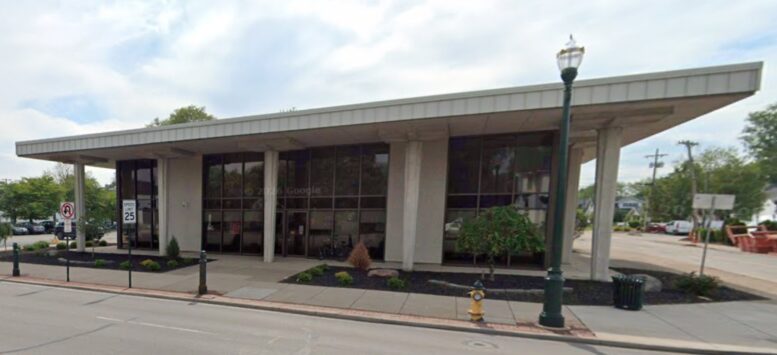
The Bowling Green Historic Preservation Commission’s Historic Building of the Month for February 2026 might not strike everyone as historic, because it looks so modern. However, according to the Secretary of the Interior’s guidelines, a structure at least 50 years old may count as historic. The State Savings and Loan building at 300 S. Main St., now a Key Bank branch, was built nearly 60 years ago.
In December 1968, the State Savings and Loan Company celebrated the grand opening of its new building with a two-day open house. Anyone starting an account or adding at least $50 to an existing one received a free dictionary. The event also featured an art display by high school students. Prominent businesspeople and public servants were given private tours of the new offices.
The company’s story started in 1889, when a group of Bowling Green businessmen founded the Equitable Building and Loan Company, first located in the Reed and Merry Block at 144 N. Main St. (now SamB’s). By 1915, the company, renamed Equitable Savings & Loan, was doing well enough to put up its own building at 133 E. Wooster St. (most recently Sterling’s Amish Deli). In 1949, as the State Savings and Loan Company, it moved into the former State Bank Building at 133 S. Main St. (now Myla Marcus Winery). By 1967, the company had grown enough to need a new, modern building, with more parking and a drive-up window. The Ettl Company of Toledo was the contractor, and ground was broken on Nov. 15, 1967.
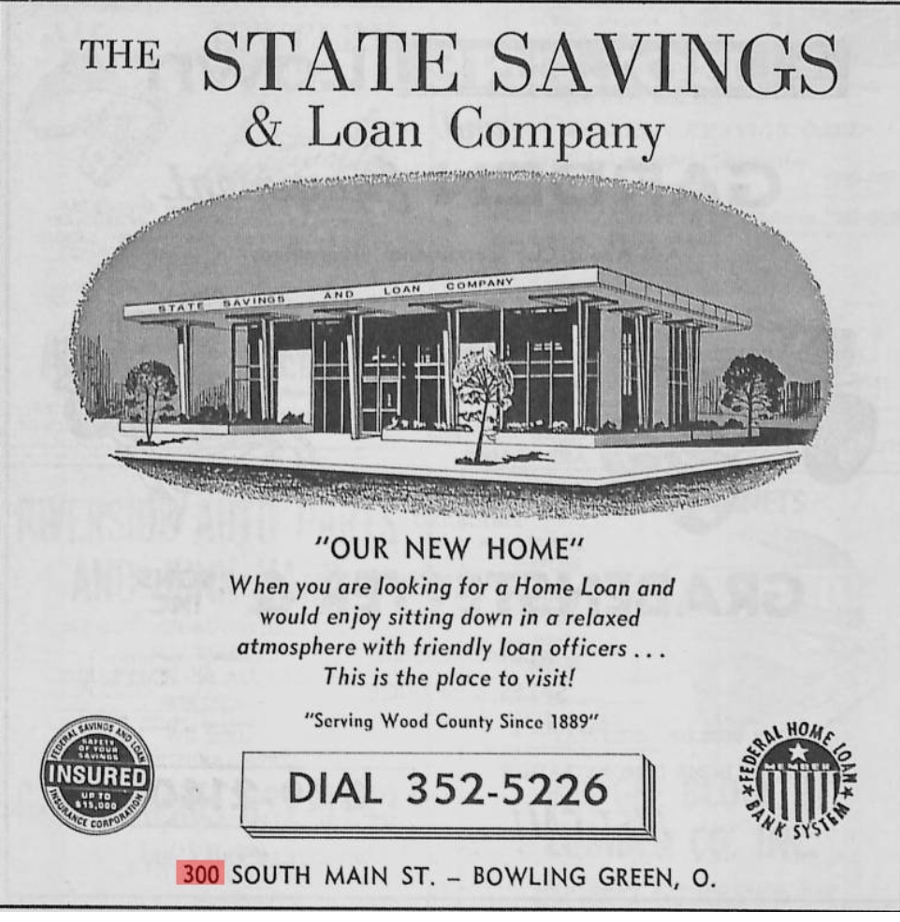
The building at 300 S. Main St. is an excellent example of mid-century modern commercial architecture. The two-story solar bronze plate-glass façade and eleven pre-cast concrete columns, covered with white quartz and marble aggregate, are typical of the style. The high, open interior with durable Formica surfaces, a mezzanine for art shows and displays, and a main stairway suspended by rods, also made a distinctly up-to-date impression in 1968.
Mid-century modern architecture did not draw on historical styles, but made use of new developments in materials, design, and marketing to create something fresh and free of nostalgia. One can imagine how new and different this style must have seemed at the time, compared to the traditional styles of other local bank buildings like the Neo-Colonial Bowling Green Banking Co. building at 222 S. Main St. (built in 1961, now Huntington Bank), or the Williamsburg Colonial First Federal Savings and Loan building at 130 E. Court St. (built in 1963, now Civista Bank).
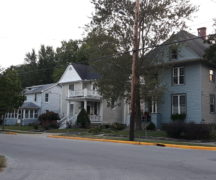
The State Savings building was constructed on the site of the former Anderson Funeral Home, which had its own interesting history. This 14-room brick Queen Anne Victorian house, with a round tower, a broad covered porch, and multiple filigreed gables, was built in 1903 by the farmer, businessman, and investor Robert Place (1851-1928), as his residence. He made the porch pillars into “columns of curiosities” with exotic and colorful stones, including bullets and stones from Civil War battlefields.
Place lived there until 1923, when his son Alfred moved in. After several years of poor health, the elder Place died in 1928. Charles Davis (1871-1932) and his wife Josephine (1875-1966) moved into 304 S. Main St. around 1930. Charles died in 1932 and Josephine rented rooms to the Delhi Fraternity until 1933. During the Depression years 1933 to 1936, the house was the local office of the Civil Works Administration and the Federal Emergency Relief Administration.
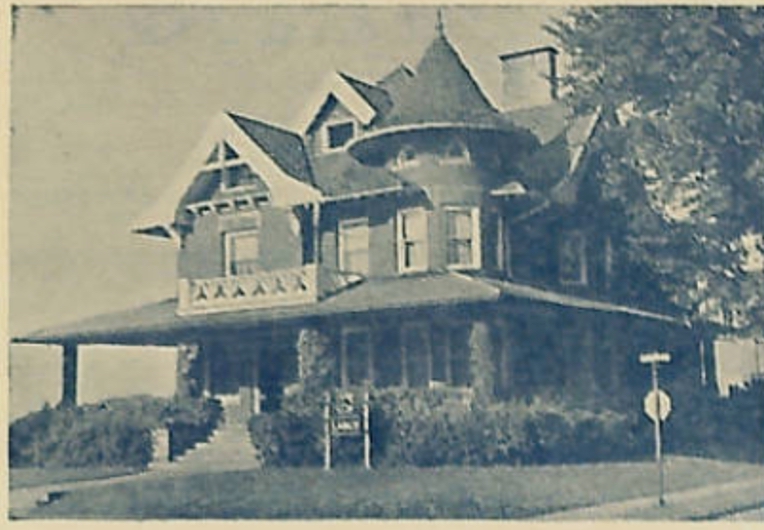
From 1936 to 1939, it belonged to the pension department of the Methodist Episcopal Church. In 1939, Ira D. “Sid” Lance (1907-1984) and his wife Vera (1912-1983) bought it and converted it into a funeral home, which they ran until 1945. In 1946 Sid’s brother and partner Fred sold the building to George L. Anderson (1910-1973) of Toledo. Anderson operated the funeral home until 1967, when State Savings and Loan purchased the property and had the old house demolished.
In 1976, State Savings began a $350,000 expansion (almost $2 million today) of 300 S. Main St. President Theodore W. Greene announced that the lobby, office, and storage space would be doubled, and the drive-up banking service tripled, by a 32-by-82-foot addition on the west side. A new south entrance would also be added, traffic patterns streamlined, and parking expanded. The new parking lot to the south required the demolition of the house at 316 S. Main St., which had belonged to Howard T. Uber (1892-1963) and his wife Rae (1892-1970). The addition was opened in October 1977.
At the time of the opening, the Sentinel-Tribune interviewed two brothers, Alva W. Bachman (1893-1988) and Elmer G. Bachman (1902-2001), one or both of whom had been on the board of directors from 1935 to 1975. Alva, a prominent local attorney, was counsel for the company and a board member until 1971. Elmer was managing officer and then executive vice president until 1969, and he served on the board until 1975. They recalled that many borrowers defaulted during the Great Depression, but after World War II, deposits “grew by leaps and bounds.” State Savings was the main institution in the county for GI loans. As Bowling Green State University grew, every year new faculty and staff sought mortgages and savings accounts. When the new building at 300 S. Main St. was built in 1968, State Savings was the oldest financial institution in Bowling Green.
In 1980, State Savings and Loan merged with Home Federal Savings and Loan of Maumee and became State Home Savings Association. Three more mergers followed in the 1980s. By 1991, State Home Savings had $338 million in assets and 14 branches in surrounding communities. Success made it attractive to out-of-town investors, and U.S. Thrift Opportunity Partners of Chicago bought 96% of its stock. In 1994, Keycorp’s Ohio unit, Society National Bank, purchased those shares. In 1996, Society became KeyBank, as we still know this distinctive building at 300 S. Main St..
(Written by Geoff Howes of the Bowling Green Historic Preservation Commission. With thanks to the Sentinel-Tribune and the Wood County District Public Library.)
Would you like to nominate a historic building or site for recognition? You can do this through the City website at – https://www.bgohio.org/FormCenter/Planning-13/Historic-BuildingSite-Nomination-Form-83
You can learn more about the Historic Preservation Commission by attending their meetings on the fourth Tuesday of each month at 4 p.m., or by visiting their webpage at https://www.bgohio.org/436/Historic-Preservation-Commission.