
By JAN McLAUGHLIN
BG Independent News
Usually at polar opposites over solar rooftop fees, city officials were recently thanked by the most vocal rooftop solar customer in Bowling Green.
Joe DeMare said he was “very gratified” that the city’s Board of Public Utilities and a consulting firm hired by the city reached the conclusion that rooftop solar customers should no longer be charged fees.
“Thank you for listening,” DeMare said during the BPU earlier this month.
For five years, Bowling Green electric rates have held steady, and the Board of Public Utilities has taken heat for charging fees for rooftop solar users. But now those rates are on their way up and those fees are on their way out.
Last month, the BPU heard a presentation on the Electric Cost of Service and Rate Study conducted by Sawvel & Associates, an engineering consulting firm. The report was given by Trey Shepherd, who presented the last such report when it was conducted in 2017.
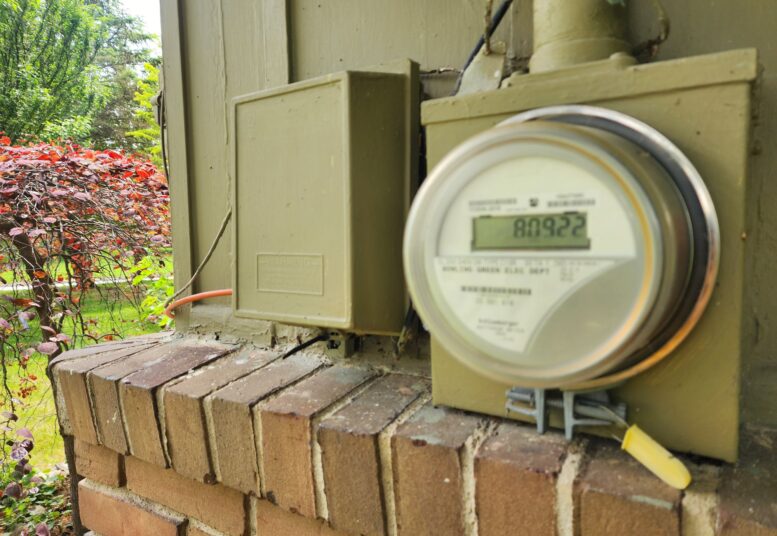
In addition to studying the overall electric rates in the city, the report looked into the utility department’s monthly “facilities charge” being billed to rooftop solar users based on the size of the installation. City officials have frequently defended the fee as necessary to ensure solar customers paid for the cost of service to their properties, and that other customers would not need to subsidize services to solar users.
It was recommended that the monthly facilities charge be reduced by 50% in 2026 and eliminated altogether in 2027. For residential customers the rate will go from $4/kW to $2/kW in 2026 and $0/kW in 2027.
According to Shepherd and city utility officials, this change is due to the rate adjustment being included in the fixed billing component (monthly customer charge). As the fixed billing component increases annually, the utilities department will collect more fixed revenue from customers, which better aligns with fixed expenses as well as replacing the fixed revenue collected from the monthly facilities charge.
Additionally, it was recommended that the city pay more to rooftop solar customers for their excess power. The study calls for the excess generation purchase rate to be adjusted from $0.075/kWh to $0.095/kWh. The city’s methodology for the excess generation purchase rate has been to use the avoided cost of energy based on the current conditions of the energy market. The higher market energy prices as well as higher capacity and transmission costs, justify the higher value of the excess energy.
Last year, city leaders agreed to change the long-standing process of how the existing city income tax is distributed among city departments. As part of the plan to pay for two new fire stations in the city, council agreed that 0.15% of the existing 0.3% income tax collection go from the water/sewer capital fund into a capital improvement fund and street repair fund.
To make up for the capital improvement money taken from the water and sewer funds, those rates will need to be increased to collect about $1.5 million annually. The average residential customer in Bowling Green would see their monthly water bill go up 70 cents, and their monthly sewer bill go up by $1.10, according to city Utilities and Infrastructure Director Brian O’Connell.
But that shift in income tax revenue does not affect the city’s electric budget, O’Connell said. The income tax only goes to the Water & Sewer Capital Improvement Fund. Electric does not receive any income tax, he pointed out.
The electric study looked at rising energy costs, rising capital costs, and rising operating and maintenance costs. The goal was to continue providing a highly reliable electric service at a competitive price – making sure rate increases are made gradually.
The city utility system has worked hard to fend off rate increases, Shepherd said. But to delay any longer would be unwise.
His report identified that $74 million in revenue is needed for the city’s electric system this year. However, at the current rates, the rates would raise $61 million.
Shepherd acknowledged that the city cannot raise rates enough to cover that $13 million gap.
“We can’t do that in a year,” he said, adding that the increases will be spread over a series of five years. “It’s important the pieces fit together.”
Those pieces include the costs of capacity, demand, energy and transmission. Shepherd presented a pie chart showing the city’s power supply mix predicted for 2027 – with 51% from Prairie State coal-fired plant, 44% from renewable resources, and 5% from the market.
While the costs of buying energy and operating an electric system keep increasing, Bowling Green has the advantage of more electric sales in the near future, Shepherd said.
The study recommended a rate stabilization strategy to help meet debt obligations in 2026 and 2027. That strategy should lead to smoother transitions to higher rates, and avoid an immediate 20% increase to customers.
To do that, Shepherd recommended the city utilities borrow $6.9 million, so rate hikes can be spread out at 7% in year one; followed by annual increases of 5%, 4% and 4% in subsequent years. The goal would be to pay back the loan by 2031.
In addition to electric costs, the city is also looking at costly transformer replacements at substations, and the moving of the electric division office currently located on East Wooster Street. The report identified about $7 million in annual capital spending needed.
Shepherd also noted that the operating and maintenance costs – including salaries, benefits, contract, supplies and materials are expected to grow from $9 million in 2023 to $15 million in 2030.
The study recommended increasing the fixed rates for all users. Shepherd said the proposed rates are still in the ballpark with other municipal utilities, and are still lower than those charged by Toledo Edison.
For residential customers, the typical monthly electric bills are currently $93. With the first increase, the bills would be $100 – compared to the typical monthly bill of $111 from Toledo Edison, he said.
The incremental increases would continue until 2030, when the typical estimated residential electric bill would be $120.
