
By JAN McLAUGHLIN
BG Independent News
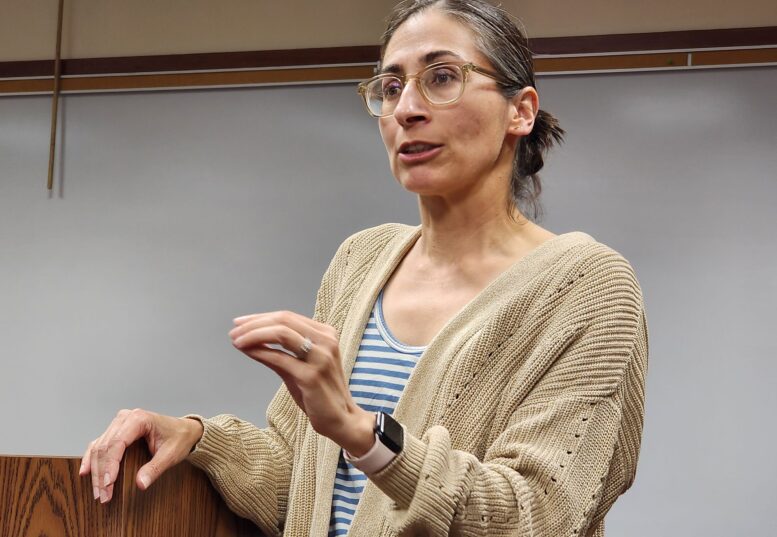
As a political science professor, Dr. Nicole Kalaf-Hughes is intrigued by the communication – or lack thereof – between elected officials and their constituents. As a citizen, she learned just how frustrating it can be to get some elected officials to listen.
It was in 2020, when her interest extended beyond research and into her own effort to effect change. As the Covid pandemic hit the U.S., Kalaf-Hughes found herself thrust into the often unsatisfying role of communicating with elected officials.
On Thursday evening at Wood County District Public Library, the BGSU professor shared her experience and offered tips on how to – and how not to – effectively communicate with federal, state and local officials. The talk was sponsored by the League of Women Voters of Bowling Green.
Kalaf-Hughes began with her experience in 2020, when she requested that the Perrysburg Board of Education adopt a mask mandate at its schools. She was told by some board members that Covid was “no big deal,” and that she was the only district resident who had expressed any concerns.
Kalaf-Hughes knew both of those responses were untrue. She knew of other mothers in the district who had voiced similar concerns, and who had been brushed aside. And she learned of one father in the district who got a response, and an invitation to meet with school officials.
So she filed a public records request as a way of “channeling my rage in a healthy way.”
As a political science professor, she saw an opportunity to conduct some research. She ended up filing 613 public records requests with school districts across Ohio, asking for correspondence regarding masks, Covid vaccines, and while she was at it, Critical Race Theory.
Some districts complied, some dragged their feet, and others said she would need to sue to get that information. She ended up getting a 47% response rate – totaling more than 10,000 emails.
Kalaf-Hughes discovered that those districts which received a lot of emails asking for masks mandates, ended up enacting the mandates.
“Communication actually mattered,” she told her audience on Thursday evening.
Even those districts with a high number of Covid cases didn’t require masks unless they were bombarded with emails, letters and calls from citizens.
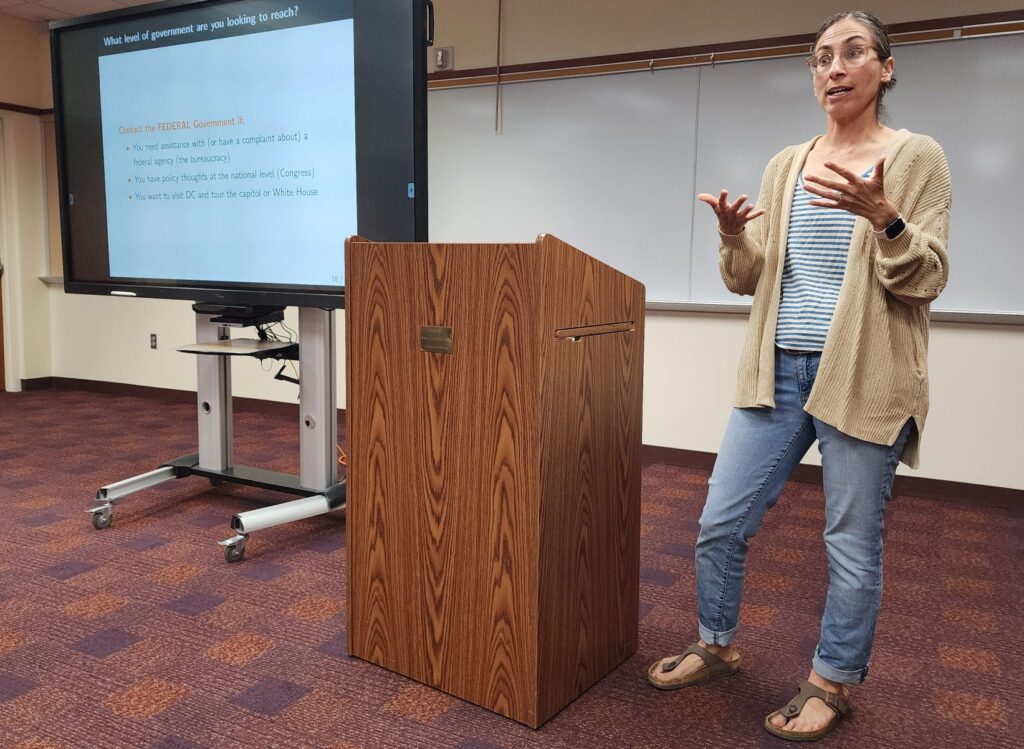
Kalaf-Hughes explained that when communicating with elected officials, the results are often varied due to the responsiveness of the official, the effectiveness of the correspondence, the reasonableness of the request, and the persistence of the citizens.
“Not all elected officials are created equally,” she said. “Some elected officials are just better at doing their job.”
Research has shown that female elected officials tend to be more responsive to their constituents. That could be because women have to work more collaboratively to build consensus, since there are fewer of them in elected office, Kalaf-Hughes said. Women make up 20% of Congress, she explained.
“They are more likely at all levels of government to respond,” Kalaf-Hughes said.
Key to successful communication is knowing who the concerns, complaints or requests should be directed to, she said.
It is a futile effort to complain about a school policy to city council, or demand more frequent coverage by the city snowplow to the school board. The same goes for state and federal issues. Concerns about veterans benefits and requests for Capitol tours should be reported to members of Congress, while displeasure with school vouchers should go to state legislators.
Local elected officials tend to be the easiest to contact.
“We see them at the grocery store. We see them at soccer games,” Kalaf-Hughes said.
Bowling Green City Council member Katelyn Elliott, who was in the audience, pointed out that the city’s website includes the cell phone numbers of all council members. Kalaf-Hughes noted her surprise.
“Not every city council gives out phone numbers,” she said.
Political party affiliation can make a big difference in getting a response or getting ignored, she said. However, there are some issues that rise above party politics.
“Sewers transcend parties,” in local government, she said. And “data centers transcend partisanship” in state government.
But at the federal level, not much can break down party walls. Evidence is undeniable that members of Congress are far more likely to respond to requests from constituents of the same political party.
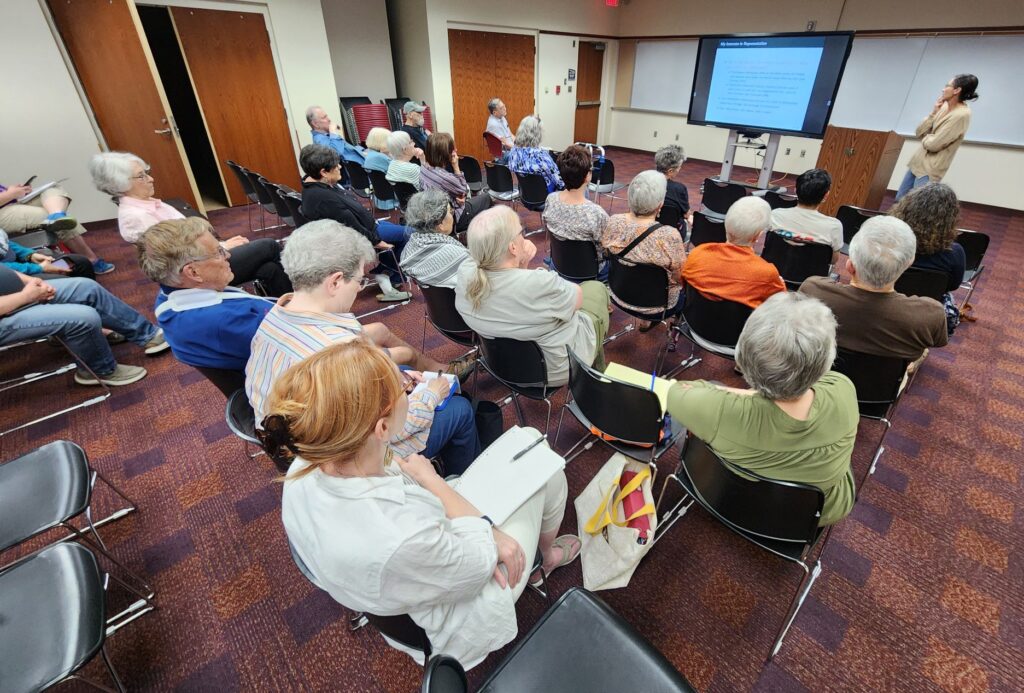
Kalaf-Hughes offered some advice on how to best communicate with elected officials:
Who:
- Make sure you are reaching out to the right person.
- Identify yourself as a constituent, and of the same political party if that’s the case. Describe past support of the official, past contributions, and connections with the official. Acknowledge appreciation for their time.
How:
- Email is the most frequent type of communication with members of Congress, followed by phone calls. Postal mail, fax, and in-person are other lesser used options.
- Don’t show up at the home of an elected official. Office visits are OK, home visits are not.
Emails should:
- Be brief.
- Have a clear subject.
- Include an introduction.
- Have an actionable request or inquiry.
- Include contact information if you want to hear back.
- Proofread it – so it doesn’t read like an error-riddled ransom letter.
Tone and timing matter:
- Be aware of tone. “Don’t be a jerk,” she said. “Do not threaten them.”
- Be aware of the legislative calendar. Responses are slower during the summer.
- Officials tend to be more responsive before an election, before an important vote, during the budget process, and when the issue is more salient.
How to make it count:
- Individually written correspondence is best. When a rush of the same exact letter comes in from many people, it tends to not be as meaningful.
- While letters rarely make it to the actual desk of the congressional member, they are tallied by the staff. So each letter adds up to another “pro” or “con” check on an issue. Don’t send a letter loaded with lots of signatures, since it may just be counted as one tally mark.
- “Everything is tracked,” she said. “It matters in the margins.”
Don’t get your hopes up:
- At best, most constituents get some type of form letter in return with typical language thanking them for “being active and informed citizens and part of the process.” The response is less than satisfying, Kalaf-Hughes said.
- It’s still important that elected officials hear how their constituents feel. “Sometimes it feels nice to rage into the void,” rather than saying nothing, she said.