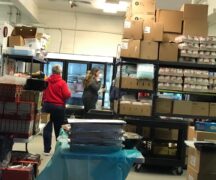

Food insecurity is prevalent in Bowling Green. In Wood County, 14.8% of residents (approximately 18,600 people) are experiencing uncertainty in getting their next meals. Nearly 1 in 7 of all our neighbors do not qualify for government assistance and rely exclusively on community food banks or charities in order to maintain their lives.
Most people do not consider supply chain issues related to problems with food security. In fact, when you think about hunger, the two are very much intertwined. Food banks do not grow and produce their own foods, so their sources of food are usually through donations, federal feeding programs, and distribution channels through various industries. When those distribution channels experience breakdowns or disruptions, food banks have empty shelves and no food to distribute.
Persons living in poverty experience the most significant impact from disrupted supply chains. Families with considerable means take brand and store switching as necessary parts of their day-to-day lives. Researchers studying food access have found that people living in food deserts have traditionally been paying more for less food than people living outside food deserts. Therefore, those families who are dependent upon food banks will be the first to experience hunger when food prices increase and lead times for delivery increase.
This has already occurred in Ohio. In 2022, Ohio’s food banks lost over 250 semi-trailer loads of USDA food due to supply chain issues. The federal government cut $500 million from the Emergency Food Assistance Program in 2025. Shipments throughout Ohio were cancelled, and food pantries experienced shortages at the same time grocery store donations were down due to the grocery stores having less to donate.
Bowling Green does not have to wait until there is another crisis. We are surrounded by farms. There is a major college in BG. There is a local charity that is very dedicated. The only thing that we need to do is work together.
Here are three ways our community can make a difference. First, the city can provide funding for partnerships between farmers and food pantries. Secondly, BGSU can work on expanding their food waste program to provide leftover food from the dining halls to needy families. Lastly, organizations like Brown Bag Food Project can be provided with grants by the city to create a stronger local food system.
A shorter local food supply chain will be stronger and more reliable, because it does not rely on a warehouse located in some far-off place, or on the federal budget, or on shipping and import delays. Most importantly, it will provide food to families who need food immediately.
References
Brown Bag Food Project. (2024). About us. https://www.brownbagfoodproject.org/about-us
Ohio Country Journal. (2022 July 4). Food banks face a “long, hot summer” of need. Ohio Ag Net. https://ocj.com/2022/07/food-banks-face-a-long-hot-summer-of-need/
Ohio Association of Food Banks. (2025 March). How Ohio’s food banks are dealing with extensive cuts from the USDA. KNAU/NPR. https://www.knau.org/2025-03-22/how-ohios-food-banks-are-dealing-with-extensive-cuts-from-the-usda
Philadelphia Inquirer. (2021 November 23). Inflation, supply-chain disruptions are hurting Philly food banks and pantries. https://www.inquirer.com/news/pennsylvania/pandemic-food-banks-pantries-philabundance-share-supply-disruptions-20211124.html
State News. (2025 June 2). Less food, more demand: Ohio’s rural food pantries cope with federal cuts. https://www.statenews.org/section/the-ohio-newsroom/2025-06-02/less-food-more-demand-ohios-rural-food-pantries-cope-with-federal-cuts
Wood County Hospital. (2023). Community resources. https://www.woodcountyhospital.org/about-us/community-resources/
Halima Rube
Bowling Green