

By JAN McLAUGHLIN
BG Independent News
After delivering coffee, doughnuts and more for six years, the small army of Starship robots has evacuated the Bowling Green State University campus.
BGSU was the first university in Ohio to welcome the rolling robots six years ago. The food-bearing robots rapidly spread to college campuses across the nation.
But the carry-on luggage-size robots that have been navigating campuses throughout the U.S. are now being pulled from colleges and instead being deployed in the grocery delivery sector.
Jon Zachrich, director of marketing, communications and technology for BGSU Chartwell’s Dining Services, said Friday morning that the wheeled robots are no longer transporting food on campus or nearby neighborhoods.
While the delivery service was not a necessity for campus dining, it was a nicety that some students, staff and townspeople took advantage of, Zachrich said.
In an effort to continue offering delivery food services, other options are being studied, Zachrich said.
“We’re looking at all possibilities” – some robotic, some not, he said. “We hope to have another solution by the fall.”
As of earlier this year, the Starship Technologies program had 45 robots on the BGSU campus.
When the robots arrived on campus in March of 2020, the timing was perfect. The Covid pandemic had just hit, and people were avoiding crowds and getting more food deliveries.
After just a few months in operation, the delivery area for the robots expanded west to the downtown and south to East Gypsy Lane Road. While they primarily delivered food and beverages from campus eateries, the Starship contraptions also contracted with some other establishments in the city such as McDonald’s.
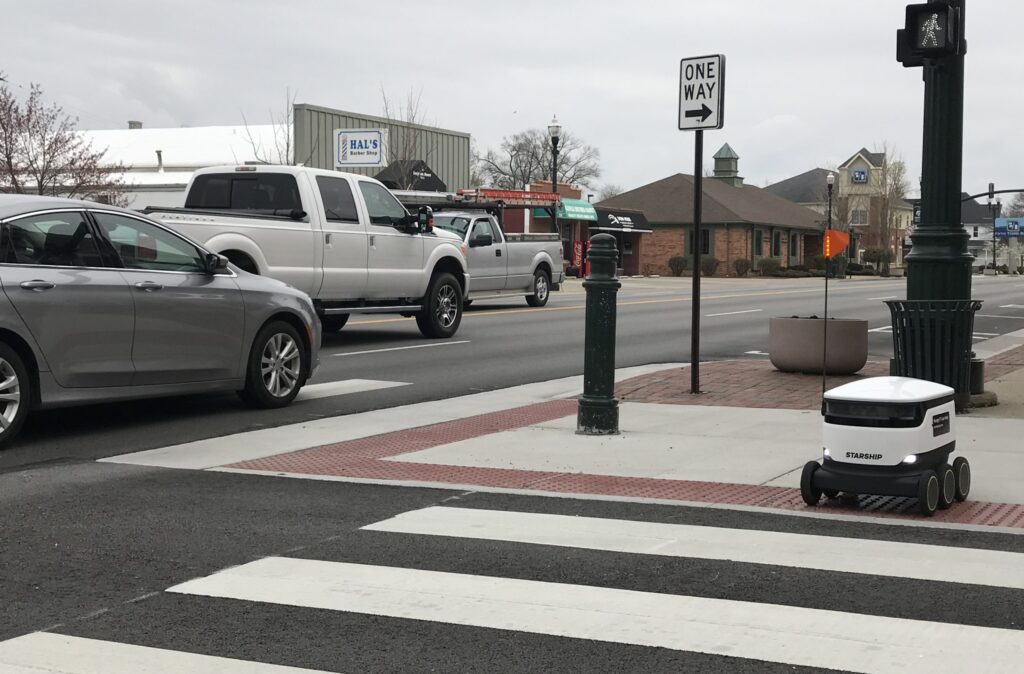
The white Starship robots became a point of interest for visitors and townspeople, who watched curiously as the robots navigated across busy streets, encountering curbs and pedestrians.
The robots can go faster, but were limited to about 4 mph on campus and city sidewalks. As the robots traveled through the community, they gathered information to help better navigate the routes.
The data gathered on routes was then shared with the rest of the Starship fleet at night as they recharged.
The robots were autonomous 90% of the time. If a robot got stuck while enroute, it would power down and contact a remote human controller to help it navigate the situation.
The robots were programmed to “talk,” using basic statements. Each was equipped with GPS and about 20 sensors, and could sound a very loud unpleasant alarm if tampered with.
After charting exploratory operations on U.S. university campuses, Starship Technologies is shifting its focus to retail grocery chains and hot food delivery in cities across the U.S. and Europe. Those operations have already taken a foothold in some areas like Finland, where roughly one in five grocery deliveries is reportedly now completed by a Starship robot.
