
By JULIE CARLE
BG Independent News
The Wood Soil and Water Conservation District and the Natural Resources Conservation Service are looking ahead to determine the most pressing conservation issues in Wood County.
Melanie Knapp, district administrator for Wood Soil and Water Conservation District, and Andrea Morehouse, district conservationist with Natural Resources Conservation Service, hosted a recent work group meeting to hear concerns first-hand from local stakeholders on land uses, water quality and accessibility to conservation programs.
They are also asking Wood County residents to participate via an online survey at this link. The survey is open through the district’s Ag Venture on Sept. 12.
Input from local citizens will help the district identify local priorities and guide upcoming programs and initiatives, and help determine conservation priorities for NRCS funding and implementation of U.S. Department of Agriculture’s conservation programs.
“We want to do projects that are important to the people who live here,” Knapp said. “People who live here, people who work here, these are your waterways.”
The local projects are meant to impact local waterways and watersheds, such as the Portage River and its tributaries, that are often secondary to the Maumee River as an Area of Concern (AOC).
Instead of the Wood SWCD determining projects independently and finding out it’s a waste of resources because “nobody really wants that,” Knapp wants local input to ensure resources are put toward projects the local communities want. “I would rather be effective and a good steward of those resources and do projects that are important to the people who live here,” she said.
Among the local land use, waterways and watershed issues discussed during the work group meeting were water quality and municipal discharge, conservation program access and effectiveness, pollinator habitat establishment, and education and outreach challenges.
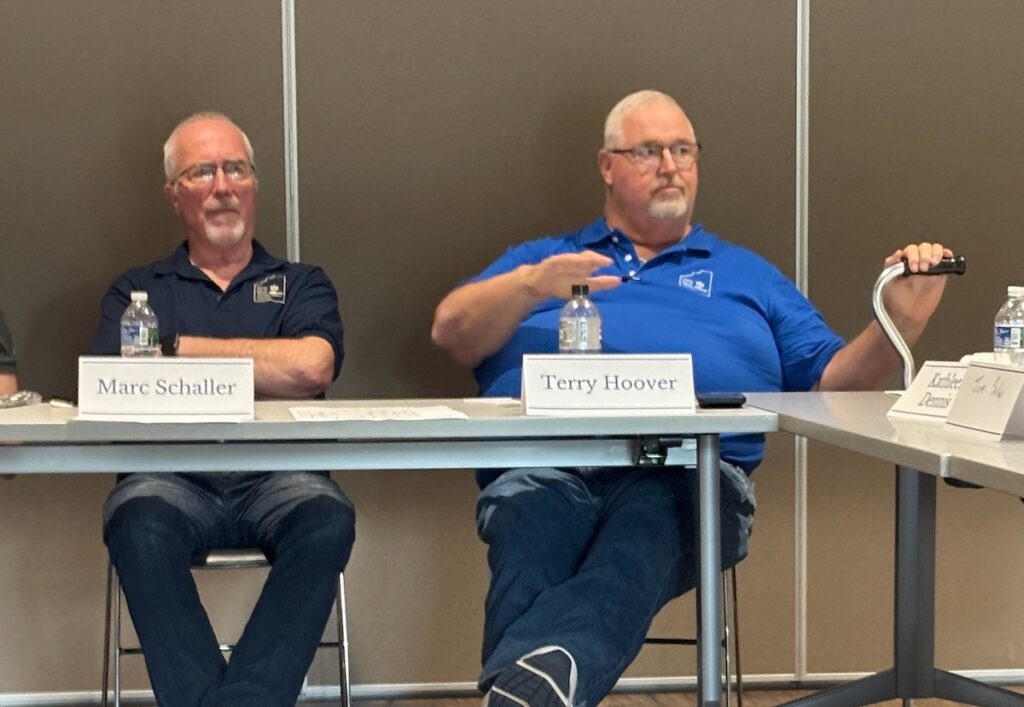
The agricultural community gets blamed for water quality issues more than it deserves, said Wood SWCD board member Marc Schaller. When large rain events occur, he questioned how cities and municipalities’ treatment plants handle the excess water.
He reported seeing minimal documentation from a local community’s treatment plant that required “nothing more than to document when you (opened a line) did it, how long it lasted, and when you turned it off,” he said. “I don’t know what the answer is; I just know I don’t like to see farmers continue to get blamed for the issues in the lake.”
Home lawn care and landscaping services are another area of concern, Lee Sundermeier pointed out. Having recently moved to the city from a rural area, he said, “More nitrogen goes on an acre of the yard than on agricultural land. I did not realize the amount of fertilizer that goes down the storm drains” after applications.
“That’s a battle because you’re now battling people who like a really green yard and they don’t care what you say,” Morehouse said. “Education is an uphill battle because there’s no regulation.”
Board member Logan Riker-Chamberlain pointed out that residential property comprises 7% of the Maumee watershed while agriculture makes up 80%. “So agriculture is going to have to play a big role because it’s such a big land use out there. The per-acre (nitrogen application) on residential land is ridiculous, but it’s such a small percentage of the watershed that it’s not going to fix the problem for us,” she said.
Kathleen Dennis, a member of BG City Council and BG Saving Our Neighborhoods Group (BG SONG), suggested “It’s perfectly acceptable to start talking to organizations that can help get this message out.”
There are organizations that are already focused on these types of issues. She plans to talk to city administration staff who are involved in sustainability. “They can start incorporating messages into what they feed out to the community,’ she said. “And BG SONG can start compiling information that can be handed out at different events.”
The group has a fall event planned, called “Leave the Leaves,” to help educate people about using leaves as nutrient resources for their lawns. “We as community members could help support fresh water initiatives by getting people to understand how impactful it (fertilizer application) is on our water quality.”
Insufficient stormwater delivery systems are another major issue for water quality, said Wood SWCD board member Kris Swartz.
“We have bigger storms all the time, and whether you are in the cities or the rural areas, the systems are undersized. They are overwhelmed, and because of that we have flooding, which relates to more water quality issues, more pollution,” he said. “Until we address those infrastructure needs, the water just keeps backing up.”
The issue is one that isn’t easily solved by the county because it is more of a regional issue. “Rivers and streams don’t stop at county lines,” Swartz said. “There needs to be a better way to make regional cooperation to get projects done across county lines.”
Despite many attempts to establish a native pollinator habitat on his property, Lee Sundermeier has had difficulty getting native plants to grow because of invasive species. Additional pollinator expertise in the county could be helpful for educational purposes and site-specific guidance.
The overall project, which includes seeking public feedback through the survey, is supported by a $20,430 grant from the Ohio Lake Erie Commission to the Wood Soil and Water Conservation District, Knapp said.
The grant report is due next April. Once priorities are determined based on the input received, the district will seek additional funding to support the priority projects, Knapp said.
“If there’s some water quality issue that is important to you and you don’t want to go through the hassle of the survey and you want to just tell me, I am more than happy to listen, even if it is with the ditch that runs past your house,” she said. She may be reached at the Wood Soil and Water Conservation Office at 419-354-5517 or melanieknapp@woodswcd.com.