By JULIE CARLE
BG Independent News
The Wood County Educational Service Center (ESC) is engaged in partnerships with Bowling Green State University, local schools and families in an effort to strengthen youth well-being and address challenges before they escalate.
WCES prevention education staff members highlighted the agency’s expanding prevention, student support and family engagement efforts during a presentation at the September meeting of the Wood County Alcohol, Drug Addiction and Mental Health Services (ADAMHS) Board.
“Our mission is to strengthen the wellbeing of youth, families and communities through proactive, data-informed prevention efforts that cultivate healthy environments, empower informed decision-making and promote sustainable growth,” said Alana Stanbery-Sigg, director of prevention services. The focus for the 2026-27 school year is to increase WCESC’s presence in schools and throughout the community to expand its impact.
The prevention team works with school districts, court systems, families and community organizations. The services are tailored to address local needs, using feedback from educators and administrators as well as information gathered through a youth survey administered every other year.
Stanbery-Sigg also discussed plans to update the survey’s language to make it more developmentally appropriate for different age groups.
The department is also working to strengthen professional development for prevention specialists, expand collaboration among prevention programs and pursue grants to support its work. A $7,000 grant awarded during the summer helped support coalition work and provided access to consultants who assisted with strengthening the coalition’s structure and bylaws, she said.
BGSU students to help deliver prevention education
One of the new partnerships connects the ESC’s prevention team with Bowling Green State University’s criminal justice program and Bowling Green City Schools.
Prevention specialists Aidan Boulton and Michelle Von Lehmden described a service-learning project involving BGSU students enrolled in a criminal justice course taught by Dr. Samantha Kopf-Apple.
The students will work alongside prevention specialists in Bowling Green elementary schools to help deliver education required under Ohio’s Erin’s Law, which addresses child sexual abuse prevention in grades kindergarten through sixth grade.
Rather than simply observing classroom instruction, the university students will gain hands-on experience preparing and presenting age-appropriate scenarios. Prevention specialists will guide the students as they develop activities that help children recognize safe and unsafe situations.
The project also introduces criminal justice students to prevention as a professional field, demonstrating how early education can help address problems before they lead to more serious consequences.
Diversion team focuses on attendance and family education
Diversion specialists Suzanne Eames and Amy Randall discussed efforts to help families address school attendance concerns and better understand attendance laws and school requirements. The team works with schools and parents to identify barriers that prevent students from attending school regularly and connect families with information and resources.
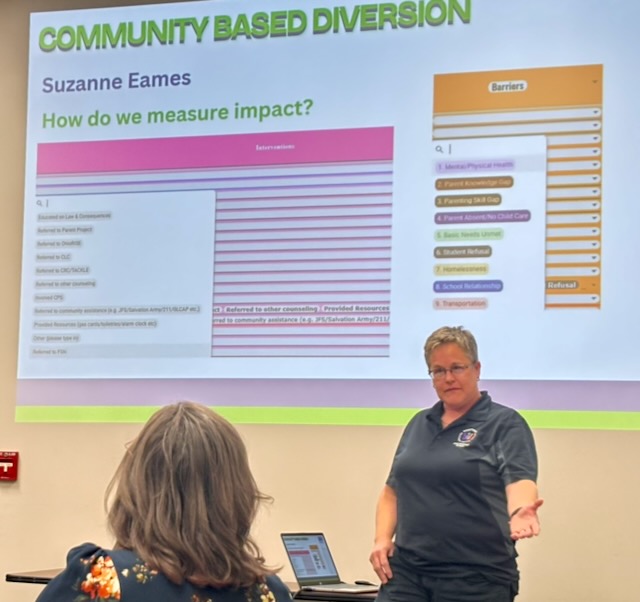
“We’ve been challenged by ADAMHS to measure our impact,” Eames said. “We’ve created categories for intervention, barriers and whether we’re able to remove those barriers.”
Randall indicated that many parents have no idea of the laws or consequences for truancy and chronic absenteeism. “With the new House Bill 96, parents don’t know how that’s changed the landscape.”
So far this year, diversion staff have provided 47 educations on the law and its consequences, Eames reported. Through pre- and post-meeting surveys, they are tracking whether parents are aware of their child’s grades and their attendance.
“We find often that parents have no idea how many hours their children missed at school,” she added. “We’re trying to get parents to actually look at that information and engage with it.”
Board members also discussed opportunities to expand general attendance education for parents. The ESC team noted that schools are sharing attendance information through newsletters and that additional approaches, including small-group programming and online resources, are being considered or offered.
Family programs connect parents and children with support
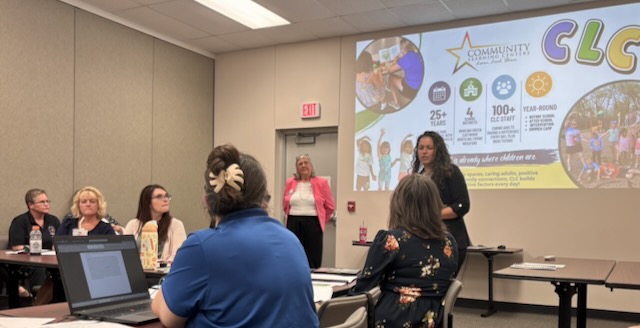
ESC’s Community Learning Centers (CLC) in partnership with prevention services are bringing additional resources to students and families through before- and after-school and summer programs in BG, Eastwood, North Baltimore and Rossford schools.
According to Kelly Duling, staff are helping with the Family Resilience Parenting Program’s 10-week sessions in the schools, “where parents are getting resources, support and tools to help navigate the crazy world of being a parent, because trust me, it is not easy.”
In addition to providing a safe place for students, helping with homework and supporting academic development, CLC is expanding its role in prevention education and family engagement.
The program provides a space “for parents to come together and have that support when they say, ‘Hey, I’m having this issue with my child getting to school on time,’ and other parents can say, ‘Yes, I have that same issue,’” she said.
Yeah, exactly. It is a challenge, but it provides a space for parents to come together and have that support when they say, “Hey, I’m having this issue with my child getting to school on time.” Other parents can say, “Yes, I have that same issue.” And then we are introducing the Character Strong program.
The center also plans to provide child care during parenting sessions, allowing children to participate in activities while their parents attend.
Children will take part in Character Strong activities focused on social-emotional learning, including feelings, emotions, respect, kindness and coping skills. The program is planned at each of the four CLC locations at least twice a month.
The centers are also expanding family nights, where parents and children can participate in hands-on activities, crafts and science, technology, engineering and mathematics projects. Planned additions include meals, prevention resources and opportunities for families to learn about the skills their children are developing.
The ESC team said these efforts build on CLC’s established relationships with families and schools, helping staff recognize challenges and connect parents with resources before concerns grow.
Community outreach continues to expand
Stanberry-Sigg also highlighted prevention messaging and community partnerships beyond school buildings.
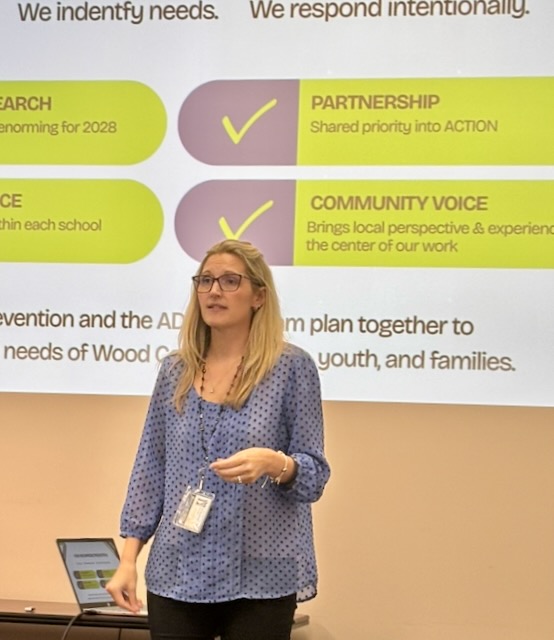
The ESC is distributing prevention messages through Cinemark and prescription bags in collaboration with Medibag. Staff are also participating in planning efforts for the return of Youth Olympics in partnership with the prosecutor’s office and working with BGSU on its Drive Sober or Get Pulled Over campaign.
Another initiative, Start With Hello, encourages inclusion and connection among students. At Penta Career Center, students wrote positive and encouraging messages on notes that were displayed for classmates to read and share.
Through expanded prevention education, attendance support, parenting resources and community outreach, the Wood County ESC aims to strengthen the connections that help young people succeed and address challenges early.