
By KATELYN ZIEMS
BG Independent News
The Great Depression was a time of financial uncertainty in the United States. Despite this constant pressure on the working class during the 1930s in America, people still found ways to find joy in everyday life.
Sports and media, such as baseball, boxing, and musical artists, allowed the everyday American to escape the harsh reality of the Great Depression.
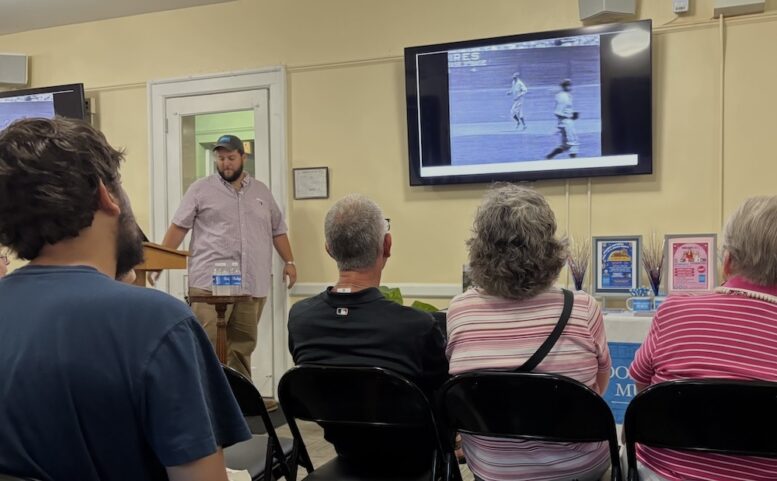
“A Ray of Hope: Sports and American Culture in the 1930s” was the Wood County Park District’s most recent topic in its America 250 lecture series. The lecture was hosted at the Wood County Museum on Sept. 2.
“We’ve been covering a lot of intense topics,” said Chase Fleece, historic farm coordinator for Carter Historic Farm and adjunct professor of history at Bowling Green State University. “So the next two, this one, sports and American culture, and then the next with food culture, were just kind of a little reprieve from some of the deep history.”
The lecture began by discussing sports and the impact of the Great Depression on some of America’s most beloved and popular athletics of the time, including baseball, boxing, football, and a special focus on the track star Jesse Owens.
With a focus and an in-depth discussion on baseball, Fleece offered highlights surrounding the first All-Star game in 1933, the first night game of baseball being played in 1935, and multiple All-Star players of the time, such as Babe Ruth, Lou Gehrig, and Joe DiMaggio.
The lecture switched gears to focus on boxing, where Fleece talked about formative matches such as the 1936 and 1938 Heavyweight Championships between Joe Louis and Max Schmeling became rallying points for American citizens facing international political turmoil prior to World War II.
Football was also mentioned, although the sport was not yet popularized in the United States to the level that it is today. The sports section of the lecture concluded with a detailed discussion about the track athlete Jesse Owens, and the significance of his participation and success in the 1936 Berlin Olympics.
The discussion then shifted from sports to culture in America as a whole, ending with a specific focus on music and movies of the time.
Examples of popular musical artists of the time included Woody Guthrie, the Carter Family, and Glenn Miller.
Attendees were treated to music from the time, including “This Land is Your Land” by Woody Guthrie and “In the Mood” by Glenn Miller. Popular and culturally influential movies from the era included “Gone With the Wind,” “Snow White and the Seven Dwarfs,” and “The Wizard of Oz.” The discussion ended with a reflection on how this media is still influential today.
“Ray of Hope: Sports and American Culture in the Great Depression” is just one of the many lectures of the Great Depression Lecture Series hosted by the Wood County Park District. As a part of their America 250 series, the lecture series was meant to highlight American history, as well as the importance of revisiting it.
“It’s really important, I think, to every once in a while deeply think about the country that you live in and its kind of trajectory, where it’s come from,” Fleece said about the importance of having these historical discussions. “History really is the study of the past to understand the present…and you can’t understand the present without understanding where you came from.”
There was a major turnout at the sports and culture lecture, with attendees Duff Madaras, Tek Madaras, Dennis Walston, and Harry Reynolds attending nearly every lecture in the Great Depression Lecture Series.
“I have been a teacher-coach, and I coached track for 47 years,” Duff Madaras said regarding his interest in attending the lecture. “So, when I saw it was going to be sports during the Depression, for me, this was the most popular one to come to. We’ve been to them all, and I really enjoyed the athletics.”
Tek Madaras added, “Each program is built on the next one, so I feel like we’ve been educated through the whole Depression.”
Fleece also commented on the importance of these historical discussions for the community.
“I think what I try to instill is that even the local, like Bowling Green and Wood County, is connected to a more statewide and national story,” he said. “If you tell the history of Wood County or Bowling Green specifically, you can tie that into a national story, that some of the things that happen here are affected, certainly, by what’s happening across the country, but also things that happen here affect the rest of the country. So basically, that’s why I’m pushing these things. We’ll talk about the national stuff, but we’ll also talk about the local stuff because it’s all the same story.”
The Wood County Park District’s Great Depression Lecture Series continues on Oct. 20, with the lecture, “A Chicken in Every Pot: Food and Culinary Culture in the Great Depression.”