
By JULIE CARLE
BG Independent News
In a busy elementary school library, lessons about the human heart are doing more than teaching science — they’re empowering children to save lives.
For the past 12 years, one veteran educator has led her school’s participation in the American Heart Association’s Kids’ Heart Challenge. Elmwood Elementary School Librarian Christina Farabee got the school involved to share the importance of good heart health.
As an aneurysm survivor herself, and whose mother suffered a heart attack, Farabee admitted that the work is deeply rooted in lived experience.
What started as the Jump Rope for Heart during February’s Heart Health Awareness Month, has expanded from jump-rope drills into a wide-ranging health initiative that now includes heart and brain health and stroke awareness.
The focus in those early days was simple: get kids moving and raise some funds for the organization.
Today, the curriculum is far broader.
Students rotate through physical education, music and library lessons that connect movement, heart rate and healthy habits. They learn hands-only CPR, the dangers of vaping and tobacco, and — increasingly — how the brain and heart work together, Farabee said.
“Their awareness has widened so much,” Farabee said. “Your heart will not pump unless your brain works.”
That evolution reflects a growing emphasis nationwide on teaching children to recognize stroke symptoms early — a shift that became personal for the longtime coordinator.
“It’s a huge thing and everyone needs to learn,” she said.
This year, that lesson got an unexpected boost — and a gigantic stack of comic books.
A little serendipity and a lot of generosity
The program took a dramatic turn over winter break, when Farabee was watching ESPN and saw NFL linebacker Bobby Wagner featured during the Walter Payton Man of the Year Award. Wagner, formerly of the Seattle Seahawks and now with the Washington Commanders, was nominated and ultimately won the award for the F.A.S.T.54 comic book about stroke awareness that he helped create after losing his mother to a stroke in 2009.
“Bobby lost his mother to a stroke. So he turned what he thought was negative into positive, teaching us the signs F.A.S.T.,” she said. She knew the lesson would resonate with the students if it was coming from a sports celebrity, like Bobby Wagner.
“I thought, oh my,” Farabee recalled. “If we could just get a few of those for the library…”
She emailed Wagner’s team through Virginia Mason Franciscan Health, a Seattle hospital that helped get the books published. Farabee requested four copies that could be kept in the library and checked out.
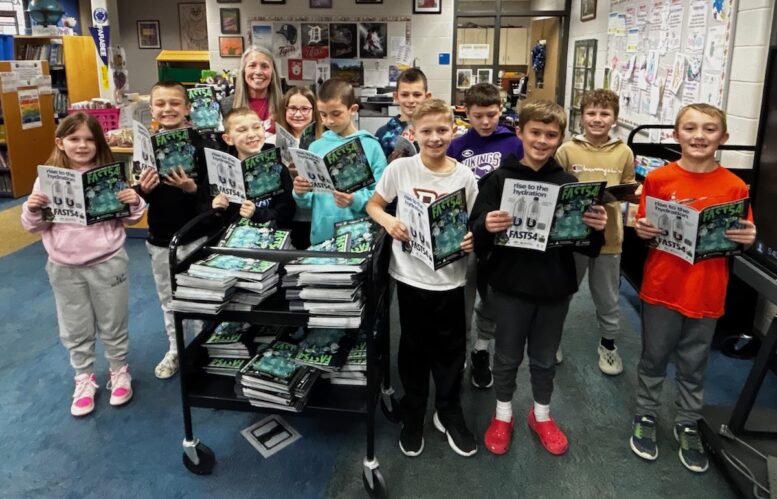
What arrived instead stunned her: first, a box of 50, which she decided they could host a raffle for those 50 books.
Shortly after, another shipment arrived, this time with more than 450 comic books – enough for every elementary student in K-4th grade.
“Talk about heart; they showed what it means to have a truly giving heart,” she said. “For someone to think of us from so many miles away — that’s huge kindness.”
Elementary Student Council steps up
Inside the classroom, the impact is already clear.
A group of 11 third- and fourth-graders, who are leaders in the elementary student council, eagerly recited the F.A.S.T. acronym taught in the comic:
- F — Face drooping
- A — Arm weakness
- S — Speech difficulty
- T — Time to call 911
Several admitted they had never heard of stroke symptoms before.
“I didn’t even know what a stroke is,” one student said.
Now, they speak about it with confidence — and urgency.
“It’s important to know how to see when somebody’s having a stroke,” another explained. “So nobody else dies.”
For many, learning through a football star’s story made the lesson stick.
“We get to learn about a pro NFL player and the good that he did by creating the comic book,” one student said with a grin.
More than a fundraiser
While the Kids’ Heart Challenge still raises money — more than 100 Elmwood students signed up this year and raised $3,200—for Farabee, education is first and foremost the reason she has led the charge for a dozen years.
Every child participates in the health lessons, whether they fundraise or not.
“A big and important part to me is awareness,” she said.
The school bested the modest $3,000 fundraising, but the real measure of success, she added, is what students carry home.
“If these kids are smart enough and listen — and 90% of them have phones already — they can dial nine-one-one,” she said. “The operator can talk them through it.”
Paying it forward
Farabee is already seeing the lessons ripple far beyond the classroom.
Students are encouraged to share their books with family members and talk about stroke warning signs at home. The goal is simple: build a generation that recognizes emergencies faster than the last.
“We just hope everyone learns a little bit and pays it forward,” she said.
After three decades in the district, she still sees the program’s power firsthand — especially when young voices confidently explain symptoms many adults miss.
And it all started, she noted, with one ordinary evening and a sports broadcast she almost didn’t watch.
“If I wasn’t watching,” she said, “we would’ve missed this all.”
