By JULIE CARLE
BG Independent News
Betsy Ross is one of the most recognizable names in American history. Generations of Americans have learned the familiar story of a Philadelphia seamstress who helped create the nation’s first flag, cutting a five-pointed star with a single snip of her scissors.
But historical research shows there may be much more to her story than the flag.
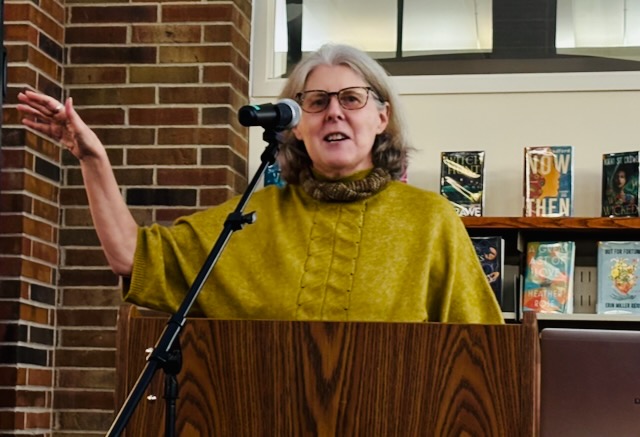
Historian Marla Miller, Distinguished Professor emerita at the University of Massachusetts Amherst, challenged audiences to look beyond the familiar legend during her presentation, “Betsy Ross and the Making of America,” which was part of the Threads of Democracy series, organized by the Bowling Green State University Department of History.
Rather than focusing solely on whether Ross made the first American flag, Miller explored the life of a skilled craftswoman, businesswoman and working mother whose contributions extended far beyond the iconic symbol.
“This is not a story of design. It is a story of production,” Miller explained, offering a different way to understand Ross’s place in the American Revolution.
Miller, a historian of women at work, has spent much of her career examining the contributions of women whose labor has often been overlooked in traditional accounts of early American history. Her research grew out of a recognition that scholarship about colonial-era craftsmanship tended to emphasize men’s trades, such as silversmithing and carpentry, while women’s work was frequently confined to discussions of domestic responsibilities.
Her first book, “The Needle’s Eye: Women in Work and the Age of Revolution,” sought to restore the history of women’s skilled labor and artistry.
When Miller began researching Ross in 2006, she encountered a similar gap. Although Ross was a familiar figure in American popular culture, she found little serious historical scholarship examining her life and work.
The challenge was partly archival. Ross, who lived from 1758 to 1836, was not famous during her lifetime. Few personal papers or business records survived, and even her obituary made no mention of the flag-making story that would eventually define her legacy.
Miller turned to family accounts, Quaker records and other historical documents to reconstruct Ross’s life. Particularly important was the testimony of Ross’s daughter, Clarissa, who in 1857 asked her nephew William Canby to record the family’s recollections of her mother’s involvement in making the flag.
But Miller’s research revealed a woman whose professional accomplishments deserve attention regardless of what happened in 1776.
Ross entered the upholstery trade as a young woman, learning her skills in the Philadelphia workshop of upholsterer John Webster. According to family testimony, she impressed Webster with the quality of her needlework, leading him to offer her an opportunity to learn the business.
It was a skilled trade that required much more than sewing.
Women working in upholstery shops produced mattresses, bed curtains, window treatments, chair coverings, decorative trimmings and other furnishings for wealthy households. Their work involved specialized techniques, knowledge of materials, an understanding of fashion and considerable physical labor.
Miller illustrated the complexity of the trade by describing everything from the construction of elaborate bed hangings to the production of tassels and the heavy stitching required to make mattress foundations.
These were not simply domestic tasks performed by women in their homes. They were specialized forms of craftsmanship that helped furnish some of the most prominent households of the period.
Ross continued working in the trade throughout her life, building a business that eventually involved multiple generations of her family. Her daughters also participated in the work, creating a lasting family enterprise.
The American Revolution brought new opportunities and challenges.
Ross’s first husband, John Ross, died in January 1776, leaving her to navigate the responsibilities of supporting herself. At the same time, Philadelphia was preparing for the possibility of British military action, and the emerging American military and naval forces needed flags.
Miller explained that flags in the 18th century were more than symbols. They served practical military purposes, communicating information and identifying ships and military units.
Women with experience in textile production and upholstery were well positioned to take on this work.
Ross’s former supervisor, Anne King, was among the women receiving flag-making contracts. Miller suggested that Ross, drawing on her training and experience, would have been well aware of the growing demand.
The familiar story of George Washington, George Ross and Robert Morris visiting Ross’s shop to discuss a flag design remains difficult to verify, Miller said. She acknowledged that some elements of the story are plausible, while others lack definitive documentation.
There is evidence that Washington knew the Ross family professionally. Miller discussed a discovery in Washington’s financial records documenting a furniture purchase from Mr. Ross, the upholsterer, in 1774.
Still, Miller cautioned against allowing the debate over the first flag to overshadow the more substantial evidence of Ross’s career.
Her work as a flag maker is documented, particularly in the years surrounding the War of 1812.
Working alongside her daughter Clarissa, Ross secured government contracts for military flags, including large garrison flags. In 1811, she received a contract for six flags measuring 18 by 24 feet for a military installation in New Orleans.
The scale of that work challenges the familiar image of Ross quietly stitching a flag in her parlor. These were enormous projects requiring space, materials, organization and considerable production capacity.
Her flags traveled well beyond Philadelphia, reaching military installations and communities throughout the expanding nation.
Miller also explored how Ross’s legacy developed after her death. Clarissa played an important role in preserving the family story, hoping her mother would receive recognition for her contributions to the Revolution.
The story gained wider attention as the nation approached its centennial in 1876. At a time when women were debating their political and civic roles, Ross became a figure who could be embraced by different sides of the women’s suffrage debate.
For some, she represented a woman whose work contributed to the nation’s founding. For others, her story reinforced traditional expectations of women’s roles.
That tension helped propel the flag-making legend into the national imagination.
Throughout the presentation, Miller encouraged the audience to consider how historical memory is formed, what evidence survives and whose contributions are remembered.
Questions during the discussion touched on women’s property rights, the challenges of researching people who left few personal records, the meaning of public history and the difficulty of separating historical evidence from popular legend.
Miller described public history as an approach in which historians work collaboratively with the communities they serve, recognizing that audiences bring valuable knowledge and perspectives to historical interpretation.
Threads of Democracy events continue through the spring.
Heritage Holiday: Saturday, Dec. 12, 1-4 p.m., Carter Historic Farm, 18331 Carter Road, Bowling Green.Celebrate an old-fashioned holiday with wagon rides, warm beverages, cookie decorating, crafts, classic games, carols in the schoolhouse, traditional decorations and one-room schoolhouse activities.
Textiles and Memory Book Talk: Tuesday, Jan. 26, 4-5 p.m., Wood County Committee on Aging, 140 S. Grove St., presented by Michelle Sweetser, head librarian and university archivist for the BGSU Center for Archival Collections, and an avid quillter. She will lead a discussion of themes from Miller’s book, featuring personal quilts and other collections of textile-related memories, relating to broader themes of women in textile work in early America.
Black History Month Book Talk: Tuesday, Feb. 9, 4:30-6 p.m., Wood County District Public Library, 251 N. Main St. Dr. Kelly Barnes, a scholar whose interests include 18th and 19th-century United States history, Black American girlhood, transatlantic material culture, interpretive planning, and exhibit design, will lead the second Book Talk discussing themes from “Betsy Ross and the Making of America.”
Women’s History Month Book Talk: Tuesday, March 30, 5-6:30 p.m., BGSU Jerome Library, Pallister Room. Dr. Andrea Freimuth will lead the third and final Threads of Democracy Book Talk. Freimuth, an assistant professor at Bluffton University, will present “Revolutionary Women and the Making of America —Memory, Mythology and the Historical Archive.” Her scholarly work centers on the interpretation of early American history in modern memory, particularly the gendered representations in popular culture.
Threads of Democracy Quilt-A-Thon: Thursday, April 8, 3-7 p.m., Wood County Committee on Aging, 140 S. Grove St, Bowling Green. In true community style, the assembling the Threads of Democracy Community Quilt will be assembled in true community style. This will consist of quilt squares submitted by the community sewn together to create many Community Quilts, bound together by the community itself. No sewing experience is necessary to participate – if you can cut fabric, use an iron, sew a straight stitch, or have extensive quilting experience, you are welcome to help. An RSVP link will be available soon for participants to register.
The National Endowment for the Arts provided a grant to support Threads to Democracy, an America 250 series celebrating the nation’s 250th anniversary.