
By JULES SHINKLE
BG Independent News
Bowling Green State University’s Department of Theatre and Film performs “Birthday Candles” by Noah Haidle the next two weekends, Oct. 15-18 and 22-24. Sara Lipinksi Chambers is directing the production.
Tickets can be purchased online here or at the Wolfe Center for the Arts.
The story revolves around the long life of Ernestine Ashworth (Story Moosa). Each year, she bakes her own birthday cake. It’s a tradition she inherited from her mother and is accompanied by a host of cherished rituals.
Against the turmoil of life’s tragedies, Ernestine clings to these dependable steps: preheat the oven, measure the flour, cream the butter and sugar, mix the batter, bake for 30 minutes.
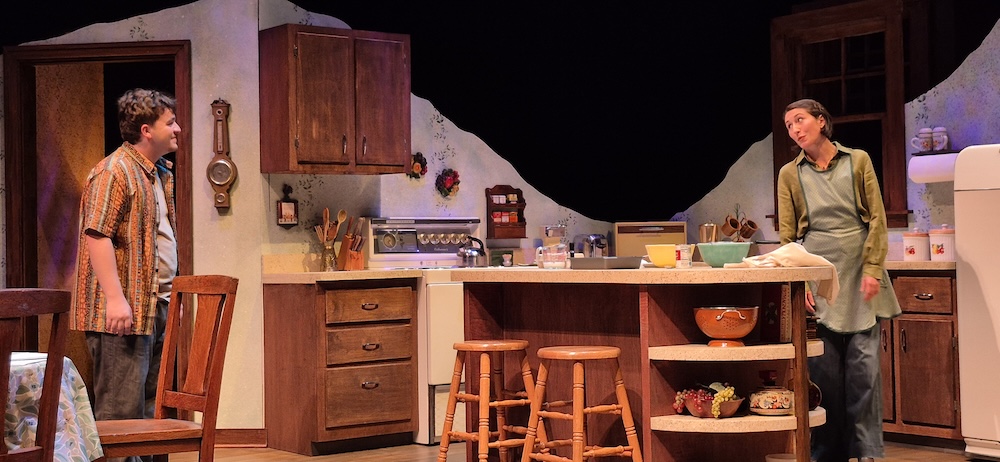
She’s also a natural thespian, doling out the same romantic monologue of the cake’s cosmic significance year after year. Her lifelong friend Kenneth (Ean McIntosh) shares a similar penchant for the dramatic.
Matt (Noah Wilson) is Ernestine’s prom date and eventual husband. Together they raise a family, Madeline (Gabrielle Dunn) and Billy (Andrew Canter).
Ernestine’s birthday brings them together some years and acts as a boiling point for simmering tempers on others.
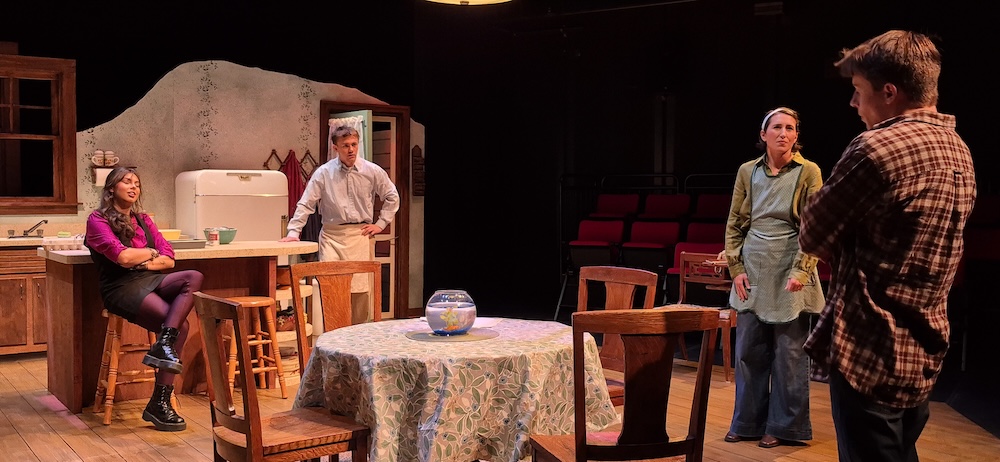
Gifts accumulate in her home like sediment, settling in with the cumulative weight of time. When something is thrown away, it’s always in an act wrought with pain. It drives home the point that Ernestine leans on things, not people, to provide stability.
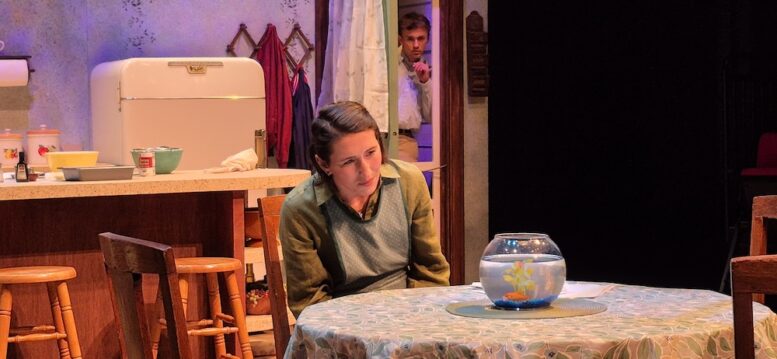
Her pet goldfish, Atman, is perhaps the only protagonist that’s truly immune to erosion. Atman’s memory of the world resets every three seconds, his body replaced a few times a year. By being so ephemeral, the goldfish achieves liberation from suffering.
Atman, Kenneth tells Ernestine, is Sanskrit for “the divinity within yourself.”
“Hell of a name for a goldfish,” she replies. “Go big, or go home.”
In the first scene, Ernestine is a teen basking in her mother’s love. A year passes, and her demeanor shifts immediately, subtly—she’s suffered a terrible loss, the sort that unceremoniously throws her to adulthood. Moosa communicates these shifts beautifully.
The characters relish these sort of thematic metaphors. Though Haidle’s script straddles the edge of highfalutin, never does it feel like a lecture. Whenever a teenager snaps at their parent, thinking they’re the first to use the line, “You’re a shadow in a suit posing as a human,” we’re reassured that the play is plenty self-aware.
Moosa, who remains on stage for the show’s entire duration, displays remarkable talent. She proves to be easily capable of this technical feat and much more. Ernestine is treated with great emotional delicacy, somehow massively theatrical and reserved at the same time.
Also worth applauding is the gorgeous set designed by Kelly Mangan. The kitchen and living room are warm, lived-in spaces. It’s no wonder Ernestine holds onto these rooms so dearly. The three windowpanes echoing out above the kitchen sink are a great touch.
While watching “Birthday Candles,” a distressing question starts to sink in: are we forced to play with the cards we’re dealt? It’s ultimately unclear how much Ernestine and her loved ones actually change throughout the play. People depart, re-enter, bestow gifts, leave wounds. So much time passes, but so much remains the same. Are we capable of reinvention, or just tweaking our recipe?
“Birthday Candles” is the kind of drama that chews on philosophical questions with its mouth open. Go big or go home.