

By JAN McLAUGHLIN
BG Independent News
As Bowling Green’s natural resources manager, Cinda Stutzman has a front row seat to the pesky tick population in the region.
Like much of the country, Ohio is seeing more of the pests popping up.
“We are encountering them more frequently,” Stutzman said from her office surrounded by Wintergarden Woods.
But ticks aren’t relegated to woodlands. City officials have received concerns from parents finding ticks on their young soccer players, and pet owners report plucking the pests from their dogs.
“It’s in our neighborhoods, too – not just our parks,” Stutzman said. “It’s just a matter of being aware.”
Stutzman said she first detected the black-legged tick at Wintergarden Woods in 2022. At that point, the parks and recreation department increased its tick education outreach efforts.
“I’ve been watching the population distribution maps of this species for 20 years. It was a matter of time until they spread here from both the north and the east. Awareness is key,” she said.
Spraying areas to get rid of ticks is not financially or ecologically realistic, according to Stutzman. The best way to avoid problems with ticks is to take steps to prevent them from accessing skin. And if that fails, the next best action is to remove them as quickly as possible from skin.
Tickborne diseases can spread to people or pets through the bite of an infected tick. To feed, a tick will wait on a blade of grass or a leaf until a person or animal brushes by. The tick will climb on and make its way to the skin where it can feed. If not removed, a tick may feed for several days. While it feeds, the tick will get larger as it fills up with blood. The longer the tick is attached, the greater the chance it will pass on any disease germs it may have.
“We all need to make sure we are more vigilant,” Stutzman said.
Stutzman recommends some steps to prevent ticks from burrowing in skin. First, she usually wears light colored clothing so ticks can be easily spotted. She also tucks her pants into her socks, so the ticks can’t sneak under her pants.
She recommends that visitors to the parks stay on trails. And they may want to consider spraying their clothing with items such as lemon-eucalyptus, cedar or DEET.
“Every day I come to work where there are ticks. Obviously, I have a high tolerance level,” dealing with ticks, Stutzman said. She is not surprised to find them, nor squeamish about removing them.
“We do a quick tick check,” as soon as a tick is spotted on a park employee or volunteer, she said.
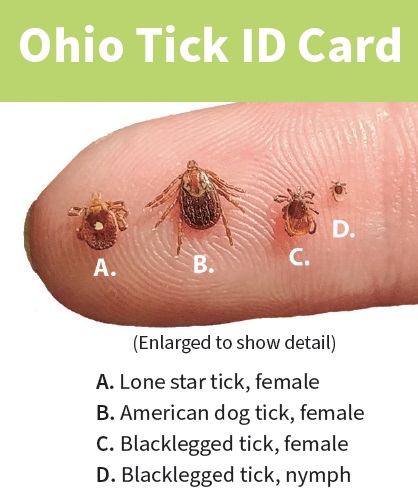
Spotting ticks can be difficult, since some like the black-legged ticks – most likely to carry Lyme disease – are the size of a sesame seed.
Anytime Stutzman’s workday involves going off trails in Wintergarden Woods and St. John’s Nature Preserve, she follows the same routine when she gets home. Her clothes go directly into the washer, and she goes straight into the shower.
The best way to remove a tick from skin is using tweezers to grasp the tick as close to the skin surface as possible. Stutzman cautioned against using “grandpa’s” or other “folk” remedies like a lit match, which can make the tick just dig deeper into the skin.
The majority of ticks seen by Stutzman this year have been American dog ticks and blacklegged ticks. She has seen one lone star tick, the type known to cause cases of red meat allergies in humans.
Though Stutzman wants Bowling Green residents and park visitors to be aware of ticks, she also wants people to get outside.
“We don’t want people to be scared to come to the parks and enjoy the great outdoors,” she said.
Following is information from the Ohio Department of Health on ticks. Pamphlets are available at city parks and on the parks and rec webpage.
Diseases spread by ticks are an increasing concern in Ohio and are being reported to the Ohio Department of Health more frequently in the past decade, with Lyme disease and Rocky Mountain spotted fever (RMSF) being the most common. Other tickborne diseases such as anaplasmosis, babesiosis, and ehrlichiosis are also on the rise. Though rare, diseases such as tularemia, southern tick-associated rash illness (STARI), and Powassan virus may also be carried by Ohio ticks. In addition, tick bites can also cause conditions like alpha-gal syndrome, which causes a red meat allergy.
The best way to prevent tickborne diseases is to prevent tick bites. In Ohio, tickborne illnesses are most often transmitted between early spring and late fall since ticks are most active during warm months. Take action to decrease your risk of infection: protect against tick bites, check for ticks, remove ticks as soon as you can, and watch for symptoms.
Avoid areas where ticks live
- Avoid wooded and brushy areas with high grass and leaf litter.
- Walk in the center of trails.
- Take extra precautions in spring, summer and fall when ticks are most active.
Use tick repellents
- Use insect repellents registered by the U.S. Environmental Protection Agency (EPA) labeled for use against ticks on exposed skin for protection that lasts several hours. Always follow the product label. Parents should apply this product to their children, avoiding their hands, eyes and mouth.
- Treat clothing and gear, such as boots, pants, socks and tents with products containing 0.5% permethrin. It remains protective through several washings. Always follow the product label. Pre-treated clothing is available and may provide longer lasting protection.
Cover up to keep ticks off your body
- Wear long pants, long sleeves and long socks.
- Tuck pant legs into socks or boots and tuck shirts into pants to keep ticks on the outside of your clothing.
- Light-colored clothing will help you spot ticks more easily.
Don’t let ticks hitchhike inside on your clothing
- Remove ticks from your clothes before going indoors.
- Examine gear and pets. Ticks can ride into the home on clothing and pets, then attach to a person later, so carefully examine pets, coats and day packs.
- Tumble dry clothes in a dryer on high heat for 10 minutes to kill ticks on dry clothing after you come indoors. If the clothes are damp, additional time may be needed. If the clothes require washing first, hot water is recommended.
Check your whole body for ticks
- Bathe or shower as soon as possible after coming indoors (preferably within two hours) to more easily find and wash off any ticks that may be crawling on you.
- Conduct a full-body tick check using a hand-held or full-length mirror to view all parts of your body upon return from tick-infested areas. Parents should check their children for ticks under the arms, in and around the ears, inside the belly button, behind the knees, between the legs, around the waist, and especially in their hair.
Use a removal method that is proven to work
- The best way to remove a tick is to use fine-tipped tweezers to grasp the tick as close to the skin’s surface as possible.
- Pull away from your skin with steady, even pressure.
- Don’t twist or jerk the tick; this can cause the mouth-parts to break off and remain in the skin. If this happens, remove the mouth-parts with tweezers. If you are unable to remove the mouth-parts easily with clean tweezers, leave it alone and let the skin heal.
- Dispose of a live tick by putting it in alcohol, placing it in a sealed bag/container, wrapping it tightly in tape, or flushing it down the toilet. Never crush a tick with your fingers.
- Wash your hands and the bite area with soap and water.
- Do not use petroleum jelly, a hot match, nail polish, or any other “folk” remedies to remove a tick. These methods do not work.
Watch for symptoms
The most common symptoms of tick-related illnesses are:
- Fever/chills: With all tickborne diseases, patients can experience fever at varying degrees and time of onset.
- Aches and pains: Tickborne disease symptoms include headache, fatigue and muscle aches. With Lyme disease, you may also experience joint pain. The severity and time of onset of these symptoms can depend on the disease and the patient’s personal tolerance level.
- Rash: Lyme disease, southern tick-associated rash illness (STARI), Rocky Mountain spotted fever (RMSF), ehrlichiosis, and tularemia can result in distinctive rashes.
Tickborne diseases can result in mild symptoms treatable at home to severe infections requiring hospitalization. Although easily treated with antibiotics, these diseases can be difficult for physicians to diagnose. However, early recognition and treatment of the infection decreases the risk of serious complications.
Most tick diseases in Ohio are caused by these common ticks:
- Blacklegged tick (lxodes scapularis) – The blacklegged tick, also known as the “deer tick,” may transmit the bacteria that cause anaplasmosis and Lyme disease, as well as the parasite that causes babesiosis. The risk of exposure to this tick is greater in wooded or brushy areas and along the edge area between lawns and woods.
- Lone star tick (Amblyomma americanum) – The lone star tick may also transmit the bacteria that cause ehrlichiosis. It may also transmit other diseases. This tick is most common in shady areas along roads and in meadows and woods.
- American dog tick (Dermacentor variabilis) – The American dog tick may transmit the bacteria that cause Rocky Mountain spotted fever. It is often found in overgrown lots and along weedy roadsides, paths, and hiking trails.
Create a tick-safe zone around home
You can make your yard less attractive to ticks. Here are some simple landscaping techniques that can help reduce ticks:
- Clear tall grasses and brush around homes and at the edge of lawns.
- Place a 3-foot wide barrier of wood chips or gravel between lawns and wooded areas and around patios and play equipment. This will restrict tick migration into recreational areas.
- Mow the lawn regularly and keep leaves raked.
- Stack wood neatly and in a dry area (discourages rodents that ticks feed on).
- Keep playground equipment, decks, and patios away from yard edges and trees and place them in a sunny location, if possible.
- Remove any old furniture, mattresses, or trash from the yard that may give ticks a place to hide.
Preventing ticks on pets
Pets can also be affected by tick bites and tickborne diseases. To reduce the chances that a tick will transmit disease to your pets:
- Check your pets for ticks daily, especially after they spend time outdoors.
- If you find a tick on your pet, remove it right away.
- Talk to your veterinarian about tick prevention products for your pet. Cats are extremely sensitive to a variety of chemicals. Do not apply any insecticides or repellents to your cats without first consulting your veterinarian.
- Reduce tick habitat in your yard.