By DAVID DUPONT
BG Independent News
In 1958, a call went out for jazz musicians to assemble for a photoshoot on the steps of a brownstone at 17 East 126th Street in Harlem.
Fifty-seven answered the call on time. Several showed up late. Fancy that.
The photographer Dick Kane was on assignment for Esquire magazine. The result after wrangling with the gregarious crew of jazz celebrities as well as a gaggle of mischievous neighborhood kids who photo bombed the shoot before that was even a thing.
The result was undisputedly the greatest jazz photograph ever, and one of the great American photos.
The photo does not capture the entirety of the jazz who’s who — Louis Armstrong, Miles Davis, John Coltrane, Duke Ellington, Ella Fitzgerald, and Benny Goodman were on the road, not surprisingly. But Dizzy Gillespie, Count Basie Lester Young, Thelonious Monk, Coleman Hawkins and four dozen plus more luminaries did show up.
“A Great Day in Harlem” captured what would prove to be dusk of the Golden Age of Jazz. Jazz had enough popular culture cache to be prominently featured in a large circulation magazine. It was a time when figures from the music’s five decade history were still performing.
These musicians despite representing three generations still shared enough musical vocabulary to jam together.
Free jazz is still down the block and fusion in another borough.
When on Monday (May 25, 2026), Sonny Rollins, 95, died in his home in Woodstock, New York, he was the last musician from the “Great Day” photo still standing. Saxophonist and composer Benny Golson died in 2024. Now they’re all gone.
Rollins was the last of an era when jazz musicians had the status of legends. These were more than musicians honing their craft. They were mythic. The demigods in the unfolding of an American art form deeply rooted in the work songs their enslaved ancestors sang or the gospel tunes that gave them hope. By 1959, that music had asserted its place in the storied concert halls of the world.
Rollins fed that mythic stature. Like so many of his generation, he came from modest means — his parents were from the West Indies. He grew up surrounded by others who would shape the sound of America, most notably Thelonious Monk.
And like so many of his contemporaries, he was a victim of the plague of heroin addiction that claimed many of his peers who might otherwise have taken a place on those steps in Harlem.
It sent him first to Rikers Island, and later to the Federal Medical Center in Lexington, Kentucky, where he kicked his habit.
His career took shape despite these interruptions. In 1954 between Rikers and Lexington, he played a session with Miles Davis and brought along three three tunes, “Oleo,” “Airegin,”and “Doxy,” all still staples of the jazz repertoire.
Rollins established himself as a leading voice on tenor saxophone rivaling Coltrane. That was a loving rivalry between two men devoted to pushing their art beyond the limits.
Like Rollins, Coltrane collaborated with Miles Davis and Thelonious Monk.
Rollins’ stay in the federal facility fore-shadowed his later self-imposed breaks from performing.
The most famous sabbatical taken not long after “Great Day” was photographed.
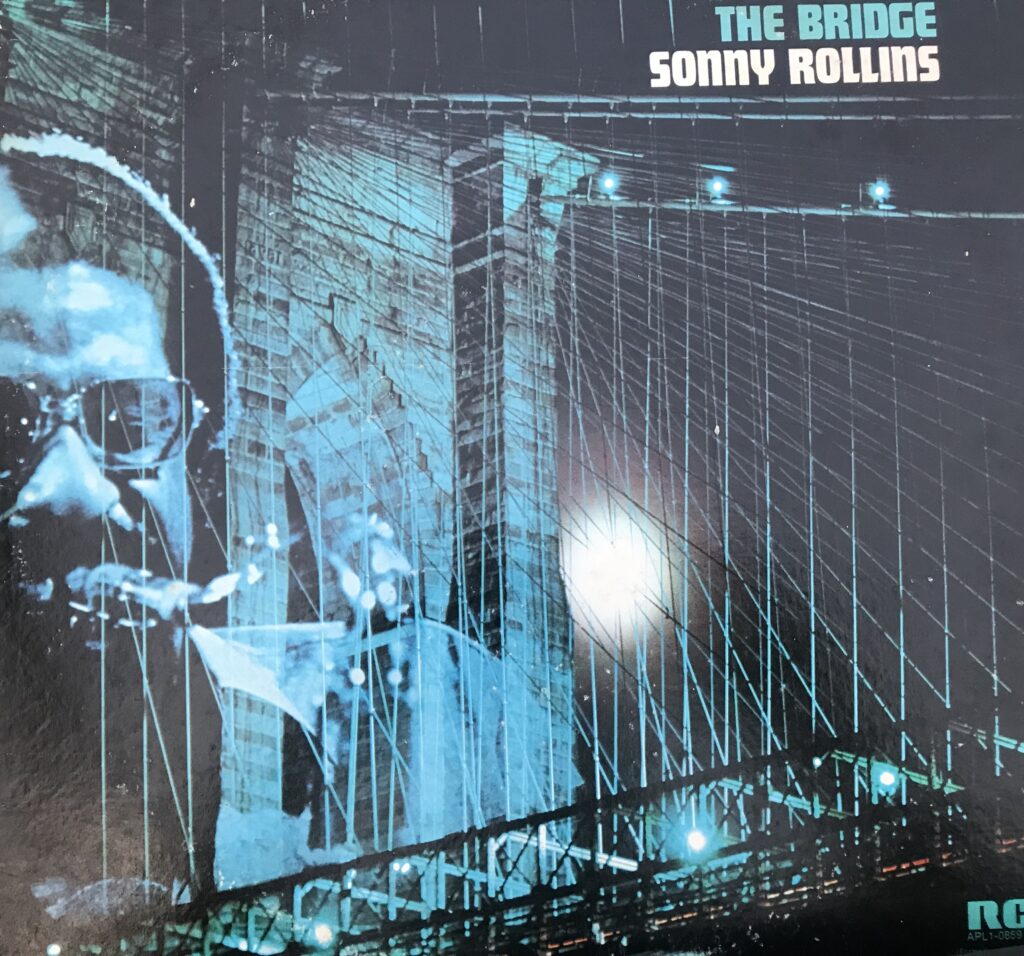
Frustrated with his music, he took more than two years off to practice — or “woodshed.” But not wanting to disturb a neighbor who was pregnant he took his horn to woodshed on the Williamsburg Bridge.
The first album released on his return was titled “The Bridge.”
His albums in the 1950s into the 1960s are classics. The most famous Saxophone Colossus” recorded in included “Blue Seven.” That blues spurred composer Gunther Schuller to write an essay minutely analyzing how Rollins uses a simple eight-note phrase to build his solo. The essay itself is a classic. The album opens with “St. Thomas,” the first and most famous of his calypso-inspired songs.
Rollins, though, was best experienced live. More so even than other jazz artists. That’s where my memories are.
I first saw him at Middlebury College in fall, 1979 (as best I remember). Certainly I’d listened to plenty of Rollins’ records, including “The Next Album,” released in 1972 after another sabbatical. This break including travels to India was devoted to spiritual development. That album includes a personal favorite “The Everywhere Calypso,” which displays the same melodic continuity as “Blue Seven,” in a more energetic and playful manner.
What I heard coming from the Middlebury chapel stage stunned me. Fronting a quartet — Mark Soskin, piano , Jerome Harris, electric bass, and Al Foster, drum set, Rollins erupted with a volcanic sound, the melodic-rhythmic lava spilling from deep within Rollins’ psyche.
I was so moved that back home in East Barre, Vermont, I wrote my first ever piece on jazz. I wasn’t on assignment, and had nowhere to publish it. Still I wrote it trying to put into words what I had experienced.
Almost a half century later, that manuscript resides mouldering in a box upstairs in another second floor office space now in Kennebunk, Maine. It proved to be the progenitor of maybe a million words written about jazz and other arts, written for a dozen or so local and international publications, spanning the time of print through digital. The desire to own the rights to that work helped spawned the creation of BG Independent News.
(Rollins himself late in his career seized his destiny and started his own label to release his music, principally recordings of live performances.)
That first piece did turn out to be useful. A few weeks after I wrote it, I saw a notice in the alternative paper, The Vermont Vanguard, looking for a correspondent to cover poetry readings. I didn’t have much work to show, but I sent the Rollins story to the editor. He liked it better than what the paper had published. I now had the jazz beat as well as poetry. (That this put me at odds with my then employer, a free advertising weekly, is a story for another day. Let’s just say this also marked the start of a pattern of clashes with management.)
I saw Rollins three more times. Once in the early 1980s at UMass. My strongest memory from that show is Rollins’ rolling unaccompanied cadenza which suddenly burst into an extended quote of “Tomorrow” from the musical “Annie.” That encapsulated elements of his style — a penchant for flying alone, his tendency to employ musical quotations, and his love of schmaltzy show tunes.
I saw him twice more, both times in Ann Arbor. I wrote about the last in 2005 show for the website One Final Note.
I concluded with this observation: ”Arriving home my wife asked how it was. And for once I could tell her precisely. ‘If I had never seen Sonny Rollins before, I would have been glad to hear this show and be satisfied that I had heard him. But I’m sure glad we got to see him 20 years ago.’”
That he had entered the closing phase of his career was already evident, though it wasn’t until 2014 when respiratory problems forced him into retiring something few of his colleagues ever do.
As I contemplated writing this I realized this could be the last I write about jazz. Though I’ve seen some awesome shows here in Maine — Kahil El’Zabar and Chucho Valdes — and do have a Substack account, I’ve not felt the surge of inspirational voltage I felt back there in Vermont. Until now. Maybe my jazz writing career will be bookended by Sonny Rollins. Maybe this will get the juices flowing again.
When Sonny Rollins is in play you never know what will happen.