
By JULIE CARLE
BG Independent News
The Children’s Resource Center provides a vital and comprehensive continuum of behavioral health services for youth in Wood County, but significant systemic barriers have hampered some of the agency’s ability to deliver services.
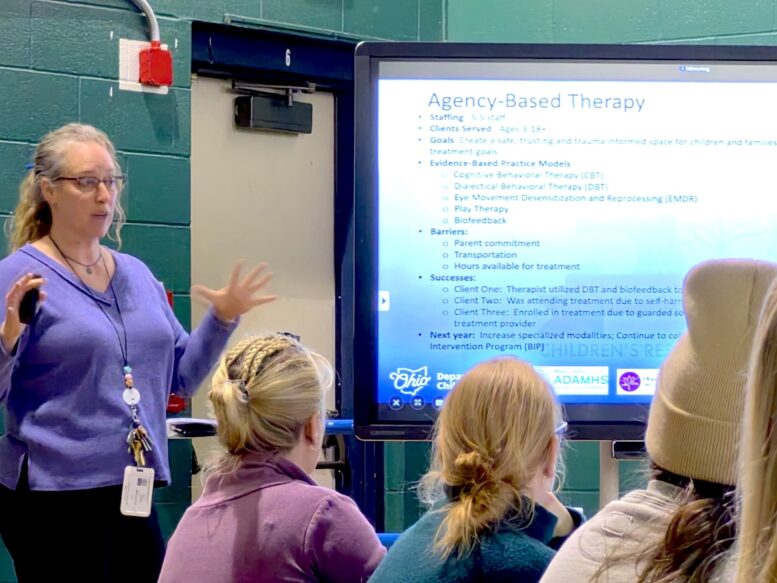
CRC staff shared program outcomes, successes, barriers and future plans during the February Wood County Alcohol, Drug Addiction and Mental Health Services board meeting.
Among the obstacles is a state-mandated reduction of local mobile crisis services.
In fall 2025, the Ohio Department of Mental Health and Addiction Services mandated that local mobile response services could only be provided from 8 a.m. to 8 p.m. Monday through Friday. The change aligned with the state department’s plan for state-level centralization of crisis services. The shift in state policy toward regional crisis services directly impacted local funding and the structure of mobile response teams.
The directive impacted CRC’s ability to provide those around-the-clock emergency services to children in their homes or communities.
“One of our barriers is that the state currently is not willing to fund 8 p.m. to 8 a.m. or all the weekend,” said Carmen Uresti, CRC director of emergency services that includes the crisis team and the mobile response and stabilization services (MRSS).
The mobile response and stabilization services are designed “to go out to the crisis,” she explained. “We can go into school systems and homes and help stabilize these crises through MRSS. Our goal is to be at the crisis in 60 minutes.”
The 60-minute service goal is needed because Wood County’s service area, at 617 square miles, is huge. The types of crises that crop up are extremely varied.
Other barriers are workforce burnout and the high cost and long wait times for ambulance transport; however, aside from some of the barriers, Uresti said they have had many successes in the services they provide.
“One of our greatest successes is the safety planning we do with every client,” she said. “We work with families and walk through to ensure the spaces are safe.”
In addition to the crisis team and MRSS providing safety plans during crisis assessments, other options include placement in CRC’s residential unit or hospitalization. “We don’t hospitalize a lot but those are the three outcomes of a crisis assessment,” Uresti said.
Among the wins: clients have learned how to use coping skills, and escalations and truancy have decreased.
A new clinician has been hired to work Monday through Friday to help provide crisis assessment, crisis planning or de-escalation with families.
“Our hope is that we’ll get funding next year to increase emergency services, 24/7/365,” she said. They also hope to increase program recognition and increase the number of MRSS stabilizations provided.
Program outcomes, successes, barriers and future plans also were addressed in CRC’s prevention, outpatient, residential and early childhood mental health services.
Outpatient services include agency- and school-based services, case management, day treatment and co-occurring disorders, reported Mindy Bahnsen, director of outpatient services.
“Our job, especially with kids, is to open the doors, make therapy or any kind of services a positive experience,” she said. By making the experience positive when they are children allows them to seek help in the future rather than forcing them to address trauma before they are ready.
One of the recurring challenges across multiple outpatient programs is the lack of parental involvement. “Many parents don’t get engaged in their child’s therapy,” Bahnsen said. “Parents often say, ‘I’m going to drop off my kid, and I’m going to sit in the car and then bring my kid out to me when you’re done.’ That is one of our barriers.”
School-based services are in high demand, but often the time constraints of a school day make it difficult to address deep-seated trauma, she said.
The day treatment program provides an immediate, in-the-moment environment to teach social and emotional regulation skills. The co-occurring disorders program struggles with referrals, as many teens using substances did not have external motivators, such as probation, to seek treatment.
Melanie VanDyne, chief executive officer of CRC, discussed the expansion of short-term crisis, residential treatment with the addition of the state-grant funded, regionally based facility that is adjacent to CRC.
The new building will house an expanded short-term residential unit and a new behavioral health urgent care, significantly increasing the agency’s crisis response capabilities. The 14,300-square-foot facility will include 16 beds and a 24/7 nursing staff. The average length of stay is estimated to be 30-60 days.
Once the regional residential facility is completed, CRC will renovate its current residential space.
Lindsey Saloiye, director of residential services, CRC’s existing residential unit is open 24 hours a day, seven days a week for youth who are in crisis of if there is a need for respite services, said Lindsey Saloiye, director of residential services.
“Kids come in to us through crisis or through a respite stay,” she said. “They’ll be with us until they’re stable or until respite is scheduled. We work on coping skills, being able to make sure that medication is being taken appropriately.”
She reported about the successful, smooth transition of four siblings who were removed from their home by Jobs and Family Services and successfully placed in CRC’s care.
The renovated residential space at CRC is expected by the end of July, VanDyne said.
Rachel Theis, director of prevention services, said they provide services to a large number of children and caregivers across 18 counties. They provide consultation and training, and also face challenges with less grant funding.
During the past quarter, infant and early childhood mental health services reported helping 118 children and 183 caregivers, and provided consultations to 23 classrooms that included 320 children and 46 caregivers. Programmatic consultations reached 1,948 children and 253 caregivers served.
In Wood County, 20 parents, 25 children and 6 professionals received primary care prevention services, and 25 trainings were provided for 601 participants.
The challenges CRC and other behavioral health agencies are facing are presented to the board before upcoming funding and strategic decisions are made.
In other business, the board approved a resolution that requires a 120-day notice of contract terminations or substantial changes in the contract terms for contract agencies.