By JULIE CARLE
BG Independent News
Melissa Owens became fascinated with historical fashion while she was isolated during the COVID pandemic. The Wood County Park District’s Vintage Valentine’s Beauty program was the perfect opportunity to expand her knowledge about fashion history.
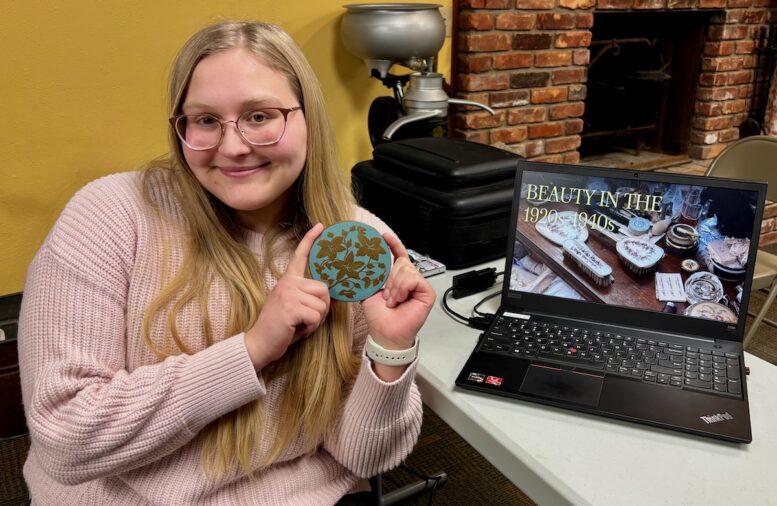
Gabby Mancini, historic interpretive assistant at Carter Historic Farm, shared makeup and beauty trends from the 1920s to the 1940s. At the heart of her talk was the idea of incorporating some nostalgia into beauty routines for Valentine’s Day or any day.
Many of the trends, brands and products that once sat on every women’s vanity, still influence the industry today.
Makeup use shifted dramatically after the Victorian era, where it had been discreetly used, and largely reserved for royalty, the wealthy, and prostitutes, Mancini said.
“That isn’t to say that everyday woman did not wear makeup. They did, but it was done so very discreetly,” she said. They used minimal blush and powder, “just to enhance the natural beauty and discreetly cover up any imperfections.”
However, by the 1920s, use of makeup became more mainstream for everyday women.
Coming from the end of World War I, life was changing for women. The passage of the 19th Amendment, which said no citizen could be denied the right to vote on account of sex, and the fact that many women had gone to work during the first world war, gave women the chance “to kind of look at themselves,” Mancini said.
Bolder styles emerged after World War I, spurred by new social freedoms for women.
“They had a taste of that sort of freedom and got to rethink gender roles, rethink what their role was and how they could express themselves politically and, in their personality,” she said. “A big part of that was through their looks.”
Makeup became a little bolder with a touch of rouge on their cheeks to provide some color, but still maintaining a natural look.
As the movie industry started to take off in the late 1920 s with the early silent films and later the “talking pictures,” the public became infatuated with the movie stars and their looks.
Actresses such as Clara Bow, Jean Harlow and Greta Garbo wore makeup that enhanced their looks. Clara Bow’s beauty routine included a sad-eye look and extremely thin, tweezed eyebrows.
“All these girls were like, ‘Hey, I want to look like Jean Harlow,’” she said. “And then they released them to the public and they could.”
One of the early cosmetic companies was Max Factor. Founded in 1909 by Maksymilian Faktorowicz, the company became a pivotal force in the cosmetics industry. Before he started making products for the public, Faktorowicz created makeup for stage and film, replacing the traditional grease paint with pancake makeup.
Early products required unique application methods. Early mascara, cake mascara, was called “mascaro.” It had to be activated with water or spit and brushed on eyelashes.
Beauty advice during this period was highly prescriptive. Guides, such as Virgina Vincent’s 1937 book “Makeup,” were created to help woman match the looks of the stars. The advice was based on face shapes and a color harmony theory that dictated specific eyeshadow, rouge and lipstick colors based on a woman’s hair color from Titian redheads to brownettes and brunettes.
Max Factor institutionalized this color theory through his “color harmony rooms.” The rooms were designed to determine the most flattering hair color for actresses based on their skin tone.
Mancini’s talk gave the small but attentive audience a deeper appreciation for the social and historical significance of makeup. She said that cosmetics were linked to women’s liberation, technological change and even World War II propaganda, when Hitler banned women to wear cosmetics when attending Nazi meetings. Women in the U.S. did not prescribe to the drastic sentiment. Instead, the industry framed the use of makeup as a patriotic duty, Mancini said. Lipstick shades like Victory Red were marketed to boost morale and project an image of American strength and courage.
Some vintage makeup products and shades have been recreated by modern brands like Bésame Cosmetics, while others, like Revlon’s “Fire and Ice” lipstick, have been continuously available since the 1950s.
Because bold lipstick symbolized romance, rebellion and power over the decades, a red lip never goes out of style. In fact, romance may evolve, but red lipstick remains Valentine’s Day’s unofficial uniform.