By JAN McLAUGHLIN
BG Independent News
Bowling Green citizens and city leaders have identified ways the community can go more green.
Those plans include the creation of a downtown recycling and composting program, increase in renewable energy generation, identification of resiliency centers for the public during emergencies, and promotion of green infrastructure throughout the community.
The goals for 2026 were narrowed down last week during a meeting of Bowling Green City Council’s Sustainability Committee, made up of chairperson Bill Herald, Kathleen Dennis and Mark Hollenbach.
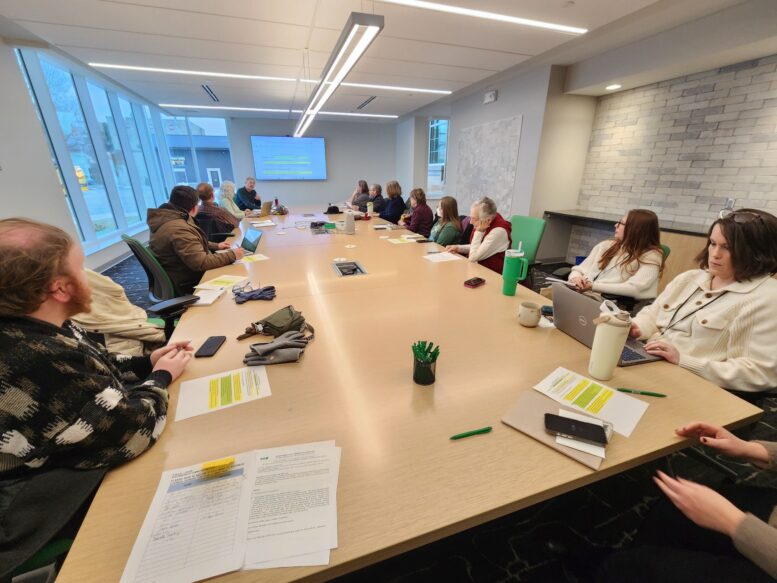
To encourage more public input and back-and-forth discussion, Herald organized the meeting as a work session – with council members, city officials and community members all gathered around a large table in the room next to council chambers.
Together, they discussed goals in the city’s 300-page sustainability plan that should be tackled first, and which priorities are already being worked on by other city departments.
The top priorities set by the committee are:
- Prioritize and fund CARIP (Climate Action and Resilience Improvement Plan) commitments and projects each year as part of the annual budget process; consider appropriating a certain amount to serve as matching funds to access federal or state funding.
- Create a downtown pilot recycling/composting program.
- Increase energy efficiency and renewable energy generation.
- Identify resiliency centers in the city and ways to communicate that information to residents.
- Promote green infrastructure, including a list of more specific recommendations.
And the endorsed goals that are the list of other council committees, with the sustainability committee wanting to “keep an eye on” included:
- Increased emphasis on streets, sidewalks, and drainage.
- Contract for an engineering/design study on Poe Road from Mercer to Mitchell to add a combination of protected on-street bicycle lanes and/or shared use paths and to evaluate other infrastructure to improve pedestrian and bicycle safety.
- Prioritize the completion of ongoing improvements at the water treatment plant, including plans to increase reservoir capacity.
- Restart efforts to establish an interconnection agreement with nearby communities to provide water in an emergency.
- Backup and hardened power supply.
- Subdivision regulation update to incorporate green infrastructure.
Following are some of the discussion topics on each of the priorities selected by the sustainability committee.
Downtown recycling and composting program
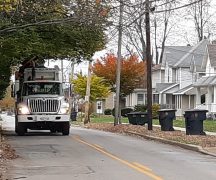
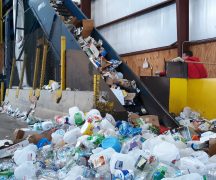
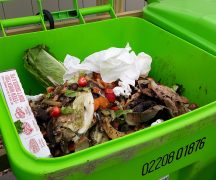
City leaders have discussed a downtown pilot recycling and food waste composting program in the past – but such a project requires buy-in from the businesses and an investment by the businesses and the city.
Citizen Rose Drain mentioned one business owner who has expressed an interest in trying a pilot program, however, there is no space behind some of the businesses for additional dumpsters. Drain suggested that perhaps the city could dedicate a parking space in each city parking lot for dumpsters for recyclables or food waste.
Amanda Gamby, director of communications for Bowling Green, said the composting program would be simple, with the city’s food waste contractor being open to more customers. However, involving downtown stores in recycling would be an additional expense for the businesses.
“They will have to pay more for doing what is right,” Gamby said.
Council member Kathleen Dennis asked if there might be a way for the city to assist with those expenses.
Gamby said there may be state recycling grants that would help pay for the bins.
Citizen Jim Evans suggested that residents could support the cause by making voluntary “green” contributions on their city bill payments.
Emergency planning for resiliency centers
Evans talked about the three ways Bowling Green residents could benefit from public buildings being dedicated as resiliency centers during extreme heat or cold, or extended power outages.
Some sites could offer people a place to spend daytime hours, others could provide locations for food and water distribution, and others could offer overnight lodging, Evans said.
Evans presented a spreadsheet of public buildings that could be used for such purposes, and stressed the need for public education about where people can turn for help.
“People need to know,” and not wait until the last minute, he said. “You can’t wait for the disaster to happen.”
Dennis noted that several emergency preparedness plans and mutual aid agreements for Wood County and Bowling Green are already in place, through the Wood County Emergency Management Agency and the Wood County Health Department.
Council President Mark Hollenbaugh, Dennis and Evans agreed that the city needs to identify the plans in place and communicate the options to citizens.
Green infrastructure
The sustainability committee agreed that promoting green infrastructure should be a priority. That would include features like rain gardens, bioswales and trees, according to Dennis.
Builders should be putting trees in areas of new development, and permeable materials should be used for alleyways, she added.
DeMare suggested green infrastructure should be extended beyond just residential areas.
More energy efficiency
The committee endorsed the need for more generation of renewable energy in the city. Citizen Joe DeMare pushed community and homeowner solar. He said the rooftop solar fees adopted by the BG Board of Public Utilities can be overridden by City Council. He told the council members that he had drafted an ordinance that stressed council’s ultimate authority on the matter.
Overlapping goals
While the sustainability committee endorsed items like walkability, less use of vehicles, more sidewalks, and better drainage management, Gamby and Hollenbaugh pointed out that those goals are being worked on by other city departments. So the sustainability group noted that it would keep an eye on those efforts.
After the meeting, Herald said he felt that the working session type of meeting allowed for more interaction and dialogue.
“Personally, I think there are two accomplishments. First, of course, is the list of goals; which is a result of good dialogue and excellent input from council, the administration, and residents,” he said.
“Second, I’m really pleased with the success of the more interactive, working-session nature of the meeting,” Herald said. “This roll-up-our-sleeves-and-work-together approach increased resident input resulting, in my opinion, in a better sense of community and better informed decisions. In a time where individuals can feel disconnected from government, this was an example of genuine responsiveness.”