By JAN McLAUGHLIN
BG Independent News
Wood County election officials are hoping for a routine election next Tuesday – but are preparing for the myriad of problems being predicted across the nation.
“Given the current environment, there are very few things we haven’t discussed,” said Terry Burton, who shares director duties with Julie Baumgardner at the Wood County Board of Elections.
This is the first time that the election officials have felt the need to caution local poll workers about possible interference from other governmental agencies, Burton said.
“We don’t anticipate this will be an issue in Wood County,” he said.
But local poll workers have been advised this year about the possibility of unauthorized “observers” showing up at the polls. There are detailed rules for who can observe and how they must conduct themselves. (The rules are listed at the end of this story.)
Voting officials know ahead of election day who is authorized to observe at polling places. If someone shows up to observe who isn’t on the list, poll workers have been advised to call the Wood County Board of Elections, which will notify the Wood County Prosecutor’s Office.
“We have no doubts on election day that we will address it quickly and promptly,” Burton said.
“I really don’t think voters need to worry,” he said.
But Burton knows that the potential for possible interference in the elections has already caused concerns. “There is damage due to the fear,” he said.
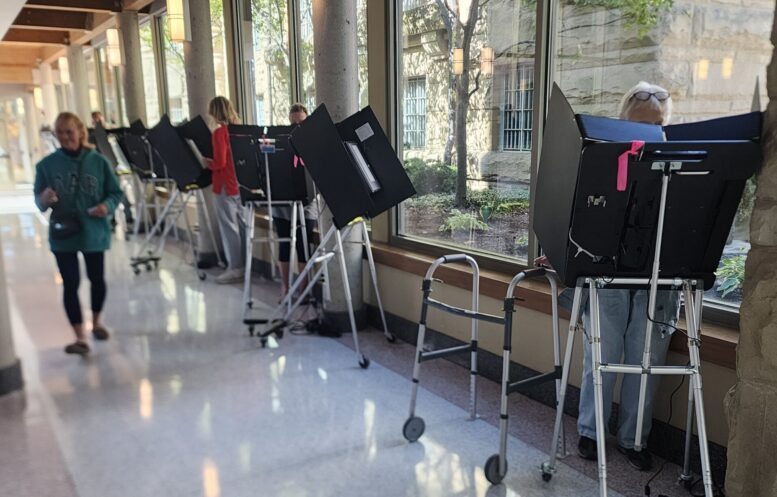
Election observers have registered for early voting in Wood County, but as of Monday none had appeared at the courthouse complex, where early voting is taking place.
“I’m not anticipating a huge observer turnout in Wood County,” and if they follow the rules, most voters won’t even notice them, Burton said.
“If they qualify under the rules, observers aren’t a bad thing,” Burton said. But if they interfere, the Board of Elections won’t hesitate to have them removed, he said.
When the polls close on Nov. 3, concerns may remain for possible federal election interference. In the event of close voting results – which may well happen in Ohio – the state could be in the spotlight as Florida was in the Bush-Gore ballot recount in 2000.
“Then it becomes much more contentious, much more litigious,” Burton said. “I don’t know that this year will be worse than others. But that’s the unnerving part of the process.”
Following are the rules for election observers in Ohio.
Qualifications for election observers
All observers must be qualified Ohio voters. They don’t need to be registered in the county where they observe.
People not eligible to observe
• Peace officers in uniform
• State highway patrol troopers in uniform
• Firefighters in uniform
• Armed services or militia members in uniform
• Anyone wearing any other uniform
• Anyone carrying a weapon
• Candidates (unless they’re on a party controlling committee, or appointed to observe an Official Canvass, recount, or election audit)
• Election “monitors” (organizations may call people “monitors,” but Ohio law only recognizes official observers)
Pay
Observers cannot accept pay from any county, city, village or township for serving as an observer.
Oath
Every observer is required by law to take this oath prior to observing: “You do solemnly swear that you will faithfully and impartially discharge the duties as an official observer, assigned by law; that you will not cause any delay to persons offering to vote; and/or that you will not disclose or communicate to any person how any elector has voted at such election.”
On Election Day, a precinct election official must give this oath. For other types of observers, an election official, director, or deputy director may administer the oath. When observing over multiple days, observers don’t need to retake the oath but should affirm to an election official that they understand they remain under oath.
Watching and inspecting
Observers may only watch election proceedings. They may never handle any election materials.
Observers may move freely where ballots are being cast, processed, counted, or recounted, as long as they don’t engage in prohibited activities. The board may deny observers access to areas where ballots are not being handled.
Communication with election officials
Observers may not interfere with election officials running the election. They may have casual conversations with officials during slow times to gather information about the process, but their statutory purpose is to watch. Observers may not enforce laws or advocate for voters. They may leave the voting area to contact the board of elections with concerns, which the board may address when appropriate.
Observers at a precinct are permitted to “watch every proceeding of the precinct election officials from the time of the opening until the closing of the polls.” Observers are also permitted to “inspect the counting of all ballots in the polling location or board of elections from the time of the closing of the polls until the counting is completed and the final returns are certified and signed.”
However, observers shall not be permitted to witness the examination and opening of identification envelopes returned by, and the processing and counting of absent voter’s ballots cast by, electors who have confidential voter registration records in a manner that would permit the observers to learn the identities or residence addresses of those electors.
Audio and video devices
Observers cannot use any electronic or audio/visual recording devices in ways that disrupt the election, intimidate voters, or violate ballot secrecy or voter privacy. They cannot use phones, walkie-talkies, or other communication devices to discuss the election inside a polling place. As long as they aren’t harassing, they may collect information from the posted registration lists.
Observers may use communication devices and audio/video devices if:
• The devices make no noise (low vibration is allowed).
• They only send and receive text messages, emails, or other nonverbal communications.
• They don’t take photos, videos, or record conversations inside.
• They don’t talk inside the polling place using the device.
• They don’t create disruptions.
• They don’t use devices to interfere with an election or intimidate voters.
Prohibitions
Observers must not:
• Campaign in any way.
• Block voters from reaching or leaving the polling place.
• Disrupt the election.
• Intimidate, harass, or try to influence voters or precinct election officials.
• Carry weapons.
• Violate ballot secrecy or voter privacy.
Observers cannot enforce laws or advocate for voters before precinct election officials.
Removal
While the board must allow observers throughout the election process, it can remove observers who violate Ohio law or Secretary of State directives or who interfere with the election.
Only the voting location managers, directors, deputy directors, and appointing authorities can order the removal of observers. Law enforcement officials must remove observers when ordered by these officials.
If an observer is removed, the voting location manager, director, deputy director, or appointing authority may take their certificate of appointment and return it to the board office with a note about the removal.
Who may appoint observers
These “appointing authorities” may appoint observers at primary, special, or general elections:
• Any political party (county or state) supporting candidates on the ballot.
• Any group of five or more candidates.
• Ballot issue committee recognized by the board as supporting or opposing a ballot issue.
Types of observers
Ohio law provides for six types of election observers. A person may observe at multiple locations during the election process.
• Observers at early in-person absentee voting locations.
• Observers at precincts on Election Day. Precinct observers may be present from one-half hour before polls open until precinct election officials finish processing ballots, complete other post-closing tasks, and return the ballots and other supplies to the board.
• Observers at a board office before the official canvass. An appointing authority may appoint one observer to watch provisional ballot casting at the board office, ballot counting on Election Day, and absentee/provisional ballot processing before canvassing.
• Recount observers.
• Post-election audit observers.
Congressional election observers
These observers gather information about elections, including for contested elections in Congress. States must give these observers full access to observe all federal election administration procedures, including areas where ballots are cast, processed, counted or certified.
Congressional election observers must not:
• Handle ballots or election equipment.
• Advocate for any position or candidate.
• Reduce ballot secrecy or voter privacy.
• Interfere with voters casting ballots.
• Interfere with election administrator duties.
• Otherwise disrupt election administration.
State or local election officials can remove a congressional election observer if they believe the observer has or will engage in:
• Intimidation or deceptive practices prohibited by federal law.
• Disruption of voting, processing, counting or certification.