By JAN McLAUGHLIN
BG Independent News
One citizen showed up to a public meeting 2½ years ago when the Wood County Commissioners heard a request for a tax abatement for a data center planned in Middleton Township.
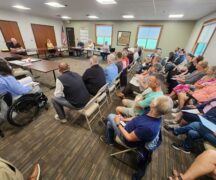
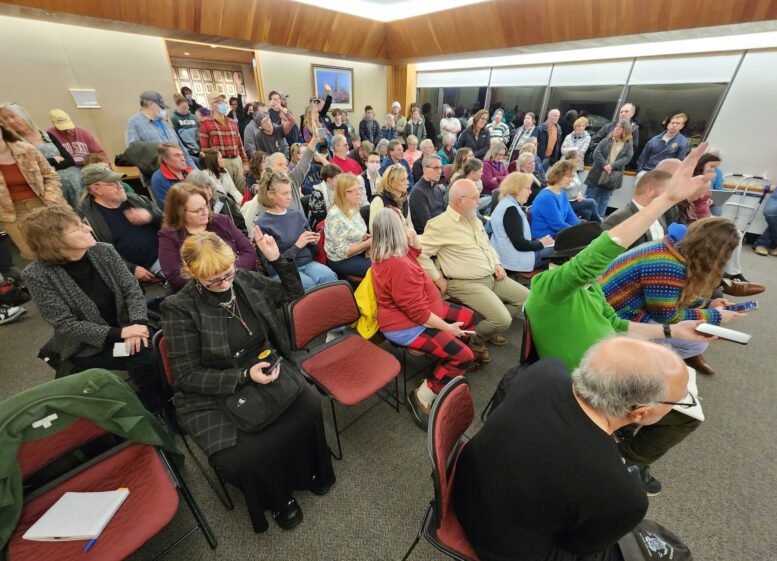
The same room was packed beyond capacity last month by citizens wanting someone to listen to their concerns about the Meta data center being constructed north of Bowling Green.
For more than 2½ hours, an estimated 150 residents questioned the Wood County Planning Commission about the lack of transparency they saw surrounding the data center. And they asked commission members to stop more data centers from possibly moving into their neighborhood.
“You guys are our firewall,” one resident said to the county planning commission.
But under current Ohio law, the county planning commission is a flimsy firewall – and has limited authority when it comes to zoning changes.
Some residents voiced their anger and desperation, while some planning commission members responded in a defensive and condescending manner.
This article will address the zoning change process in unincorporated areas of Ohio, the lack of controversy surrounding data centers when the Middleton Township proposal was being considered, the common use of non-disclosure agreements, the questionable need for the tax abatement, and the latest estimates by Meta of the site’s water and electric usage.
First – What’s the process?
While zoning change requests in cities and villages are decided by municipal bodies, the process in unincorporated areas (townships) goes through an extra step.
The requests are first filed with the township, which then sends them to the county planning commission. The planning commission listens to testimony and votes to recommend approval or rejection by the township.
The power rests with the township. The request next goes to the township zoning commission, which makes a recommendation to the township trustees – who rule in favor or against the change. In this case, the county planning commission recommended that the township approve the zoning change.
“I can understand people’s frustration,” Wood County Commissioner Craig LaHote, who serves on the county planning commission, said of the required process.
“To us it’s second nature,” Wood County Planning Director Dave Steiner said about the process as ordered through the Ohio Revised Code.
After the township trustees make a final decision on the zoning request, those opposing the change have 30 days to circulate a petition to put the issue up for a public vote in the next general election, Steiner said.
While every step of the process is public, very few people are aware of or pay attention to the public notices, and even fewer actually attend the public meetings.
At the January planning commission meeting, residents made a request that sounded reasonable – that a moratorium be placed on any new data centers in Wood County. But unlike some other states, Ohio law does not give counties the authority to issue moratoriums for a specific land use.
LaHote suggested that the citizens direct their concerns to their state legislators, and ask that changes be made in the Ohio Revised Code provisions for county planning commissions.
The county planning commission’s next meeting is March 3, at 5:30 p.m., in the county commissioners’ hearing room in the county office building in Bowling Green. As with the January meeting, the data center is not on the agenda. However, the planning commission will again listen to public comment on any topic related to zoning.
Steiner is hoping for a more respectful meeting with no angry exchanges like those in January.
Second – Changing views on data centers
When the news of an $800 million data center coming to Wood County was first announced, it was touted as an economic development coup. It was viewed as a potential source of great tax revenue for schools, the township and the county.
Even up until Meta officially announced that it was the company behind the plan, the news was positive. State, regional and local officials attended the public announcement hosted at Bowling Green State University.
LaHote acknowledged that had county officials known the potential downsides of a data center back then, they may have been able to make people aware.
“There’s certainly more information available now,” he said.
Wood County Economic Development Director Wade Gottschalk agreed the reception for data centers was far different when the Middleton Township site was under consideration.
“They were relatively sought after nationally,” he said.
“There was no ‘anti data center’ movement,” Gottschalk said. “That’s a movement that started recently. It wasn’t there in 2023 at all. There was nobody at those meetings.”
Gottschalk bristled at accusations that the data center plans were kept from the public.
He cited public meetings at four levels – the county commissioners, the planning commission, the township zoning commission and the township trustees.
“We were hardly being secretive,” Gottschalk said. “It wasn’t a controversial thing. There was no opposition to data centers anywhere.”
That has since changed. With data centers popping up across the nation, citizens are raising red flags about massive water consumption, electric usage, and possible environmental and health concerns.
Though Meta’s name was not revealed until summer of 2024, the plan for the site to be used as a data center was public for at least a year prior to that.
“What they were was never hidden,” said Rex Huffman, president of the Wood County Port Authority. “There were a lot of hearings along the way. I didn’t see how this was sneaking up on anybody.”
Third – Tax abatement
Wood County had what Meta was looking for – large open acreage, access to water from the Northwestern Water and Sewer District, close proximity to the existing First Energy substation nearby on Mercer Road, and fiber-optic lines traversing the area.
The cherry on the top was approved in September of 2023, when the data center was granted a tax abatement by the county commissioners.
As is customary with these types of large projects, the developer sought a Community Reinvestment Area agreement providing a 75% tax abatement for 15 years for the project. It was approved.
The school districts potentially impacted by the tax abatements had already approved agreements to get their share of the property taxes. Both Eastwood and Otsego school districts will likely get an estimated $900,000 a year from the project.
The only objection to the tax break came from Russ Fought, who said his home just to the west of the project will be greatly affected.
“I’m not against economic development,” he said at the county commissioners meeting. “I’m not against this project.”
Fought praised the work of county economic development officials for doing a great job. As a third generation bricklayer, he said he benefits from economic growth. “You’re doing a great job keeping the county in the black,” he said.
But this is different from previous projects, “because it wasn’t across from my house,” he said. And with property owners facing stiff increases from the recent land revaluations, this was a bad time to be offering tax abatements to newcomers, Fought said.
“I’m against giving away so much – as taxpayers,” he said.
Fought said Wood County has what the developer is looking for – land, water, electricity – and there is no need to offer tax abatements as well.
“We have the assets that they need and they want,” he said.
Looking back, LaHote acknowledged that the project may not have hinged on the tax break being granted by the county commissioners.
It won’t be known until later this year how much property tax revenue the Meta site will ultimately bring into Wood County.
Fourth – Non-disclosure agreements
In January, citizens at the planning commission meeting stressed that more transparency in the process should be required. Many officials in the region only knew of the Meta plan as “Project Accordion” for more than a year before it was officially announced.
Neighbors of the data center expressed frustration that more information isn’t required before decisions are made.
When making zoning change decisions, the boards that review the requests usually don’t know the end users – or even the specific use planned for the property, Steiner said. Property should be zoned based on the range of uses allowed under a zoning classification, since the specific use may change, he added.
While many officials were in the dark about the details, others signed non-disclosure agreements with the developer.
LaHote said he has never been asked to sign an NDA, and other members of the planning commission also denied signing such an agreement.
A spokesperson for Meta said this week that most companies don’t want their competitors to know their plans, and they want to make sure a project is a certainty before putting their name on it.
“Most companies don’t want their name affiliated with a project that doesn’t happen,” Gottschalk said.
“The majority of them don’t pan out,” he explained.
Jerry Greiner, president of the Northwestern Water and Sewer District, said NDAs have become commonplace. He listed off projects in Wood County that have required NDAs, such as Amazon, the Home Depot distribution center, and several First Solar expansions.
“They are pretty common when we’re being approached as a utility supplier,” Greiner said.
Gottschalk agreed that the use of DNAs has become pretty standard.
“The vast majority of projects we’ve worked on in the last 25 years have had non-disclosure agreements. It’s part of economic development,” he said. “It may not be ideal.”
While NDAs are intended to keep people from tossing about specifics about a project, Gottschalk said their power is limited.
“We can’t sign away public records law,” Gottschalk said. “State public records laws still apply.”
Lastly – letter from Meta
In a letter dated Jan. 7, to the Middleton Township Trustees, the Meta Global Infrastructure Team offered some updates on the local project. This information came directly from Meta, and has not been corroborated.
Water use
The operational water use at the Middleton Township site is anticipated to be less than the approximate use of two full-service restaurants annually.
The minimal water consumption will be possible because the data center will use a closed-loop, liquid-cooled system with dry coolers. This cooling system requires no operational water. The data center water use will be limited to domestic needs, equipment cleaning, and fire protection.
Energy
Meta said it has worked closely with First Energy to meet energy needs and to make sure that consumers are not paying the project’s energy costs.
Through the partnership with First Energy, Meta will pay for millions of dollars in new energy infrastructure investments – network upgrades, utility substations, and transmission lines – that will directly benefit the data center and add resiliency to the electrical grid in the surrounding township. The company said it will share details regarding energy usage, greenhouse gas emissions, and other environmental metrics in its annual sustainability report.
Meta is also partnering with Williams, a pipeline and power plant developer that the company has worked with at other locations, to build and operate behind-the-meter onsite natural gas generation to support the site’s growing energy needs that will be completely funded by Meta.
Williams will have a separate air permit and is required to comply with all applicable federal, state and local air quality and permitting requirements for its equipment during construction and operations. Because the energy provided by Williams is behind-the-meter, it will not impact rates paid by utility customers.
Air quality
Meta complies with federal, state, and local air quality and permitting requirements including those that are designed to protect public health from hazardous air pollutants. These policies ensure that emissions of all facilities, including data centers, stay below levels protective of human health within an acceptable margin.
Meta runs its backup generators as minimally as possible – for maintenance and testing, and in rare emergency events when power is lost from the utility – and in compliance within its air permits.
Construction
In collaboration with JE Dunn, Meta said it is using inward-facing lights and is piloting motion sensor technology to further reduce unnecessary illumination. Nighttime lighting is maintained as needed to ensure the safety and security of the site and workers.
Jobs and economic development
The construction and operation of Meta data centers and network infrastructure drives economic and job growth at regional and national levels. The construction of this site will support more than 1,000 jobs for skilled trades people, including steel workers, pipefitters, electricians, and carpenters from Ohio companies including Rudolph Libbe, Vernon Nagel, Lake Erie Electric, Shook Construction, Valley Interiors, and Xtreme Elements.
Once up and running, the data center will support at least 100 operational jobs, including for electricians, HVAC specialists, server and network techs, safety and security experts, and engineers.
Community development
Meta provides grants to support projects led by local schools and non-profits in communities where we have data centers. Grants are available to local schools and eligible nonprofit organizations that address critical community needs in Wood County by supporting STEAM education, using technology for community benefit, and enabling strong, sustainable communities.