By JAN McLAUGHLIN
BG Independent News
The confirmed measles case in Bowling Green has local public health officials reaching out to those who may have come in contact with the person diagnosed with measles.
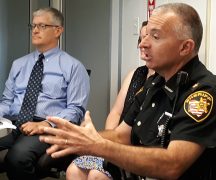
“Measles is highly contagious,” Wood County’s Acting Health Commissioner Rachel Aeschliman said Wednesday morning. Even after the carrier has left a location, “it can stay in a space for two hours after they have left.”
Little information is available on the age or vaccination status of the infected person other than the patient is an adult, who had a known exposure to measles while recently traveling on Amtrak, according to Aeschliman.
The person sought medical care and is now in self-isolation.
In an effort to make people in the community aware that they may have come in contact with the measles, the Wood County Health Department on Tuesday reported on the measles diagnosis, and on the multiple locations that people may have been exposed to the disease.
“We’re interviewing people to figure out where they had been,” Aeschliman said.
Anyone who was at the following locations during these times may have been exposed to measles:
• Bowling Green State University on Sept. 23, in the Overman and Physical Science Buildings, from 9 a.m. to 6:30 p.m.
• Pagliai’s restaurant on Sept. 23, between 5 to 9 p.m.
• Wood County Hospital Emergency Department on Sept. 24, between the times of 8:30 p.m. to 1:30 a.m. on Sept. 25.
• Wood County Hospital Emergency Department on Sept. 25, between the times of 6:30 a.m. to 2:15 p.m.
• Falcon Health Center on Sept. 28, between the times of 10 a.m. to 2 p.m.
The health department is asking that anyone present at these locations during these times to fill out the Measles Close Contact Investigation Form that can be found at woodcountyhealth.org or on the Wood County Health Department social media page.
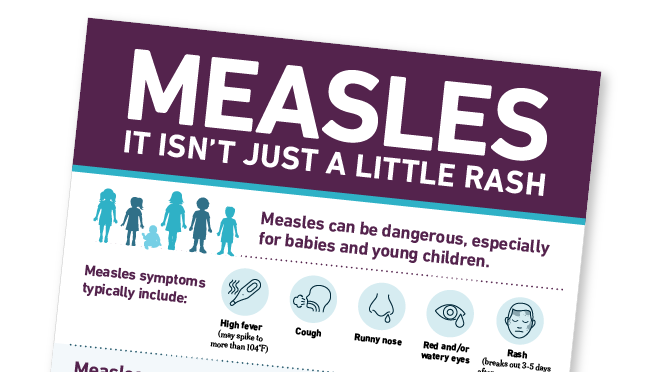
Measles is an acute, highly contagious viral disease. Symptoms include fever, runny nose, cough, red, watery eyes and rash. The rash normally occurs on the face first then moves downward. Although measles is usually considered a childhood disease, it can be contracted at any age.
A person with measles is considered contagious four days prior to a rash occurring through four days after the rash began. People who suspect they may have been exposed to the disease are being asked to call their health care provider or the emergency room rather than just showing up in the office or the hospital.
“It’s really important for them to call before they go,” Aeschliman said. “This helps prevent future cascading exposures.”
The population most at-risk for measles are those who have not received the vaccine. According to public health officials, the MMR vaccine provides the best protection, with that immunization being 97% effective against measles.
“Most people in our community are protected,” Aeschliman said.
You are considered protected (immune) if you have one of the following:
• You were born before 1957.
• You have documentation of at least one dose of MMR vaccine (two doses are recommended to be considered fully immune).
• You have ever had measles diagnosed by a healthcare provider.
Measles vaccination is recommended for anyone age 1 and older who may be unvaccinated to protect themselves and others. Children should get the MMR vaccine at 12–15 months and again at 4–6 years, with earlier doses (as young as 6 months) sometimes recommended during special circumstances such as for travel or during outbreaks. Check with your healthcare provider with any questions.
What to do if you were in a location of potential measles exposure
If you are protected:
• Your risk is very low.
• Monitor for symptoms for 21 days after exposure.
If you are not protected or unsure:
• Call your healthcare provider as soon as possible.
• You may be eligible for post-exposure vaccination to reduce risk. Post exposure vaccination must be received within 72 hours after exposure.
• Watch for symptoms for the next 21 days.
If you develop illness with fever or unexplained rash:
• Call ahead before going to a doctor, urgent care, or ER.
• Limit contact with others to prevent the spread of illness.
If you were at any of the locations during the times listed above and are not immune to measles, the symptoms likely would appear within the next 21 days. People who have weakened immune systems may take longer to experience symptoms.
“If somebody is sick, they should stay home and away from people,” Aeschliman said.
Most people in the Wood County community are protected through vaccinations, and the overall risk to the public remains low.
“People often wonder if they should be worried,” Aeschlimon said. Though the disease is highly contagious, people who may have been exposed should just monitor themselves for symptoms.
For those people who don’t have their immunization records, and aren’t sure if they have been vaccinated against measles, they may consider getting the MMR vaccine now.
“It’s OK to get it again,” Aeschliman said.
Wood County vaccination rates
Mistrust in vaccines, and misinformation from once stalwart health information sources, have led to fewer children getting timely vaccinations across the nation. And that has resulted in more outbreaks of diseases once thought to be nearly eradicated.
But here in Wood County, the vaccination rates for children remain strong, Tyler Briggs, head of the epidemiology division at the Wood County Health Department, reported in April.
Strong vaccination coverage among children and adolescents helps protect the community and support uninterrupted learning in local schools, Briggs said.
Local vaccination rates are most accurately reflected through school-required immunization records, which are carefully reviewed as part of enrollment and ongoing compliance. According to Briggs, these records provide a reliable picture of coverage across key age groups, particularly at kindergarten, seventh grade, and 12th grade milestones when routine vaccinations are typically required.
The required vaccines are mandatory unless parents sign off due to medical or philosophical (which covers religious) exemptions, Briggs said.
Among kindergarten students, Wood County has consistently exceeded the recommended 90% vaccination coverage needed to help prevent outbreaks of vaccine-preventable diseases. Over the past five years, approximately 92% of kindergarteners have been up to date on required vaccines, including DTaP (whooping cough), polio, MMR (measles, mumps, and rubella), hepatitis B, and varicella (chickenpox).
For comparison, the statewide average in Ohio is 84.5%.
Measles requires special attention due to its highly contagious nature, according to the health department. While 90% coverage is generally sufficient for many diseases, public health experts recommend at least 95% vaccination coverage to prevent the spread of measles.
In Wood County, MMR vaccination rates among kindergarteners have averaged 93.6% over the past five years, not hitting the recommended 95%, but consistently close to this higher threshold. This compares favorably to the statewide rate of 87.5% and aligns closely with national averages, which are typically around 93%.
Most measles outbreaks in the United States occur in communities with lower vaccination rates, often linked to close-contact settings such as social gatherings or travel.
By seventh grade, Wood County’s vaccination coverage is higher. The MMR vaccination rate rises to 97.2%, exceeding the recommended threshold and providing an added layer of protection as students grow older and more socially connected.
At the 12th-grade level, most recommended vaccinations have already been completed. One exception is the meningococcal (MCV) vaccine, which protects against a serious bacterial infection. Wood County’s current MCV completion rate is 80.9%, which remains below the recommended 90% target. Increasing awareness and improving access to this vaccine remains an important focus moving forward, according to the health department.
The health department staff works closely with local pediatricians, school nurses and local pharmacies to stress the importance of following the vaccine schedule. The health department watches the local child immunization rates closely for any sign of slippage.
Vaccination rates across the nation
According to the Johns Hopkins Bloomberg School of Public Health, data reported by the CDC shows that overall childhood vaccination rates in the United States are continuing to decrease, with vaccination exemptions reaching an all-time high.
During the 2024-25 school year, coverage for measles, mumps, and rubella (MMR), diphtheria, tetanus, and pertussis (DTaP), polio, and varicella vaccines decreased among kindergartners.
MMR vaccination coverage was 92.5%, below the 95% threshold needed to prevent transmission of measles virus. State-level coverage for MMR vaccines varied, ranging from 78.5% in Idaho to 98.2% in Connecticut, and only 10 states had coverage above 95%. These immunization gaps have led to measles outbreaks in multiple states and the highest number of measles cases since the disease was declared eliminated in the U.S. in 2000.
National diphtheria, tetanus, and pertussis (DTaP) coverage among kindergartners also declined, falling from 92.3% in 2023-24 to 92.1% in 2024-25. Idaho reported the lowest DTaP coverage (78.3%) against whooping cough, and Connecticut and Virginia reported the highest (both at 98.2%). Additionally, polio vaccination coverage dropped from 92.7% to 92.5%.
The CDC also reports estimates of both medical and non-medical exemptions to vaccination requirements. While medical exemptions remained stable at 0.2% in 2024-25, non-medical exemptions reached an all-time high of 3.4%, with 3.6% of kindergartners receiving an exemption from at least one vaccine. This represents approximately 138,000 children across the country.
In Idaho, 15% of children have a non-medical exemption for at least one vaccine, while Connecticut has a rate of just 0.1% for non-medical exemptions. These numbers demonstrate the connection between vaccination exemptions and vaccination coverage, with higher exemption rates generally associated with lower coverage, and vice versa. Connecticut stopped allowing religious exemptions in 2021, while Idaho continues to allow both personal and religious vaccination exemptions.
Measles outbreaks across U.S.
As of Sept. 24, the Centers for Disease Control reported 3,659 confirmed measles cases were reported in the U.S. in 2026. Among these, 3,642 measles cases were reported by 47 jurisdictions: Alabama, Alaska, Arizona, California, Colorado, Connecticut, Delaware, District of Columbia, Florida, Georgia, Idaho, Illinois, Indiana, Iowa, Kansas, Kentucky, Louisiana, Maine, Maryland, Massachusetts, Michigan, Minnesota, Missouri, Montana, Nebraska, New Jersey, New Mexico, New York City, New York State, North Carolina, North Dakota, Ohio, Oklahoma, Oregon, Pennsylvania, Rhode Island, South Carolina, South Dakota, Tennessee, Texas, Utah, Vermont, Virginia, Washington, West Virginia, Wisconsin, and Wyoming. A total of 17 measles cases were reported among international visitors to the United States.
There have been 40 new outbreaks reported in 2026, and 95% of confirmed cases (3,478 of 3,659) are outbreak-associated (2,094 from outbreaks starting in 2026 and 1,384 from outbreaks that started in 2025).
There were 48 outbreaks reported in 2025, and 90% of confirmed cases (2,066 of 2,289) were outbreak-associated. For comparison, 16 outbreaks were reported during 2024 and 69% of cases (198 of 285) were outbreak-associated.
Partnering with community for strong vaccination rate
The Wood County Health Department supports vaccination efforts by working closely with healthcare providers across the county to ensure every child has access to recommended immunizations. Families are encouraged to first contact their primary healthcare provider for information about immunizations and vaccine availability. If a provider does not offer immunizations, the Wood County Health Department provides vaccines for children from birth through age 18, helping ensure no child misses important protection due to access barriers.
Appointments at the Wood County Health Department can be scheduled by calling 419-354-9049. The clinic accepts Medicaid and many private insurance plans, and no child is turned away due to an inability to pay. The department’s safety net program ensures that all children have access to needed vaccines, regardless of insurance status or financial circumstances.
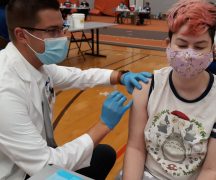
New this spring and summer, the health department began expanded outreach efforts by partnering with local school sports physical events to offer immunizations for adolescents. These events will focus on areas of higher need where vaccination completion rates require improvement, helping bring services directly into communities and making it easier for families to keep their children up to date.
While Wood County’s vaccination rates are strong overall, the Wood County Health Department continues to partner closely with local schools and community organizations to provide education, address barriers, and support families in making informed decisions. Maintaining high vaccination coverage is a shared community effort.