
Written by GEOFF HOWES
Bowling Green Historic Preservation Commission
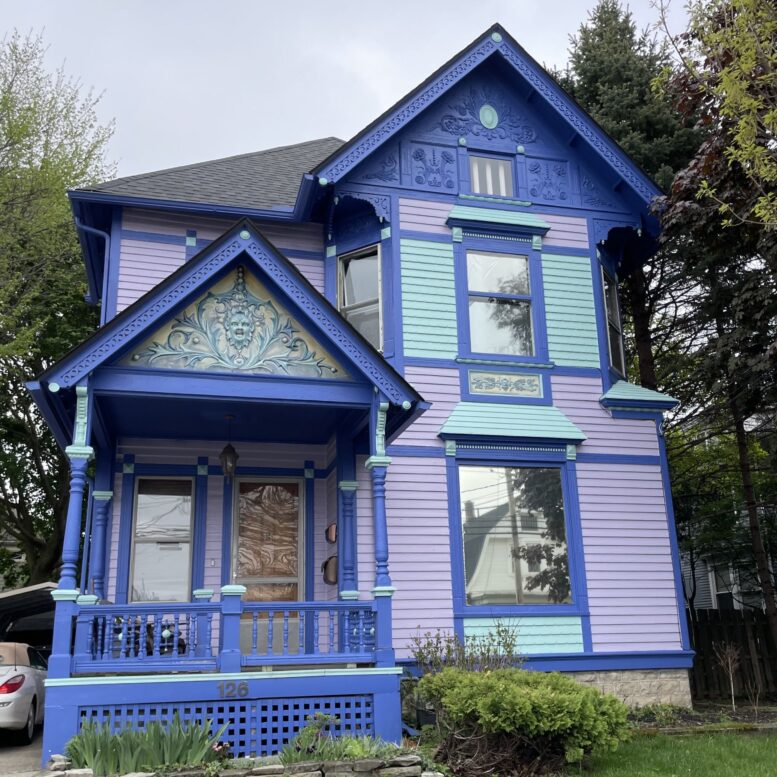
The Bowling Green Historic Preservation Commission’s Historic Building of the Month for May 2026 is the colorful Victorian house at 126 N. Prospect St. Built in 1892, it has been home to many distinguished Bowling Green residents, including a hardware store owner, a restaurateur, an insurance agent, a jeweler, a local Democratic Party leader, and a BGSU human resources administrator. At one point, it came close to being torn down.
This is one of two “Painted Lady” houses on North Prospect Street. (The other is 237 North Prospect; see the Historic Building of the Month for January 2025.) The Painted Lady movement, which highlighted ornate architectural details with a variety of bright colors, was not a Victorian-era development, but began around 1980 in San Francisco and spread to other parts of the country.
In 1887, James P. Kramer (1846-1897) sold his hardware in Canal Winchester, Ohio, and moved to booming Bowling Green. He and John Chaney bought the Lynch Brothers’ hardware store in the Buckeye Block on South Main (now Rock’em Sock’em and Qdoba). Kramer & Chaney’s was known as one of the best hardware stores in Wood County.
Kramer married Marilla Waters of Columbus in 1868. They had one daughter who died in infancy; a son, Ernest, who died of typhoid fever in 1890 at age 18; and a daughter, Mildred, who became a schoolteacher.
The Kramers lived in a modest home at what is now 126 N. Prospect St., but in 1892 they made plans for a bigger residence on the same site. Kramer sold the old house to C. M. “Joe” Dow, a millwright, who moved it to Haskins Road in May. By mid-June, Ordway Brothers builders had already put up the frame of the new residence.

The Kramer House is a Queen Anne Victorian with a steeply pitched, cross-gable roof. The typically asymmetrical design features gables of various sizes and a prominent, off-center front porch with decoratively turned spindles and “gingerbread” trim. In the center of the porch gable is a wooden relief of a foliate head with Pan-like horns, also known as a Green Man. The façade includes ornately carved flowers, leaves, and fruit.
On May 5, 1894, the home was the scene of the “very pretty and quiet wedding” of Mildred Kramer and Elmer L. Spafford, a civil engineer. The Spaffords moved into a house on North Main Street and later to Toledo, where Mildred taught school.
James Kramer had enjoyed his fine new house for barely five years when he succumbed to pneumonia on June 13, 1897, at age 51. Both his death and his funeral took place in his home. John Chaney soon closed their hardware store. Marilla Kramer lived in the house until her death in 1914. Her funeral was also held at home. The Kramers are buried in Oak Grove Cemetery.
The Sentinel Tribune of Oct. 30, 1914, reports: “Mr. and Mrs. M. A. Ireland are moving from 502 to 126 North Prospect St.” Milton Avery Ireland (1849-1929) was well known in town as the proprietor of Ireland’s Restaurant at 134 W. Wooster St. (later at 139 N. Main St.) He was also a machinist, a skill he learned while living in Kansas, and a police marshal.
“Ave” Ireland married Adelia Yonker (1855-1937) in 1874, and they had three sons and two daughters. One daughter died in infancy. Known as “Adda,” Adelia taught school in Scotch Ridge and was later the pastry cook at the family’s restaurants, deservedly sharing her husband’s fame and popularity. In 1929, Ave died of pneumonia in his home at the age of 79. Adda Ireland died at home in 1937 at age 82. The Irelands are interred in Oak Grove Cemetery.
On Aug. 3, 1939, the Sentinel-Tribune reported: “Guy and Earl Nearing have purchased the Ireland residence, 126 North Prospect St., occupied by Mr. and Mrs. E. N. Carney (Ethel Ireland). Mr. and Mrs. Guy Nearing and daughter Phyllis expect to occupy it.”
Guy Mars Nearing (1902-1987) and Charles Earl Nearing (1909-1966) were sons of Judge Charles R. Nearing (1868-1943), who built the stately house around the corner at 216 E. Court St. Their grandfather was Judge Guy C. Nearing. (See the Historic Building of the Month for January 2026 and the sign “Court Street Connections” at the corner of East Court and North Prospect.)
Guy M. Nearing, his wife Dorothy (1903-1965), and their young daughter Phyllis (1930-2017) moved into the remodeled home in November 1939. Dorothy (born Phillips) attended Bowling Green State College. She was active in the First Presbyterian Church and the Order of the Eastern Star and was director of the Wood County Chapter of the American Red Cross. She died in 1965.
Guy, who graduated from Cornell, was a partner in the Nearing insurance agency (eventually Nearing, Huber & Harger) and a vice president and director of First Federal Savings & Loan. He was active in the Republican Party and became a BGSU trustee in 1965. He passed away in 1987. Guy and Dorothy Nearing both lie in Oak Grove Cemetery.
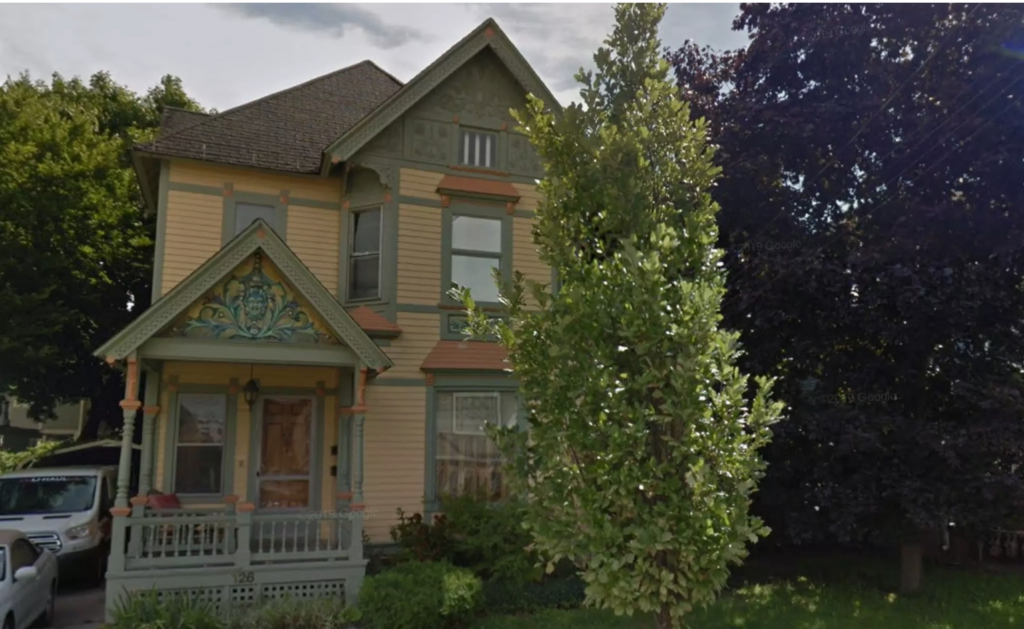
In 1947, the Nearings sold 126 N. Prospect St. to Roy and Alice Klever. Roy Klever (1905-1985) was associated for 67 years with Klever’s Jewelry on North Main, founded by his father Alex in 1918. He was an active Mason and a founder of the Bowling Green DeMolay. He belonged to the Rotary Club, the Wood County Historical Society, and the First Presbyterian Church. For two years he was president of the Chamber of Commerce. The Chamber named him Outstanding Citizen of the Year for 1977.
Roy’s wife Alice (Loose) Klever (1909-1964) was his partner in the store. She helped Roy organize the local Masonic Rainbow Assembly for Girls and was active in the Order of the Eastern Star and First Presbyterian Church. A member of the Women’s Republican Club and the Wood County Hospital Guild, she was also a secretary of the Wood County Historical Society.
The Klevers had two sons: Jon, who took over the jewelry store, now closed; and Gerald, a Presbyterian pastor. In 1964, Alice died suddenly at home of a heart attack. She was 56. Roy married Miriam Hobart (1920-1996) in 1969 and passed away at age 80 in 1985. Roy, Alice, and Miriam were buried in Oak Grove Cemetery.
In 1978, Bowling Green attorney Allen R. Baldwin (1947-2013) opened his law office at 126 N. Prospect St., recently purchased from the Klevers. Baldwin graduated from Bowling Green High School and BGSU. In 1978 he completed law school at the University of Toledo. Previously, he taught school, was a public information officer for ODOT, and served on the BG Charter Commission and Industrial Development Commission. Affectionately known as “Big Al,” for decades he was chair of the Wood County Democratic Party.
On Jan. 14, 1984, Allen Baldwin and Rebecca Ferguson were married in Prout Chapel on the BGSU campus. They welcomed two sons, Nicholas in 1985, and Benjamin in 1987, who eventually graduated from BGSU.
Rebecca Ferguson was a personnel officer with ODOT when they married. Later, she was director of employee/labor relations at the University of Toledo, and in 1997 she became assistant provost for human resources at BGSU.
Becca Ferguson and Al Baldwin hosted many Democratic Party events at 126 N. Prospect St., supporting candidates and fostering party unity.
In 2013, Big Al passed away at age 65. His successor as Democratic committee chair, Mike Zickar, recalled that Baldwin “could be abrasive, but also sweet and tender too.” That is just how this writer remembers him.
Becca Ferguson retired as BGSU’s Chief Human Resources Officer in 2015, but has stayed very active in the community. Currently chair of the Wood County Park District Board, she has also served on the Bowling Green Downtown Foundation, the Wood County Board of Developmental Disabilities, the Wood County Hospital Foundation, and as chair of the Hometown Heroes Banner program. She is a past president of BG Kiwanis. In 2017 she received the BG Chamber of Commerce Athena Award for promoting women’s leadership.
Baldwin sold the house in 1995 to Jerry and Cheryl Foltz, who rented it to students. In March 1998, the Wood County Commissioners voted to purchase it to use as temporary office space and then tear it down for parking. This plan was canceled a week later because the owners did not want to relinquish the house until May 1999. That’s how close this architectural gem came to disappearing. Luckily, it was saved by a former tenant.
Al Baldwin and Becca Ferguson had rented an apartment in the house to a series of tenants. One of them, from 1978 to 1980, was Donna (Ruffu) Parsons. In 1999, she purchased the old Victorian from the Foltzes and returned to her former home. She has lived there ever since.
Donna Parsons played women’s C-League softball, served on the Wood County Democratic Committee, and has volunteered for the Black Swamp Arts Festival. By maintaining this grand old house for decades—it was recently restored to its brilliant Painted Lady colors—she has contributed significantly to historic preservation in Bowling Green.
(Written by Geoff Howes of the Bowling Green Historic Preservation Commission. With thanks to the Sentinel-Tribune and the Wood County District Public Library.)
Would you like to nominate a historic building or site for recognition? You can do this through the City website at – https://www.bgohio.org/FormCenter/Planning-13/Historic-BuildingSite-Nomination-Form-83
You can learn more about the Historic Preservation Commission by attending their meetings (the fourth Tuesday of each month at 4 p.m.) or by visiting their webpage at – https://www.bgohio.org/436/Historic-Preservation-Commission.
