By TOM GERROW
BG Independent News
The Great Lakes are a tremendous resource for the region, holding 90% of the surface water in North America. Great Lakes water is a vital resource for industry, agriculture, and electricity production, among other uses.
For Ohio, in particular, Lake Erie supplies drinking water for 3 million Ohioans and supports a $17 billion tourism industry with more than 11 million visitors annually. Lake Erie is also the most biologically diverse of the Great Lakes, with more than 100 different fish species.
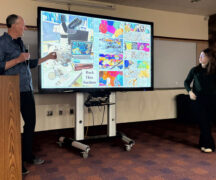
But Lake Erie and the other Great Lakes face several challenges. At a recent BGSU Science Café held at Grounds for Thought, Dr. Sarah Emery, who is the director of the Center for Great Lakes and Watershed Studies (CGLWS) at BGSU, explained the nature of these challenges and discussed efforts to address them in a presentation entitled “Tackling environmental challenges in the Great Lakes through collaborative research.”
“Harmful algal blooms are probably what pops into everybody’s mind first, especially in this area,” Emery said. “Harmful algal blooms are caused by high nutrient inputs, especially phosphorus and nitrogen. And the cyanobacteria, which we affectionately call blue-green algae, release liver and neurotoxins such as microcystin and saxitoxin.”
Emery noted that while agricultural runoff – fertilizer and manure – were the main contributors to HABs, changing climate conditions are also exacerbating the blooms. Extreme rainfall events can increase runoff from fields, and warming temperatures have extended the HAB season in the Western Basin of Lake Erie by approximately a month.
But HABs are not the only challenge causing problems in the Great Lakes. Soil erosion reduces water quality and necessitates costly harbor and shipping lane dredging operations. There are also microplastics (in sediments and the water column), PFAS (forever chemicals) and pharmaceuticals (including anti-depressants and opiates) are detectable in lakes and waterways.
Invasive species, such as zebra and quagga mussels, grass carp, sea lampreys and the common reed, are another challenge.
“There are over 180 aquatic non-native species in the Great Lakes, but really only about 13 of those cause significant ecological and economic problems,” Emery said.
Many faculty members and graduate and undergraduate students at BGSU are working on solutions for these environmental problems in the Great Lakes, Emery said. The CGLWS consists of 36 faculty members, assisted by more than 100 undergraduate and graduate students engaged in freshwater research.
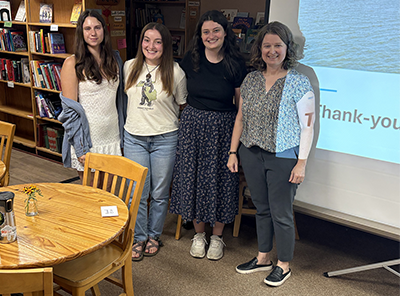
Three of those graduate students – Abby Muhleman, Jillian Darst, and Alexa Gudelman – joined Emery for the Science Café to discuss their research interests.
Muhleman’s research focuses on the ecological drivers of anuran species (frogs and toads) biodiversity in wetlands. She uses data she collects in wetlands along with data from H2Ohio’s wetland monitoring program.
“The goal is to tie all these different moving parts together and to see how ultimately they might be influencing amphibian populations in these established wetlands to see how these organisms are doing under these varying conditions,” Muhleman said.
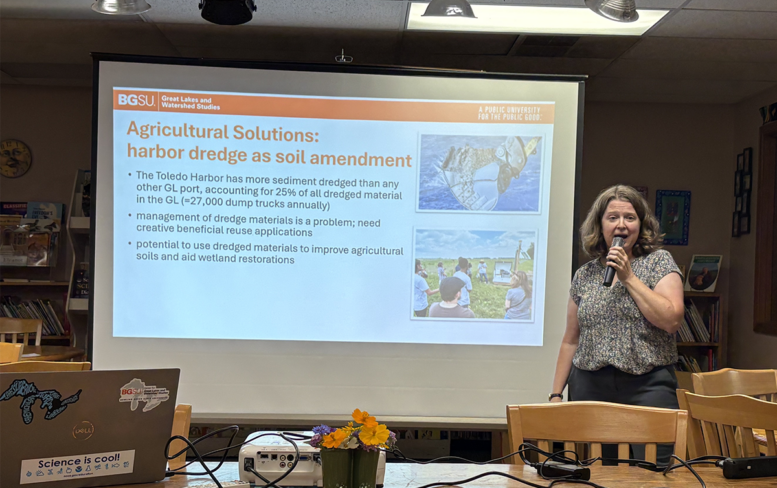
Darst’s research examines whether employing dredge materials as a soil amendment might enhance crop pest resistance. Finding a productive use for dredge materials could be beneficial for the local area, because Toledo Harbor has more sediment dredged than any other Great Lake port – the equivalent of 27,000 dump trucks annually.
“I am looking at sustainable agriculture,” Darst said. “What we found is that dredge material can act as a natural fertilizer. But that is basically all that we know about using dredge material with farming. So my research is building on top of that and looking at how dredge material with agriculture influences pests and acts as a natural pesticide or just how it works with a larger agriculture ecosystem.”
The Great Lakes have the most extensive freshwater dunes in the world, and Gudelman’s research has focused on arbuscular mycorrhizal fungi, beneficial soil microorganisms that form a symbiotic partnership with over 70 percent of all land plant species.
“Basically, I’m looking at the American beach grass – it’s our main species here,” Gudelman said. “And AMF, or arbuscular mycorrhizal fungi, is a symbiotic fungus, and it has a special relationship with the beach grass. What the fungi does is, it sends nutrients such as phosphorus and nitrogen up the roots of the plant in exchange for carbon from the plant.
“And then ERH, or extra radical hyphae, are these thread-like filaments that extend beyond the roots of the plant, and that’s what stabilizes the beach grass in place. And it graphs onto the sand and creates this underground network. I’m measuring how human impact and this underground soil activity possibly have a relationship.”
Emery emphasized that watershed-scale problems require watershed-scale thinking. This requires increasing collaborative watershed research, facilitating interdisciplinary educational opportunities to prepare the next generation for watershed-related careers, and engaging and educating communities to promote watershed stewardship and informed decision-making.