By JAN McLAUGHLIN
BG Independent News
For generations, Black contributions to the development of the United States have been minimized, fragmented and distorted.
That has had a lasting effect on Black Americans as they navigate in a nation that still does not acknowledge the generational impact of slavery, and the injustices that continue.
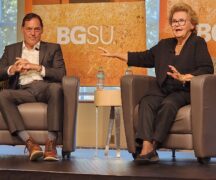
Building on its 26-year effort to spark discussion and cultural enrichment, Bowling Green State University held its annual Black Issues Conference last month.
With the theme of “Black Well-Being: Caring for Ourselves and Our Communities,” the conference focused on a holistic approach to health, promoting social, physical, financial, mental, emotional, and spiritual wellness.
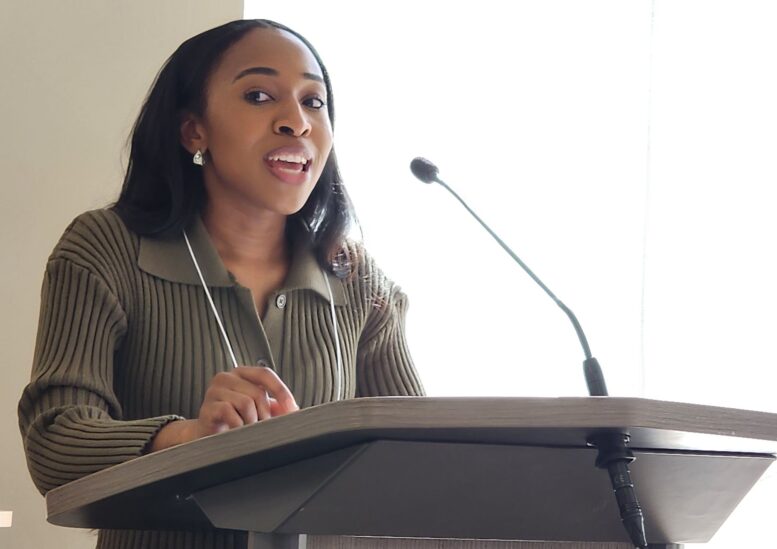
Bliss Like-Jones, a 2018 psychology alumna of BGSU who is working on her masters in school psychology, talked about the damage done by inaccurate portrayals of Black Americans through history and now.
Her presentation on “The Story We Were Never Told,” examined why accurate Black history matters for identity, mental health and community care.
The lack of positive images of Black people in the media creates a distorted version of themselves among Black youth. What happens when this is the only information they see, Like-Jones asked.
“Our children do not benefit from the erasure of difficult truths,” she said.
“If you don’t see people who look like you as scholars or intellectual leaders,” that limits what people see as possibilities for themselves, she added.
In news coverage, Black suspects are frequently shown in mugshots, while white suspects are shown in professional or family photos. Crime in Black neighborhoods is often reported as a “cultural failure,” while similar crimes in other areas are framed as “isolated tragedies.”
Figures like Serena Williams have historically been scrutinized by sports media for showing “anger” or “aggression,” while white male counterparts are often framed as “passionate” for the same behavior.
Like-Jones talked about the power of storytelling
During enslavement, when literacy was often criminalized and physical autonomy was stripped away, storytelling became the primary mechanism for survival. It wasn’t just entertainment. It was a blueprint for identity.
Spirituals and “sorrow songs” were stories set to music that contained literal maps for escape, like “Follow the Drinking Gourd” or “Wade in the Water.”
Stories kept the names of ancestors and African origin alive when the system tried to rename and “rebrand” people as property. The oral tradition grew out of necessity. Because writing was often forbidden, the “Griot” tradition (the community storyteller) became the most respected role.
Slavery attempted to make Black people the objects of someone else’s story. Storytelling allowed them to go from “property” to “protagonist.” By sharing stories of love, grief and triumph within the quarters, enslaved people reinforced their humanity against a legal system that defined them as three-fifths of a person.
Like-Jones addressed the use of African American Vernacular English. Mainstream media often labels AAVE as “slang” and Hip-Hop as “violent.” In reality, AAVE is a complex rule-governed dialect that allowed enslaved people to communicate in front of overseers, she said. It was a survival tool.
Hip-Hop is a modern storytelling tradition, Like-Jones said. It is a multi-billion dollar industry built by youth in the South Bronx using broken turntables. It is the ultimate story of alchemizing pain into power.
“Slang is not improper English. It’s actually our language,” she said.
Youth need to learn about difficult truths, starting with enslavement and continuing through the centuries, Like-Jones said.
“Erasure of history is not accidental,” she said.
They need to know about Black Wall Street in Tulsa, Oklahoma, where in 1921, white mobs destroyed an affluent African-American community, seen as a threat to white-dominated American capitalism. Hundreds were killed and thousands of homes were destroyed in the massacre.
They should be aware of the Great Migration, between 1916 and 1970, when the promise of higher wages, educational opportunities, and an escape from racial violence of the South led six million Black Americans to uproot their lives and migrate to industrial cities in the West and North.
This was the largest internal movement of people in U.S. history, Like-Jones said. “It was a protest with feet.”
Americans should know about the MOVE bombing in May of 1985, when the Philadelphia police department dropped an improvised bomb on a residential home that housed the Black revolutionary organization MOVE. The bomb and ensuing fire killed 11 people, including five children, and destroyed more than 60 nearby homes.
And it is important to be aware that John Ehrlichman, a key aide to President Richard Nixon, stated in an interview that the “War on Drugs” was a calculated political move to target the anti-war left and Black Americans. He admitted the strategy allowed the government to arrest leaders, raid homes and vilify these specific groups through the media.
Like-Jones talked about the psychological cost of erasure of portions of history, which can lead to:
- Internalized inferiority. The subconscious adoption of negative societal beliefs about one’s own group.
- Stereotype threat. The anxiety of confirming negative stereotypes, which ironically impairs performance (in academics, sports or work.)
- Reduced academic self-efficacy. If you don’t see “people like you” as the architects of civilization or the inventors of technology, it becomes harder to envision yourself in those roles.
- Identity confusion. A fragmented sense of self caused by trying to navigate a world that doesn’t reflect your true heritage.
That erasure of some history and misrepresentation of other history is especially destructive in social media traps.
Like-Jones introduced the “Modern Mirror Effects” on youth development. When Black youth don’t see themselves accurately presented, they experience “symbolic annihilation,” the idea that if you aren’t in the media, you don’t matter, she said.
While griots have carried on the tradition of oral storytelling for centuries, Gen Z is the first generation to grow up with a “24/7 digital griot,” that often hijacks history, Like-Jones said.
Youth become victims to the “doomscrolling of trauma.” Black youth are disproportionately exposed to viral videos of racial violence, she said. Hyper-niche stereotypes: TikTok and Instagram algorithms can funnel youth into “echo chambers” that prioritize negative stereotypes over holistic Black humanity.
According to Like-Jones, the “I don’t care” attitude acts as a shield against the pain of exclusion. However, that shield comes with a high price:
- Academic nihilism: A belief that education is a “rigged game” or “not for me.” This leads to higher dropout rates and limited economic mobility.
- Risk-taking behaviors: When you aren’t taught that your body is the vessel of an ancestral legacy, you treat it as disposable. This manifests in substance abuse, unsafe choices, and lack of “future-orientation.”
But cultural pride can heal, Like-Jones said. Research shows that cultural pride is a “mental health shield.” Youth with a strong sense of racial socialization (learning Black history and achievements at home) show significantly lower rates of anxiety and depression.
Families should work to make history personal – not distant. They should tell stories of power and light, not only pain. They should “tell your story,” about family history, share traditions and holiday dishes.
“They need to to talk about family – someone other than CardiB,” she said.
Like-Jones’ grandma was a sharecropper in Arkansas, before moving north during the Great Migration, and earning a bachelor’s degree in English. Like-Jones is a product of a history passed down through generations.
“My grandma’s a storyteller,” she said.
“Children deserve to know where they come from and what they are capable of,” Like-Jones said. “If we don’t tell our story, someone else will, and they may not tell them with love, truth and care.”