By JULIE CARLE
BG Independent News
A shooting shook the Old West End Festival earlier this month. A Toledo artist, who was among those injured in the tragedy that shut down the final day of the festival, did what he does best – he created art.
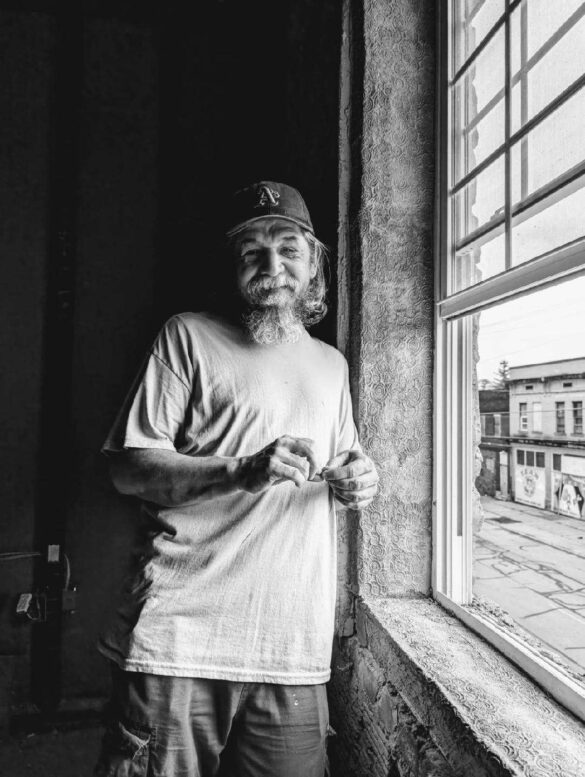
Jim Zalewski, a kind-hearted, beloved local artist, was in the midst of the chaos on June 6 at the annual festival. He was one of 12 people injured in the shooting. He was grazed by a bullet or debris from a gunshot but was within six feet of a person who was bleeding profusely.
“I had a calmness about me,” he recalled about the moment he was struck. “My first reaction was ‘I think I just got shot,’ but then he realized it didn’t look that bad. “I handled it kind of matter-of-factly.”
‘In the moment, he didn’t let the horror of the situation affect him. He saw the gunshots and a person on the ground. “I didn’t see any of it actually happen, only the aftermath of it,” Zalewski explained.
When he was at the hospital, the magnitude of the incident became real. His wound was checked and treated, and he was back home relatively quickly.
The next day, Zalewski turned to his happy space, where he allowed his reactions to find the way to paper, or in that case on a handful of yard signs.
He described his art as “abstract expressionism.”
He paints all over the canvas, “just by feel and moment in time,” he said. “I’m making marks and coming up with results that are interesting. Nothing is representational at all. It’s not tied to anything objective.”
Art is how he connects to himself, by slowing down and enjoying the process of making marks.
He was born an artist, according to a story his childhood babysitter shared.
“My mother called her over to the house, and told her, ‘I need to show you something that Jimmy did,’” Zalewski said.
Debbie, the sitter, was worried she had done something wrong in taking care of the two-year-old. “When she got there, my mom showed her that all along the landing of the steps from the first floor to the second floor were crayon marks. She told the sitter, ‘I think he’s going to be an artist.’”
She wasn’t wrong, though after high school, his art morphed to a graphic design career, then web design and marketing. “ I went from being on the production side of the art to the corporate side of art, to everything but regular art,” he recalled.
The fine art side lay dormant until about 2010, when he grew weary that he could not find the artistic connection he hoped for in his career.
“My integrity was challenged, and the work never felt genuine to me,” he said. “I knew I wanted to get back into art; it was just a feeling.”
He rediscovered the joy of recreating fine art, though it became central to his world after taking care of his mother from 2014 to 2019.
“There’s something about the human psyche and the feeling of doing something and getting lost in that feeling that makes time drift away. It makes a person connect to their thoughts in a positive way and eliminate some of the negativity that flows through you,” Zalewski said.
Aftermath art created for others
That was exactly what he tapped into after the shooting.
There was no anger in his painting, he said. “I wasn’t concerned about getting it right, releasing emotions or being representational. I just let the moments pass through me to make the marks.”
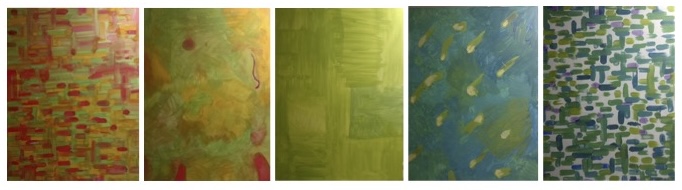
The results were five paintings, highly abstract and expressionistic, that he has since named Trauma Response 1, 2, 3, 4, and 5.
The paintings were spontaneous. “I was putting paint strokes down based upon what I was feeling, along with the music that was playing,” he said.
Once completed, he knew he wanted to share the work with others impacted by the incident.
He plans to give the five paintings away, primarily to the first responders who stepped up in the face of danger and helped those in need.
One man, who was “trained medically, saw me get hit,” Zalewski said. “He made sure I had something to compress against my leg (where he was struck)” before moving on to help people whose injuries were more severe.
At the time of the interview, he had already delivered a painting to the hospital emergency room. He also planned to visit the fire stations near his home and at Ottawa Park to present paintings to people who were at the festival attending to victims after the shooting.
Because “Art heals the things that fear destroys,” which he wrote on his Facebook page, he hopes his art might be relatable to some of those people at the festival that day.
“I think someone looking at it, if there is an emotion, connection or resonance with what I’m showing, it’s because they possibly had a similar experience,” he said.