By JAN McLAUGHLIN
BG Independent News
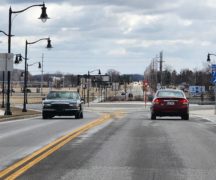
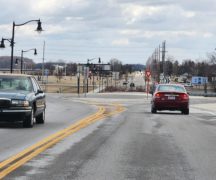
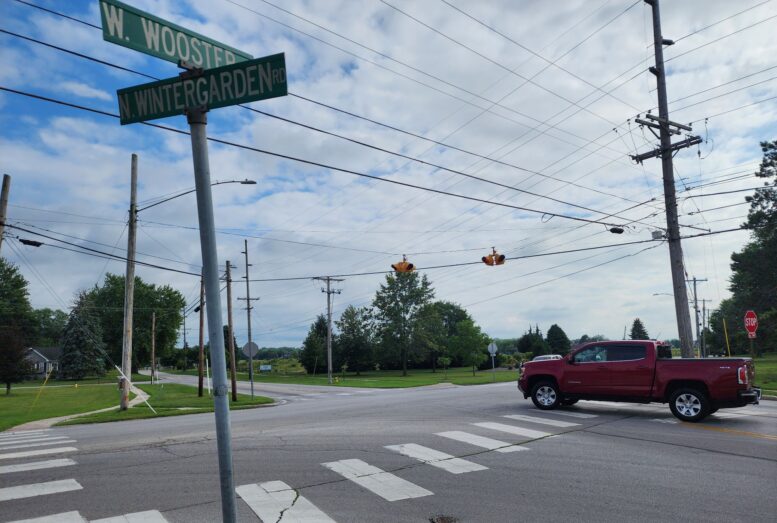
Two new roundabouts, bike lanes and wider sidewalks are all being proposed as part of the recently completed West Wooster Street Corridor Study.
On Monday evening, Bowling Green City Council’s Transportation and Safety Committee listened to the results from OHM, a community advancement firm with 28 offices in eight states including one in Perrysburg.
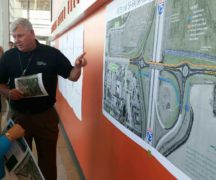
The study was presented by Tim Bock, a municipal engineer and OHM principal, who lives in Bowling Green, and by project manager Sean Oatman, who specializes in roundabouts. The firm is currently working on the roundabout proposed at Brim and Bishop roads on the north edge of Bowling Green.
The study took into consideration safety and mobility for motorists, pedestrians, bicyclists and businesses – and factored in motor vehicle traffic counts, vehicular speeds, bike and pedestrian counts and frequency of crashes and near misses.
The study divided West Wooster Street into two sections – one from Wintergarden Road almost to Haskins Road (Phase 1) and the other from Haskins Road to Church Street (Phase 2). In addition to the roundabouts, each phase also includes accommodations for bicyclists and pedestrians.
The estimated cost of the roundabout is $3.5 million, and for the shared use path about $2.1 million.
If funding is secured, the earliest Phase 1 could be constructed would be 2031-2032.
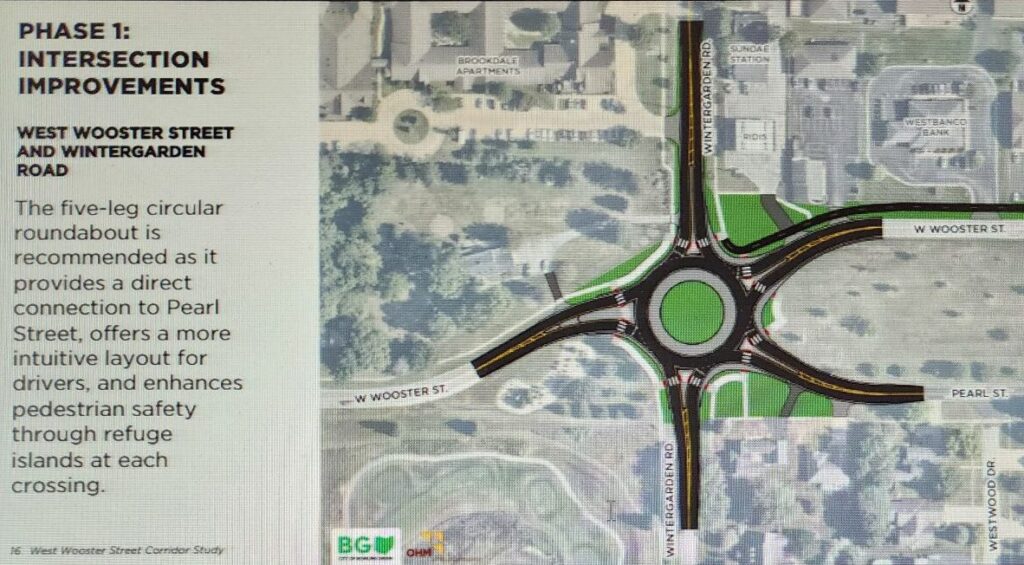
The proposed Phase 1 roundabout calls for a single-lane, five-legged roundabout connecting West Wooster, Wintergarden and Pearl streets. As planned, the roundabout would sit south of the existing Wooster Street intersection, so Pearl Street could be included as well.
Each leg of the roundabout would have its own pedestrian refuge island, Oatman said.
“This creates a safer intersection,” he said.
The traffic volume and crash history at the intersections do not warrant a traffic signal, Oatman said. But a roundabout would make the intersections safer, he said.
“There are definitely some alarming trends at the intersections,” he said.
The next part of Phase 1 includes an 11-foot wide shared use path on the north side of Wooster Street between Wintergarden and Haskins roads. The existing sidewalk on the north side ranges from four or five feet wide – not enough for both pedestrians and bicyclists, Oatman said.
This section of the project could possibly include two enhanced crosswalks with rapid flashing beacons that pedestrians activate, potentially near Martindale and Brigham streets.
Because of the tight location of the existing sidewalks along Wooster east of Brigham, the roadway in that section up to Haskins Road may see a shift in the roadway to the south, Oatman said, assuring that the stone walls along the south side of Wooster Street will not be affected.
“The intent is to share the impact on the north and south sides,” Bock said.
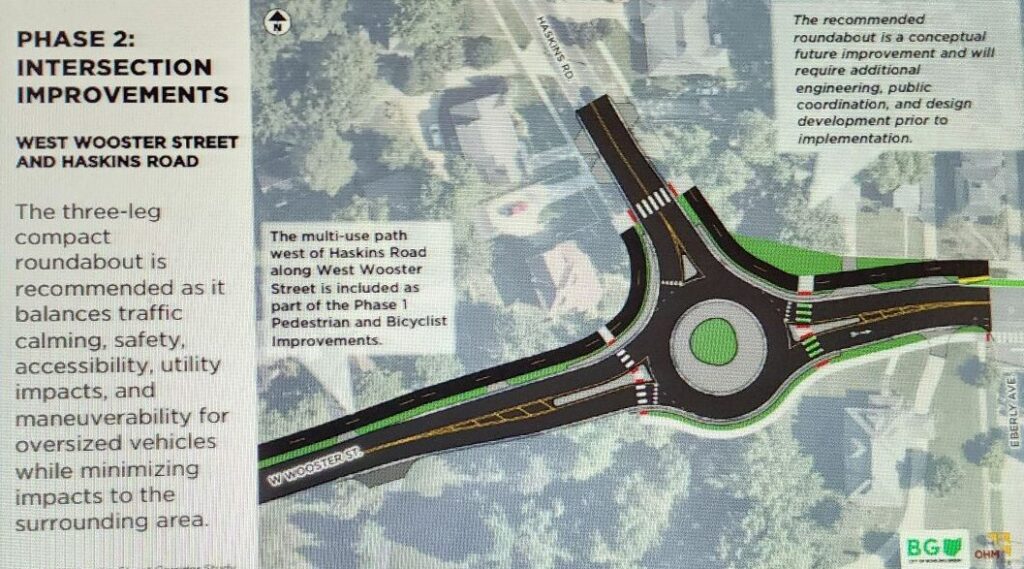
Phase 2 of the study calls for a three-legged compact roundabout at the intersection of West Wooster Street and Haskins Road. The intersection currently poses sight problems for drivers on Haskins Road turning onto Wooster.
Because this phase would come after Phase 1, this portion will require more engineering if the city decides to proceed, Bock and Oatman explained.
This roundabout would slow vehicles on West Wooster, Oatman said.
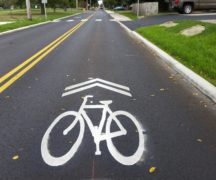
Phase 2 also proposes five-foot bike lanes be installed on both sides of Wooster Street, from Haskins Road to Church Street. That will still leave 11-foot lanes for motorists, but would require parking along the north side of Wooster Street to be removed. The sidewalks for pedestrians would remain.
Oatman noted that efforts will be made to not disturb the new infrastructure recently installed on West Wooster Street in that area.
This proposal would give designated space to all modes of travel – motor, bike and pedestrian, and would result in traffic traveling at slower speeds in the narrower lanes, Oatman said.
None of the four proposals – the two roundabouts, the shared use path and the bike lanes – are dependent on other portions of the project, Bock said.
Council heard the first reading of a resolution Monday evening, seeking funding for Phase 1. Council will hear two more readings of the resolution before voting on it at the Aug. 3 meeting.
If awarded the funds, the city would commit to paying between 20% and 30% of the actual cost of construction and construction engineering, estimated to be $1 million, and the full cost of project preparation, estimated to be $350,000.
The local portion would be funded by the city using funds from the street repair fund.