By JULIE CARLE
BG Independent News
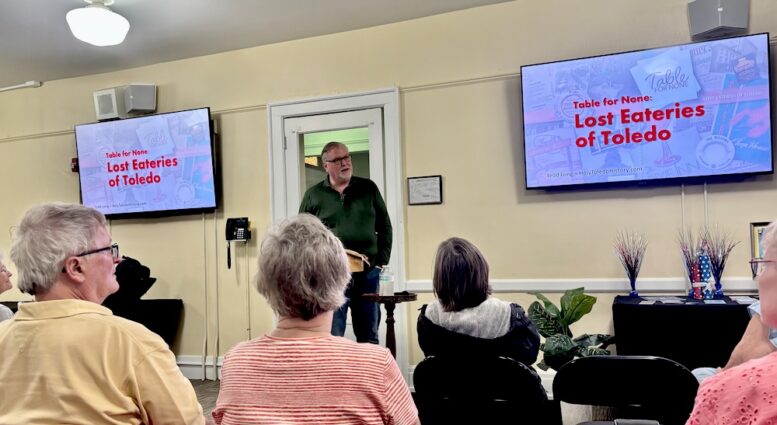
In a city shaped by industry, immigration, and neighborhood pride, the places people gathered to eat often told the richest stories, according to Tedd Long, author of “Table for None: Lost Eateries of Toledo.”
He spoke during the Wood County Museum‘s most recent America 250 Lecture Series. Long shared stories, menus and images of the elegant supper clubs, hot spots and beloved corner diners in the Toledo area that drew patrons from all over. Though many of those well-known, often-visited restaurants disappeared, they are still part of the region’s collective memory, as evidenced by the people who attended Long’s talk.
“I love doing backstories; this story, that story,” he said about the anecdotal style he uses in his books, which cover not only restaurants, but also Toledo’s ‘Forgotten Visitors,” and letters and ephemera from the city’s past.
His restaurant book covers early eating places, hotel restaurants, lunch favorites, steakhouses, fine dining, ethnic eateries, hometown classics, pizza houses, delicatessens, diners and drive-ins. His talk focused on just a handful of the places with interesting stories.
One of the earliest restaurants he talked about was (James) Conlisk’s Saloon, located in the basement of a building at Jefferson and Summit, which is about where Port Industry Square sits today. No one in the room would have ever eaten at it, because it was in operation in the 1840s.
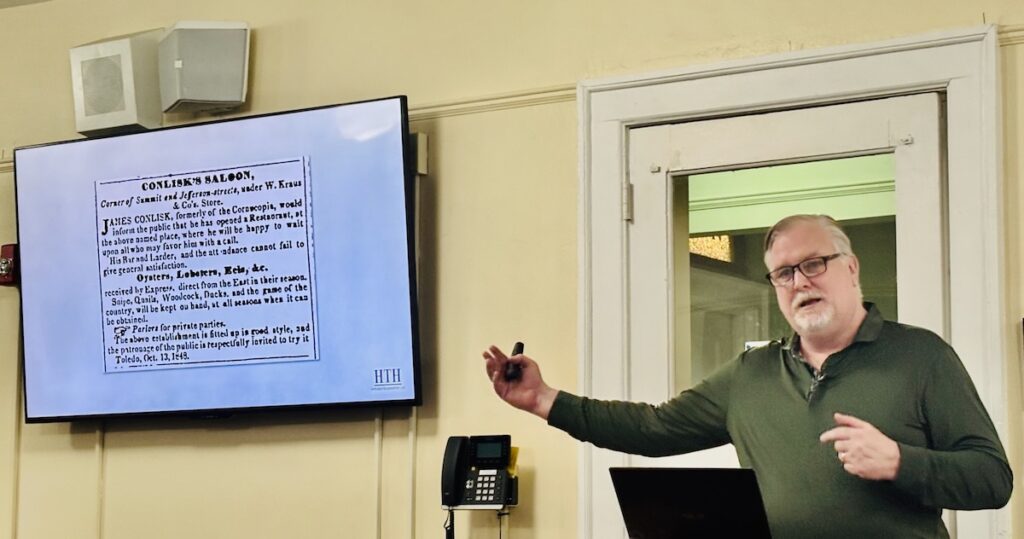
An 1848 Toledo Blade advertisement promoted the restaurant’s “really good eats from out east,” Long said. “In 1848, if you were going to go to a restaurant and you were living in Toledo, you wanted something that came from where you came from.”
The restaurant menu promised oysters, lobsters and eels. “But in 1848, even express delivery from the East Coast probably meant the stuff was two weeks old,” Long joked.
The Boody House was a popular restaurant in the days when Toledo was a booming railroad center, second only to Chicago for the number of rail lines coming in and out of the city. The Boody House, a French Gothic architecture, was located at the corner of Madison and St. Clair streets. Famous for its Lincoln Dinner, the restaurant’s menu included a portrait of President Lincoln. “But the beautiful part of it is when you open it, this is what people were eating at the Lincoln dinner around 1900 at the Boody House. Back then you started off with an oyster cocktail, cream of tomato with rice, and then a relish tray, celery, olives and radishes. When was the last time you got served a relish tray at a restaurant?” he asked.
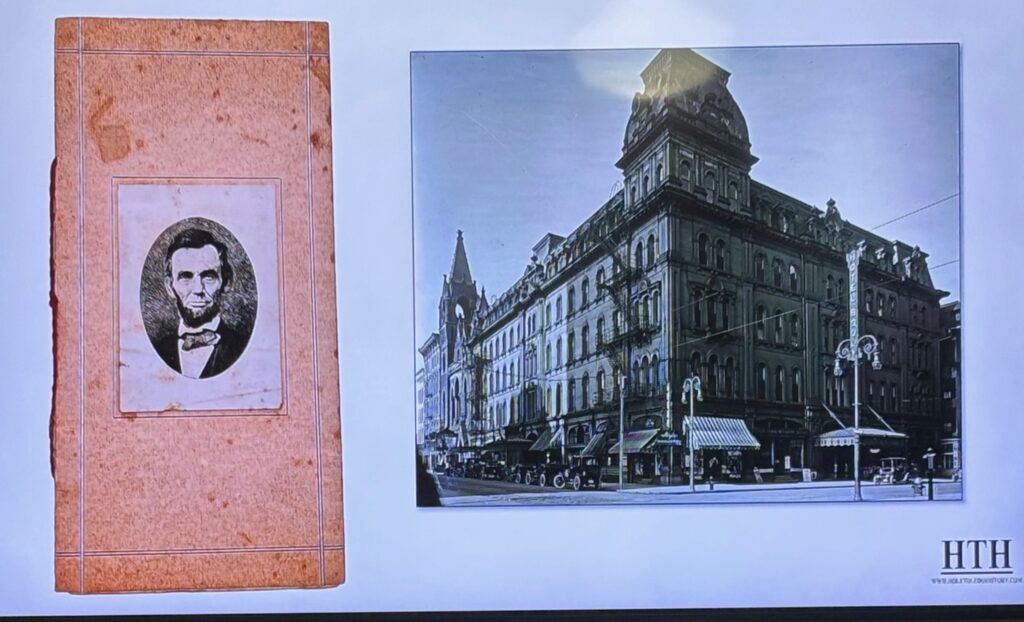
The rest of the meal included Lucas County turkey, oyster dressing, frozen eggnog, fried Belgium hare southern-style, salad at the end of the meal, followed by café noir and Sola cigars.
Among the “old standbys” Long discussed were Dyer’s Chop House, Bud and Luke, and Frank Unkle’s.
“Dyers was an interesting story,” he said. “I remember everyone telling stories about how it used to be the place for a ‘power lunch,’” he said. Originally, the restaurant was founded by Elmer Dyer in 1908 in the basement of the Ohio building. After World War I, he and his cousin bought the property on Superior and formed Dyer’s Chophouse. The restaurant was known for having an ice chest with live lobsters in front of the restaurant. “As you walked by, you would say, ‘We’ve got to go there and see what they have,’” Long said.
“When I came to Bowling Green in 1955, I liked coming to Toledo to eat,” said Bowling Green resident Dolores Black. She recalled planning to have lunch with her mother at Dyer’s only to find it was closed to women at lunch.
“You’re absolutely right,” Long said. “The reason it was home to the ‘power lunch’ was because women were not allowed in the restaurant until after 1:30 p.m. All the elite men in town would meet there because no women were allowed.”
It changed in 1974 when two women sued them in federal court and won, forcing Dyer’s to open to women.
By the third generation of Dyers, the family decided to quit the business and move on. That was a common thread among the lost restaurants, Long said. The younger generations were less interested in the long hours and demands of the restaurant business.
Krotzer’s Steakhouse on Monroe was well-known for its steaks for decades. The restaurant also succumbed to the third-generation syndrome, “when people just get tired,” he said.
Also contributing to the loss of some family-owned restaurants in the 1980s was the influx of “all these franchises that showed up with money.”
That happened to Krotzer’s. “They showed up and said, ‘We’ll buy your location.’ The family said, ‘Great!’ and it became Hooter’s,” Long said.
An interesting story, though, was that the City of Toledo refused to give Hooter’s a license to put up a new sign, so they stole the Krotzer’s sign and just put ‘Hooter’s’ on it. “If you ever noticed it, it’s the same sign,” he said.
Some of the restaurants had their own gimmicks. Bud and Luke Restaurant was nicknamed “The Mad House.
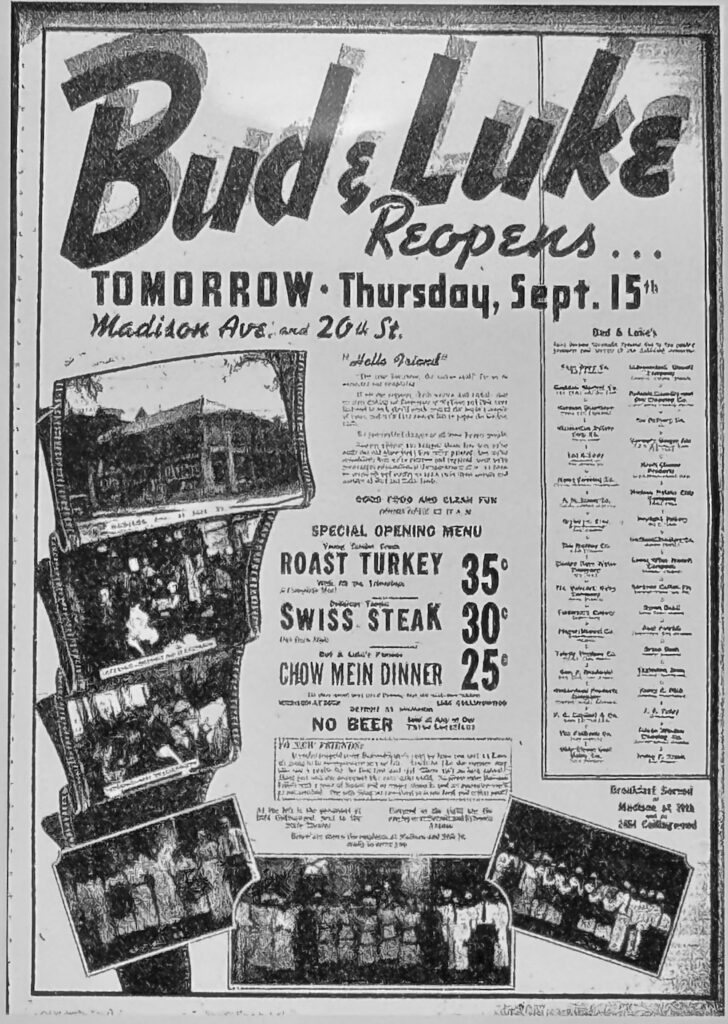
“The maître d’ would meet you at the door, and if you had a necktie on, he had scissors and he would cut off your necktie,” Long said, describing the antics of the “famously outrageous and insulting service” at the restaurant.
At Frank Unkle’s Restaurant, an elaborate and award-winning marketing gimmick paid off in numbers and memories.
“If you called him ahead, you could have a bottle of champagne delivered to your table by a person who jumped out of an airplane and parachuted into the river, who was then picked up in a boat, brought to the dock, dried off and he would run the champagne to your table,” Long said.
These spots weren’t just restaurants, but social anchors for their neighborhoods. The stories are not just about what people ate, but how they lived and thrived in Toledo, Long said.
The restaurants served as “mile markers” of Toledo’s evolution. In mid-20th-century Toledo, dining was hyper-local—people frequented establishments within walking distance, often run by families who knew their customers by name.
As suburbanization and economic shifts reshaped northwest Ohio, many of these places disappeared. In addition to the generational shifts in family-owned businesses, there were also changing demographics, population loss and the decline of neighborhood-based economies.
While many of the restaurants he featured have disappeared, he pointed out that people have a tendency to remember where they gathered for anniversary dinners, special celebrations, or everyday rituals. Many of the attendees shared memories of their favorite restaurants and meals.
“Today’s everyday places are tomorrow’s history,” Long reminded everyone. “The restaurants people gather at now—whether independent diners or modern eateries—will one day carry the same nostalgia as these lost restaurants.”
To learn more about Long’s books, blog and audio tours, visit his website: Holytoledohistory.com..