
By DAVID DUPONT
BG Independent News
BGSU has discontinued its Division of Inclusion and Belonging, as well as the Center for Women and Gender Equity and the Center for Student Connections and Opportunity, in order to comply with the provisions of Senate Bill 1
SB 1 is far reaching legislation meant assert state government control over public universities over all areas of operations. Some provisions of the bill, which passed the legislature with support of both State Sen. Theresa Gavarone, R-Bowling Green, and State Rep. Haraz Ghanbari, R-Perrysburg, and was signed into law by Gov. Mike DeWine, went into effect Friday.
[RELATED: DeWine signs higher ed overhaul bill]
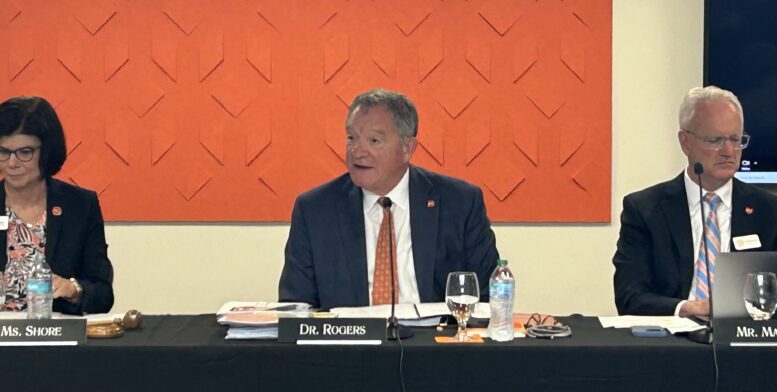
On the eve of that date, BGSU President Rodney Rogers sent a letter to the campus community explaining how the university would comply. Click to read the letter.
The law “creates additional layers of oversight across a broad spectrum of the work happening in Ohio’s public universities,” Rogers wrote.
He notes that SB 1 prohibits programs “based on those individuals’ race, ethnicity, religion, sex, sexual orientation, gender identity, or gender expression.”
Most of the programs now prohibited were housed in the Division of Inclusion and Belonging. That division, though, also included “student support and success programming and services that remain fully compliant with the law.” The university will move those services, and reallocate their resources including personnel into other offices including an expanded Division of Community and Well-Being and to strengthen the Firelands Pathway program and the Deciding Student Program.
The law mandates (without providing funding) the creation of an Office of State and Federal Compliance and Non-Discrimination. SB1 requires that “universities engage in a more rigorous level of reporting and compliance, as well as ongoing monitoring,” Rogers wrote.
Dr. Katie Stygles, who was head of the Division of Inclusion and Belonging, will serve as the chief state and federal compliance officer and deputy chief community and well-being officer.
Staff from the division will be redeployed to the Division of Community and Well-Being, the Office of the Provost, and the Division of Student Engagement and Success.
This is meant to ensure, Rogers stated, that “Bowling Green continues to be a learning community that, as codified by SB1, will ‘treat all faculty, staff, and students as individuals, hold every individual to equal standards, and provide those individuals with equality of opportunity, with regard to those individuals’ race, ethnicity, religion, sex, sexual orientation, gender identity, or gender expression.’”
Rogers reiterated that “we remain steadfast in our commitment to ensuring each student, from all backgrounds and perspectives, is welcomed and can be successful at Bowling Green State University.”
These changes are a result, he said, of months of concerted efforts involving all stakeholders at BGSU.
Rogers noted that the university had already been addressing some of the issues related to efficiency by eliminating or consolidating academic programs, so it does not need to cut programs as has happened at other campuses including at the University of Toledo.
That work was evident at Thursday’s trustees meeting where the board acted to approve a number of changes, most notably the elimination of the doctorate in applied philosophy. Decades ago that was one of the university’s signature programs, but now has only a very few students
After the meeting, Rogers explained that what has evolved from the applied philosophy program is the Philosophy, Political Science, Economics, and Law program. “That enrollment has grown, and it appears to be a very robust program.”
The university has also consolidated six foreign language departments into one that allows students to continue to specialize in a specific language.
Rogers started Thursday’s letter to the community by putting SB 1 in the context of the public’s declining trust “in many institutions that contribute to a functioning society, including the medical system, law enforcement, businesses, religious institutions, and notably, higher education.” The bill was a response to that.
Rogers said the language of the bill while requiring the end of diversity and equity programs does codify that the university must serve all regardless of race, ethnicity, sexual orientation, and other factors.
In the letter to the campus community, Rogers again asserted: “Our work has been, and remains, focused on fostering an environment where all students can be successful, whether they are direct from high school, post-traditional students, students who are military-affiliated and veterans, first-generation students, students with learning differences, students from underrepresented backgrounds, and more.”