By JAN McLAUGHLIN
BG Independent News
An audit of more than 30 intersections in Bowling Green has recorded risks to pedestrian traffic in the city.
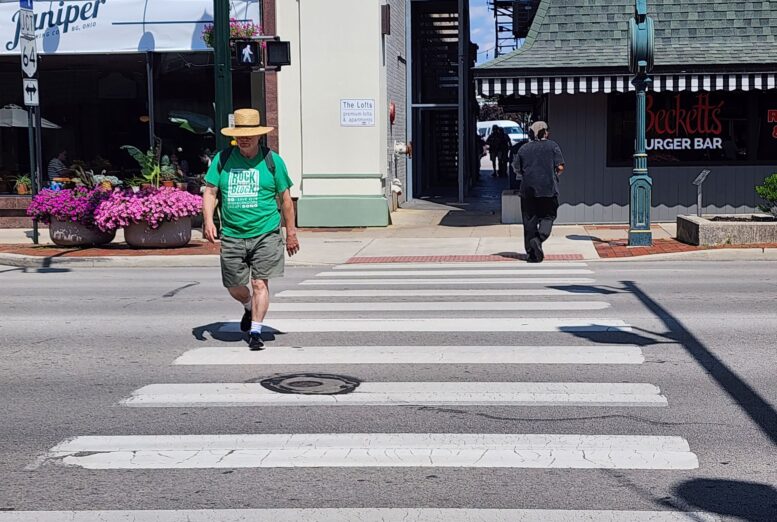
Over the last couple weeks, 22 volunteers observed impediments to traversing Bowling Green on foot. They recorded motorists failing to stop for pedestrians, crosswalk signs that gave walkers too little time to cross, or those that made walkers wait too long to cross.
The walk audit was conducted by BG Save Our Neighborhoods Group and its Transportation and Mobility Action Team, with the assistance of city government. The audit focused on various intersections suggested by local residents.
The goal is to assess the walkability of the city and identify barriers to pedestrians.
The volunteers used a walk audit toolkit created by the American Association of Retired People.
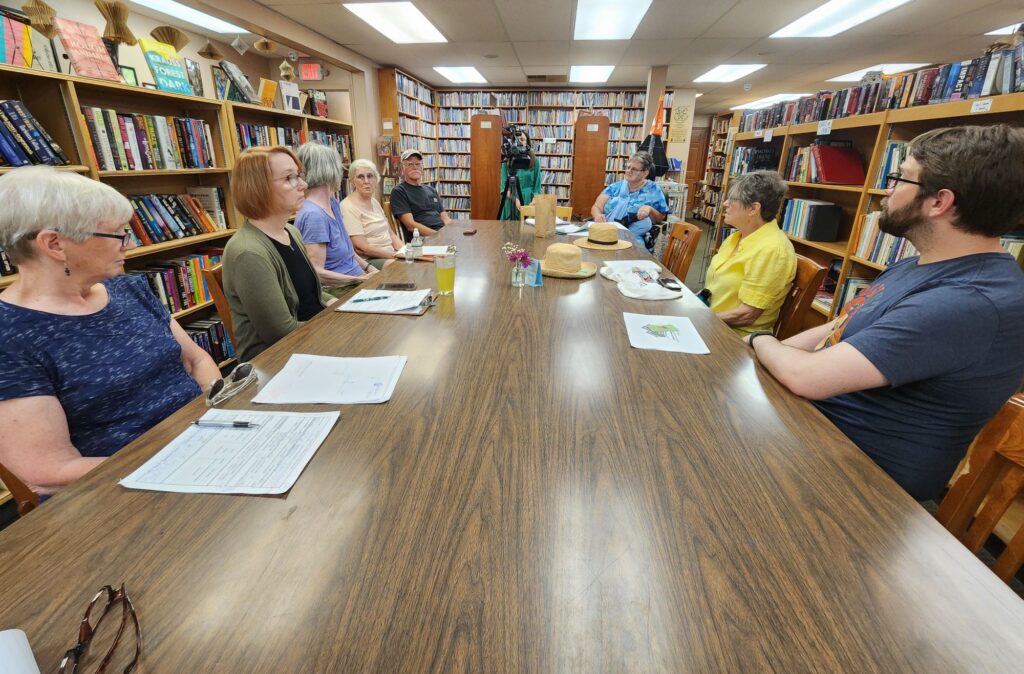
Some of the volunteers gathered last week to discuss their findings, which once compiled will be presented to BG City Council.
Jim Evans monitored some Main Street intersections in the downtown. He recorded motorists running red lights and blocking crosswalks as they turned right on red. Evans also noted a lack of speed limit signs in the downtown.
Penny Evans watched South Main Street intersections with Napoleon Road, Ordway Avenue and Lehman Avenue. She noticed drivers didn’t slow for pedestrian crossings. She also reported that a bicyclist can wait five minutes or more to be able to cross South Main Street. Evans suspected there would be more pedestrian traffic in the area if better accommodations existed.
(The city is currently working on building a shared use path and installing crosswalks with beacons on South Main Street.)
Erin Hachtel reported on the intersection of East Wooster Street and Prospect Street, where pedestrians crossing Wooster get the walker emblem on the crosswalk signs for just seven seconds before the flashing warning sign appears.
Winnie Rex observed at the intersections of North Main Street at Clay and Ridge streets. The crossing is frequently used by residents from the west side of the city who walk to jobs at Bowling Green State University.
“Trying to cross there is risky,” Rex said. “There’s nothing to protect the safety of pedestrians there.”
As David Drain monitored the intersection of North Main Street at Parkview Avenue, he asked pedestrians if they felt safe crossing the road there – to which most responded they did not. The crosswalk is frequented by people pushing strollers, riding bikes or walking to and from the manufactured home park there.
Concerns were also expressed about the lack of a flashing crosswalk for high school and middle school students crossing West Poe Road near the schools.
A second round of the walk audit is planned for this fall, when BGSU and BG City Schools are back in session. It was suggested that postal carriers who walk their routes in the city also be consulted on their experiences as pedestrians.
Ohio law sees every intersection as a crosswalk, with pedestrians having the right-of-way.
“The law says they are supposed to yield to pedestrians,” said Rose Drain, from BG SONG.
However, it was pointed out by Jim Evans that some states – like Colorado – enforce that law, and some states don’t. And some communities – like Ann Arbor – have developed a culture of motorists recognizing the rights of pedestrians.
In the past decade, 103 pedestrians have been hit by motor vehicles in Bowling Green, according to BG Police Division records.
“I think if there were greater police practices and ticketing that would change things,” Rose Drain said.
It was also suggested that Bowling Green install signs that show drivers their speed as they enter the city on Main and Wooster streets.
Another option discussed was the use of three-cycle stoplights, which include a period just for pedestrians without competing for time with motor vehicles. After the all-red phase at an intersection, Leading Pedestrian Interval stoplights give people on foot a three-second head start before the light turns green for people in cars and trucks. During that three-second signal phase, the people in cars and trucks in every direction would all be looking at red lights as pedestrians enter the crosswalks.