
By JULIE CARLE
BG Independent News
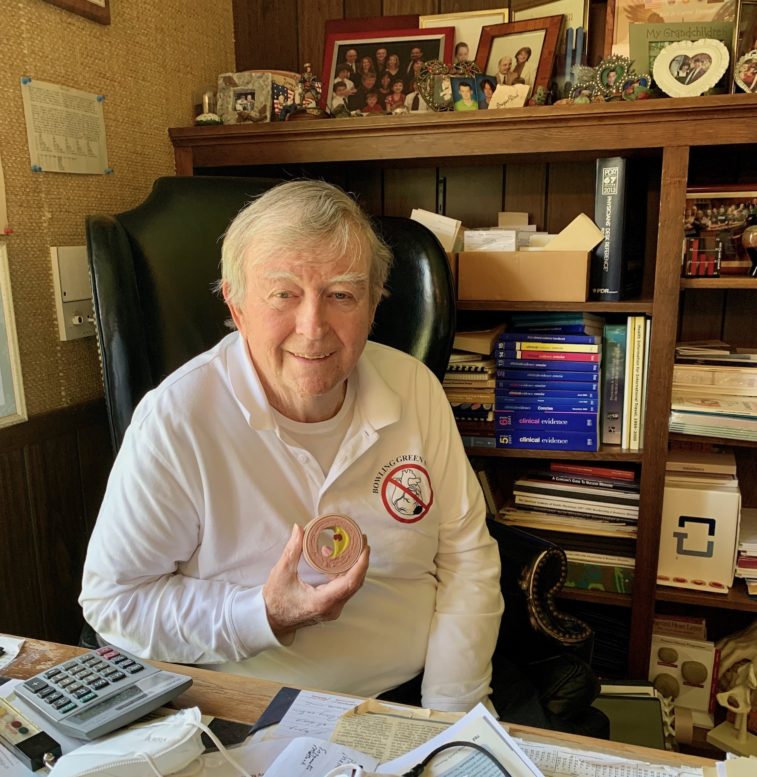
Dr. William Feeman Jr. may have retired from his private medical practice two years ago, but he continues to educate the medical community about risk factors for stroke and heart attack.
At 82 years old, Feeman recently returned from Europe, where he presented his research during the 2025 European Atherosclerosis Society Congress in Glasgow, Scotland. The research poster, titled “The (Virtual) Elimination of Atherothrombotic Disease (ATD),” shared his risk prediction tool based on nearly 50 years of evidence he gathered from his patients.
In the research abstract, Feeman pointed out that atherothrombotic disease is the most common cause of morbidity and mortality in the Western world. His work aims to help medical professionals identify at-risk patients using his prediction tool and treat them to prevent the onset of “clinical ATD,” including heart attacks and strokes.
“I’ve done a number of presentations at the European Atherosclerosis Society Symposium, but I wanted to present the one where I summed up everything in one,” he said sitting in his office still filled with files that informed his study.
Feeman’s risk factor prediction uses the risk factor profiles of patients who developed some form of clinical cardiovascular disease between Nov. 1, 1974, and Jan. 1, 2023. His Bowling Green Study included 907 patients of both genders and all ages. The primary risk factors he examined included hypertension, a lipid ratio of low-density lipoprotein (LDL) cholesterol and high-density (HDL) cholesterol, and cigarette smoking.
His approach treats various risk factors as interdependent factors, an approach that follows the Framingham (Massachusetts) Heart Study recommendations, Feeman said.
“Framingham told us almost 50 years ago that risk factors are a spectrum. You have a low-end, low-risk, and a high-risk. If you’re at high risk, you get it early. If you’re at low risk, you get it late. Nobody escapes forever,” Feeman said.
Contrary to current risk prediction models that rely on individual risk factors, Feeman’s research supports the idea of combining cholesterol, blood pressure and smoking when determining an individual’s likelihood of developing cardiovascular disease. His predictor “better captures the interplay between different risk factors,” he said.
Another limitation of the current prediction models is their ability to accurately forecast long-term cardiovascular events. They can predict heart attacks and strokes up to about seven years, but beyond 10 years, they can’t predict well at all, Feeman said.
His research uses real-world experiences that looks at why some people get heart attacks when they shouldn’t and other people who should have heart attacks don’t.
“In my personal opinion, there are things going on that has something to do with cigarette smoking,” he said. “You can have wonderful cholesterol levels and still have problems.”
He attributed the problems to irritation of the artery walls and clot formations, but admitted, “Maybe there is something else going on. We still need research, but we really do need to see how it plays out in time.”
His predictive tool starts with a risk factors graph (LDL-HDL)/LDL, or the percentage of cholesterol entering the artery wall that stays there, and systolic blood pressure, and leads to providing the average age of onset, second and third approximation of ATD. He concludes that the lower the average age of ATD onset, the higher the near-term risk of heart attacks and strokes.
Feeman referenced specific examples of patients he treated who lived well into their 90s and 100s, attributed to never having smoked. Quitting smoking can play a critical role in reducing cardiovascular risk, delaying the onset of heart attacks and strokes by up to 10 years.
He admitted his poster presentation didn’t always capture the attention of the medical professionals who attended the conference. They were more interested in research about smooth muscles.
Feeman doesn’t understand, “Why do you care about smooth muscle cells or enzymatic reactions when you can see what happens in real life,” he said. “Smooth muscle cells are very important in the atherosclerosis process, but wouldn’t you like to see how things play out in real life?”
Feeman’s research abstract will be published in the online journal Atherosclerosis. He also plans to present the research summary at the National Lipid Association in 2026.
