
By JAN McLAUGHLIN
BG Independent News
Fewer parklets have popped up this summer in downtown Bowling Green.
Two parklets have been installed – one in front of Juniper Brewing Co. on South Main Street, and one in front of Kabob It on East Wooster Street.
The other parklets are still in storage this year.
The reason seems to be multi-faceted – but not necessarily permanent. Bowling Green City Council member Jeff Dennis, who often takes vacation time to install the parklets, said family commitments interfered with team members who annually build the parklets.
Dennis also cited the “better safe than sorry” design standards for the parklets that require days of work for the volunteers installing them.
And at least one business – Grounds for Thought – now uses the parking spaces behind the coffee shop for a larger outdoor seating area.
But local residents shouldn’t worry that this spells the end to parklets or more outdoor seating areas, Dennis said.
When COVID kept customers from spending time inside businesses in 2020, the city of Bowling Green looked for ways to take business outside. Since the parklets were first constructed and installed in 2021, they have been popular among people dining, drinking coffee, knitting and taking a break while shopping.
“It’s really been about establishing whether there would be an interest,” Dennis said. The proof could be seen in four summers and falls of use. “I think that’s very encouraging. It would be great to come up with a better solution.”
Kelly Wicks, an owner of Grounds for Thought, said it was just a combination of complications – staffing and travel schedules – that led to the coffee shop not installing its parklet this summer. He is hoping the feature is back next year, and maybe becomes permanent in the future.
“We love the parklets. I really think they enhance the downtown,” Wicks said.
The parklet idea was first introduced to City Council in the spring of 2021 by council member Rachel Phipps, who saw the parklets as a way to help downtown businesses cope with the social distance requirements created by COVID-19.
The parklets were built by Ellen Fure Smith, artist and owner of Little Bare Furniture and Parklet Project member, with the assistance of BGSU students, faculty, and staff in the School of Art’s Integrated Studio.
The Parklet Project received support from more than 70 individuals and local businesses, and a $50,000 grant through T-Mobile’s Hometown Grant Program.
The city’s role in the parklets consists of reviewing the permits submitted each year for the parklets being installed. But when it comes to installing the parklets each spring, it’s an arduous task carried by few.
“It’s always been the responsibility of the businesses,” and dependent on volunteers stepping up, Dennis said.
“We’ve been able to assist quite a bit,” with the businesses sometimes supplying a free lunch as payment, he said. But this year, family commitments made the parklets less of a priority.
The two that are installed were done so by staff at Juniper and Kabob It, Dennis said.
Adding to the difficulty installing the parklets are the “very particular” design specifications by the city, which “erred on the side of caution,” he said.
Because the parklets sit along a busy state roadway through the downtown, city officials put emphasis on safety. Hence, the building materials are very sturdy and heavy. Within the first week of being installed four years ago, the parklet in front of Kabob It was struck by a hit-and-run driver in the early morning hours, when no one was using it.
That heavy-duty construction makes it difficult to re-install each year.
“They take a lot of people to move,” Dennis said.
Each year, trucks are rented to transport the materials from the Ohio Logistics warehouse, which was donated for storage.
In addition to the original three parklets, others were added since 2021 in front of Huntington Bank, the former location of Cycle Werks, Flatlands, and SamB’s.
“There’s an interest, and a lot of value to them,” Dennis said.
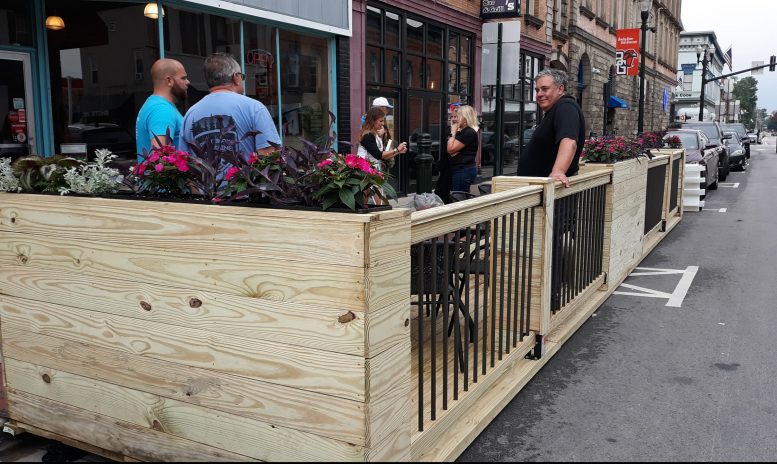
Each of the parklets are 36 feet long and 6½ feet wide. There are flower planters on the ends and on the street sides. The merchants provide the seating. Some have lighting and warmers for chilly evenings.
Located in the parking lane adjacent to the curb, parklets are designed as an extension of the sidewalk. They have the potential to increase outdoor dining options and gathering spaces downtown, where narrow sidewalks limit outdoor seating.
The parklet concept is not a new idea – with the cities across the nation already making space for businesses in on-street parking areas.
And the idea isn’t new to Bowling Green either. The city’s 2014 Future Land Use Plan called for downtown parklets, and the 2005 Downtown Plan highlighted the need for additional public gathering space.
Downtown BG Executive Director Hallie Williams said the parklet project was “adventurous,” which is good.
“Trying new things benefits our downtown,” Williams said. “They are beautiful and some people really enjoy them.”
