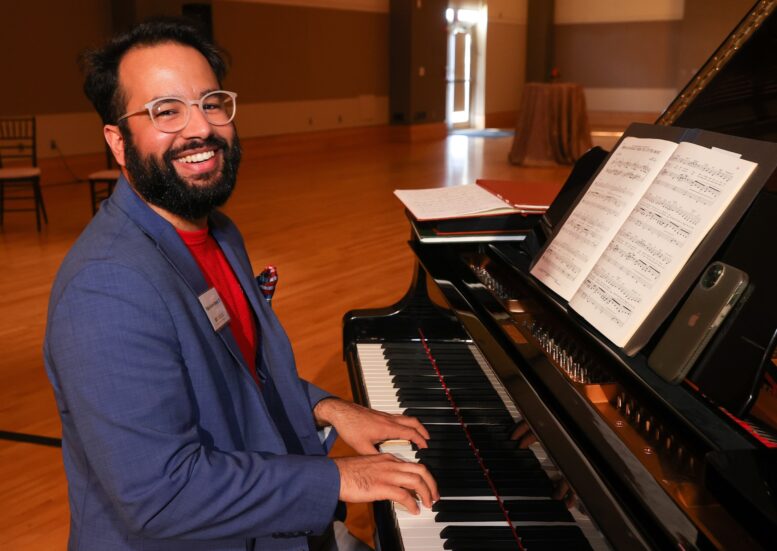
Pablo Gómez Estévez enjoys an impressive resume from his time at Bowling Green State University and as a renowned music composer and educator.
From a successful pitch to create an interactive children’s stories app where music serves as a tool for emotional literacy to earning a master’s in music theory and composition and a doctoral degree in composition from the College of Musical Arts, the Dominican-born pianist, educator and composer found a launchpad for his path to success.
“During my doctoral studies, I composed, taught, researched, and dove into areas I hadn’t explored before. I also took business courses, studied intercultural communication, worked in marketing, participated in a Shark Tank–style entrepreneurship program, and got the idea for my educational music platform, Pineo Media. It was an interdisciplinary, demanding, and deeply formative experience,” he said.
Since leaving Bowling Green, Gómez Estévez moved to New York City and immersed himself in composition, performance and entrepreneurial projects.
“Everything has been a series of leaps of faith,” he said. After finishing his doctoral program coursework at BGSU, the big city appeal of New York called him. He sought to join as an artist in residence at the City University of New York’s Dominican Studies Institute. His idea to use the institute’s archives to write a Dominican opera was met with great enthusiasm.
“New Cibao” is Gómez Estévez’s opera in progress, scheduled to premiere in 2026 and supported by the Association of Dominican Classical Artists (ADCA).. With access to the archives of composer Rafael Petitón Guzmán (1894-1983), Gómez Estévez studied the composer’s body of work that spans zarzuelas and chamber music to a major symphonic piece titled “Suite antillana,” based on melodies and rhythms from the Dominican Republic, Puerto Rico, and Cuba.
In the opera, Gómez Estévez builds a Caribbean dystopia where dreaming about gossip is mandatory, forgetting is profitable, and only guilt can break the spell. But beyond its futuristic premise, the opera delivers a pointed critique of the current Dominican media ecosystem, where gossip, celebrity culture, and scandal operate as tools for cultural narrative and social control.
The musical language of the piece weaves together perico ripiao, dembow, and operatic techniques into a cyclical structure inspired by TikTok, shaped by the fragmented logic of social media.
Even before the opera is completed and moving to initial stage production in 2026, one of the opera’s opening scenes was presented at Carnegie Hall’s prestigious Nuestros Sonidos festival in May 2025. The scene, titled “Too Niche, Too Nietzsche,” was part of an effort to spotlight emerging Caribbean voices in the contemporary classical music landscape.
Known for fusing Dominican genres like merengue and mangulina—and even others like jazz and dembow—with classical structures and nonlinear narratives, Gómez Estévez composed a piece full of emotional tension, with influences from Nietzsche, Tarantino films, and Afro-Caribbean rhythms like guaguancó.
The concert was performed to a full house by the Washington Heights chamber ensemble, part of the Association of Dominican Classical Artists (ADCA), in collaboration with The Harlem Chamber Players.
The work by Gómez Estévez will continue to lead to future collaborations and broader explorations.
In addition to the opera work, his music has been performed at the United Nations Headquarters, the ClarinetFest® festival, Newphonia, Operability Festival and the 45th International Saxophone Symposium organized by the United States Navy Band. He also has composed the music behind award-winning films including “Vainilla” and “2 Domi en 1.”
His body of work—mainly composed of chamber pieces and one-act operas—blends a kind of imagined folklore with elements of science fiction, philosophy, and Caribbean culture. Critics have described it as “joyfully unpredictable” and “infectious.”
Gómez Estévez continues to combine his musical work with Pineo Media, the transformative educational platform. He also works on editing videos, writing music for New York orchestras and translating books of the arts from Spanish to English.