
BY NICK EVANS
The organizers leading an effort to abolish Ohio property taxes are coming to a crossroads. By July 1, the campaign needs to decide if it wants to roll the dice and attempt to get on this year’s ballot or keep its powder dry and wait for another election down the road.
Last month, Ax Ohio Tax President Brian Massie announced they’ve collected 305,000 signatures so far. That puts them on track to clear the statutory minimum for the ballot, but doesn’t account for rejections. To feel confident, the campaign really wants at least 620,000 signatures for their submission.
They’re not on track for that.
Organizers can keep gathering signatures for as long as they want. Once they submit them, though, that’s pretty much it. If the campaign falls short, there’s a brief, 10-day window to make up the difference. If they can’t, any subsequent effort to make the ballot would have to start over from square one.
“I want the citizens of Ohio to hear this,” Massie said. “They can rest assured that we will not stop until we get this amendment on the ballot.”
He said the campaign will announce its plans sometime in the middle of June.
Good news, bad news
Common Cause Ohio Executive Director Catherine Turcer sees citizen-initiated ballot measures as a central part of our democracy, and she’s been personally involved in several initiative campaigns. While Turcer acknowledged it can be “challenging” to wish the anti-tax campaign well, she said the point of direct democracy is that’s it’s open to everybody.
And there are some factors working in the campaign’s favor.
“We are going into really good signature gathering weather,” Turcer said.
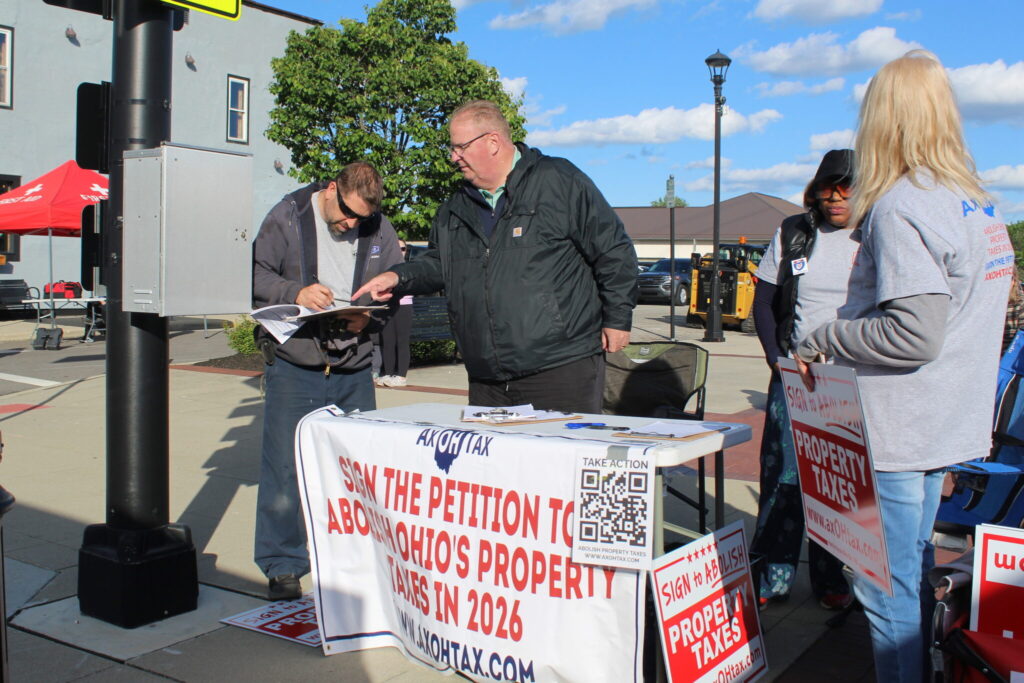
“We’re going into farmers markets and parades, Memorial Day weekend,” she rattled off. “I mean, you can start to think about the different festivals and different ways that people are out and about outside, which makes signature collection easier than, say, January.”
Their signature total puts them in “decent shape,” Turcer said. It also doesn’t hurt that the pitch is straightforward: do you want to keep your property taxes or get rid of them?
But the campaign faces significant challenges, too.
Every ballot measure sees a vast number of signatures rejected over clerical errors, Turcer said. Information could be illegible or incorrect. Petition circulators could mix up signatures from multiple counties, potentially spoiling otherwise valid signatures. And the process of physically scanning all those documents for submission takes a really long time.
“In many ways, this is about, can I submit the appropriate paperwork in a really specific way, in a way I have never done before?” she said. “And it’s easy to get caught up in the hurdles.”
What’s more, the petitions themselves have a kind of shelf life. When elections officials go to validate signatures they’re comparing the petition to current information — not whatever was current at the moment the signature was made.
“It’s a good kind of rule of thumb,” Turcer said, “(to) say 20%, 25% of the signatures that we collected a year ago could no longer reflect where the voter now lives, and so they will not count in the total.”
And that means there are risks in submitting this year, and risks in waiting until next year, too. Turcer said only the campaign knows the quality of the signatures they’ve collected so far, and she’d be shooting for a similar threshold to the one the Ax Ohio Tax campaign has in mind.
Turcer could imagine going forward with less of a cushion — but not much less.
“At least over 600 (thousand),” Turcer said, as the absolute minimum she’d be willing to submit.
Campaign check-in
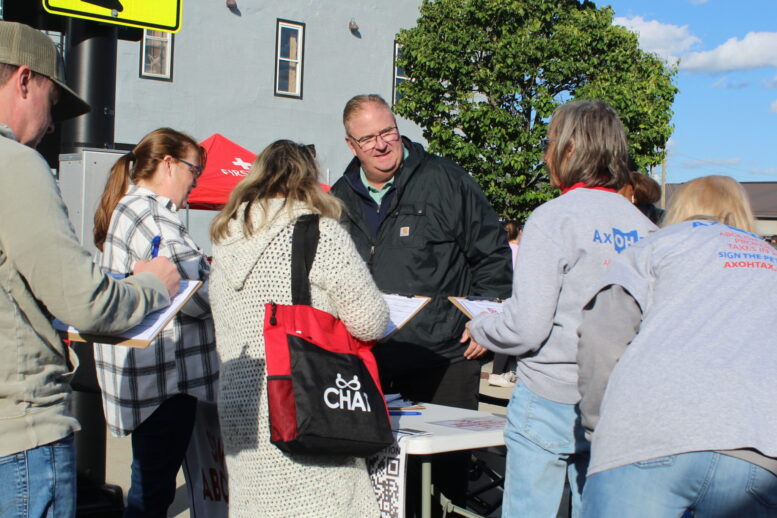
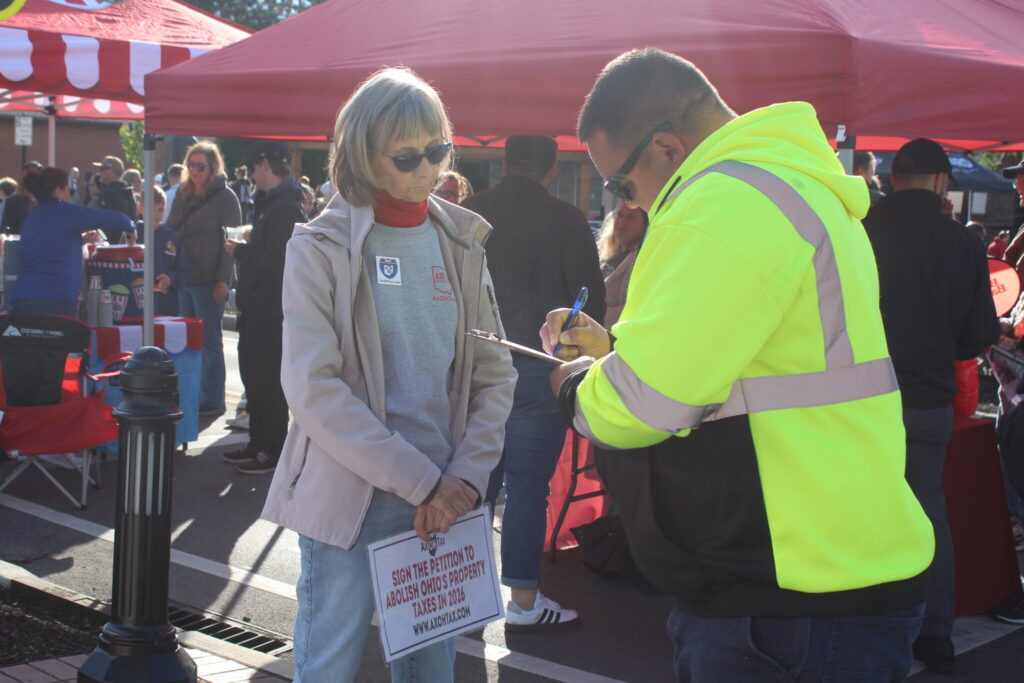
About a week after Massie’s announcement, Les Carrier joined a handful of other organizers to gather signatures at a community event in Hilliard. The former city councilman called out passersby by name and had a minute to chat with every one of them.
Carrier seemed energized by Massie’s update. Three hundred thousand signatures isn’t halfway from their goal, it’s halfway there. He used terms like “skyrocketing” or “snowballing” to describe interest in the campaign.
To him, the math is pretty simple.
“A $160,000 home in Old Hilliard now is worth $300 (thousand),” Carrier said. “Their taxes have doubled. Their income hasn’t. So, I mean, something’s got to give.”
Counterintuitively, he said enthusiasm began growing after Gov. DeWine’s administration warned eliminating the roughly $24 billion property taxes generated each year would lead to dramatic increases in sales or income taxes.
Carrier downplayed the loss in revenue — “Chicken Little is what I called it” — and said making up the difference would be simpler and fairer with consumption taxes.
“Everybody consumes at a certain level, everybody pays, and it broadens the tax base from which everything’s drawn,” Carrier said. In contrast, with property taxes, “what you’ve done is you’ve narrowed it down to those that have worked to build up equity and build up home valuation, and now they’re being punished for it.”
Consumption taxes, like sales or value-added taxes, are regressive, meaning they fall more heavily on those with lower incomes because those households spend a greater share of their income to get by.
And although Carrier thinks the solution is simple, that doesn’t mean everyone is on board. Massie, for instance, was blunt about his plans for replacing revenue. “We’re not going to,” he said, insisting instead that lawmakers need to cut spending, and “start a DOGE” in Ohio, referring to Elon Musk’s failed federal cost-cutting effort.
Carrier remains optimistic about the campaign’s chances of making the ballot this year, but he has no problem with waiting.
“I think we could make it for this year,” Carrier said. “But my personal opinion, I haven’t talked to Brian (Massie) about it yet, is if we don’t make 600 (thousand), we just keep on charging into next year.”
Andrea Beeson and Suzi Remick signed the petition after speaking to Carrier, and both expressed concerns about property taxes pushing people out of their homes.
“I feel bad for the aging people,” Remick said. “If they have to lose their homes, that would be horrible.”
Ohio farms get a significant property tax break because their valuation is based on agricultural use, but Beeson still worries about farmers near her home in Madison County getting priced out.
“Who do they sell to? Developers that can pay more than another farmer,” she said. “And now we’re getting houses and houses and houses and our schools can’t hold them all.”
Beeson and Remick said they’re still weighing whether it’s a good idea to abolish property taxes. They signed the petition because they want to give the campaign a chance to convince them and then have the chance to decide if and when the measure appears on the ballot.
“Right now, they don’t know how it would work, where the money would come from for schools and everything else,” Beeson said. “I want that option, and I want to see how they would do it.”