By JAN McLAUGHLIN
BG Independence News
The last place former inmates want to be is back behind bars. So when two former inmates returned to Wood County Jail of their own free will in mid-May, jail staff knew the IGNITE project had sparked a change.
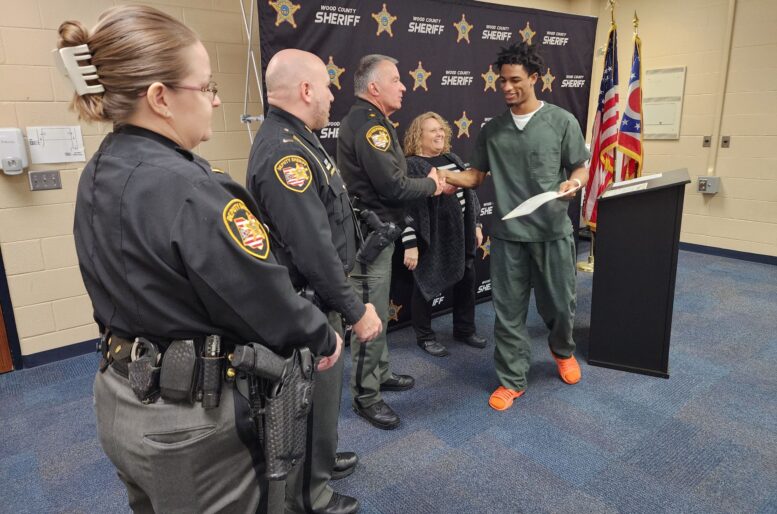
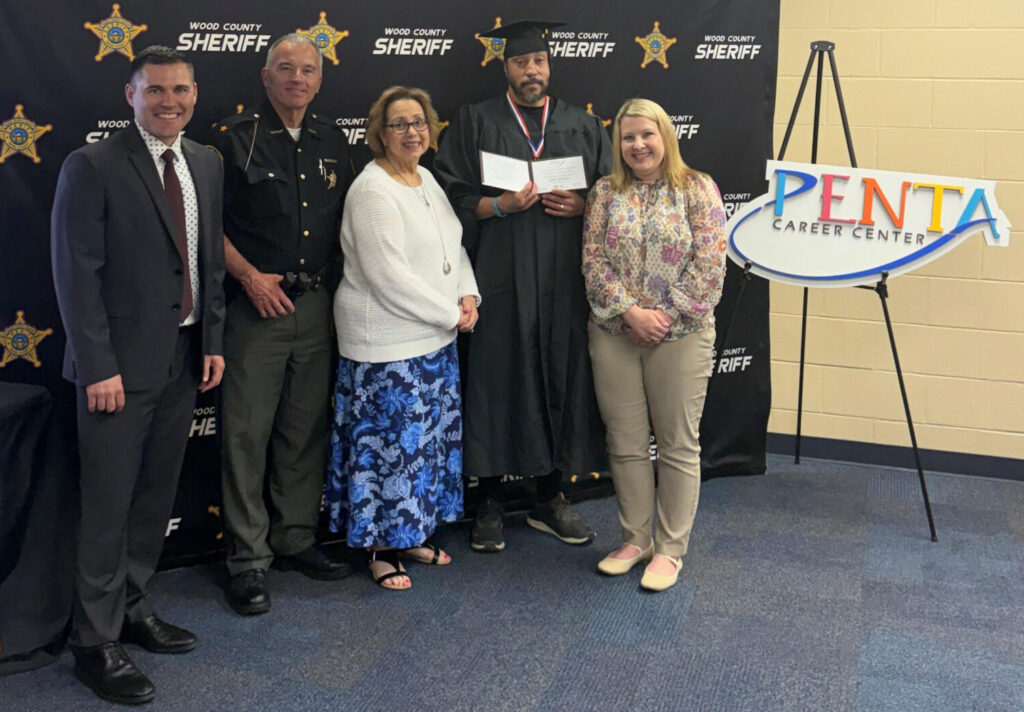
Both men had been released from jail, but came back for their graduation ceremony. James Meadows had earned his GED, and Mario Carter earned certificates for completing the introduction to carpentry program and BGSU Student Reentry Program.
To Lt. Jamison Martinez, of the Wood County Sheriff’s Office, that was a noteworthy occasion.
“Meadows’ return highlights how significant this milestone was to him and the level of commitment he made to completing it,” Martinez said. The same went for Carter, he said. “This further demonstrates the dedication of participants and the meaningful impact IGNITE has on those committed to completing the program.”
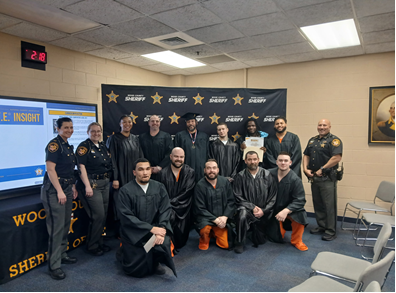
The 11 graduates wore black graduation caps and gowns – some with a flash of their bright orange jail uniforms underneath.
This was the second ceremony recognizing the efforts of the inmates who volunteered to learn while imprisoned, so they could potentially make positive changes to their lives once on the outside.
Wood County Common Pleas Judge Joel Kuhlman spoke at the graduation ceremony, noting that he had last seen some of the graduates in his courtroom. He told the inmates that he’s heard a great deal of support during his conversations with fellow judges and community groups about the IGNITE program. People on the outside want the inmates to succeed, he said.
“Good job,” Kuhlman said, aware that inmates don’t often hear those words from a judge. “I know it’s not easy to go through this program.”
The judge said their success in the IGNITE program can now define them – rather than their crimes.
What’s different with IGNITE?
Jails across the nation have been offering educational programs for decades. But most aren’t working, according to sheriffs who are trying a new strategy. Recidivism rates are still through the roof, with generations of families cycling through the system.
So in November, Wood County Jail became the fourth jail in Ohio and the 30th in the nation to offer inmates the IGNITE (Inmate Growth Naturally & Intentionally Through Education) program.
Wood County Sheriff Mark Wasylyshyn said the IGNITE program is a “game changer for jails.”
Two sheriffs already operating the program in their jails swear by the success. Genesee County in Michigan has seen a 25% drop in recidivism. And Sandusky County in Ohio has seen a decrease in “generational incarceration.”
IGNITE is designed to provide incarcerated individuals with educational opportunities, instilling hope, and preparing them for successful reintegration into society. The program partners with businesses and organizations that can share valuable skills.
Courses include skilled trades training, employment counseling, peer-to-peer mental health services, financial literacy, ServSafe certifications, parenting classes, religious and counseling services.
In addition to teaching the inmates useful skills, the program also boosts the confidence of inmates who have had limited success in society.
Researchers from Harvard University, Brown University, and the University of Michigan have noted the IGNITE program’s effectiveness at not just reducing recidivism, but also improving post-release employment opportunities, and fostering positive behavioral change inside jails.
“We could have very easily not done this,” Wasylyshyn said when the program began. “But we’re not about coasting here in Wood County.”
What can inmates learn?
IGNITE offers help learning work skills. One program gives inmates an introduction to carpentry, by partnering with Carpenters Local 351. Another helps the inmates earn ServSafe certification, training them to work in the food service industry, assisted by Penta Career Center.
There is one program on parenting after incarceration, taught by Harbor. And the Peer-to-Peer Program, led by NAMI (National Alliance on Mental Illness) of Wood County, helps inmates examine their issues and learn how to manage them. The program encourages inmates to open up about their mental health struggles.
According to Wasylyshyn, approximately 75% of inmates in the U.S. have some type of mental health problems.
“We’ve failed as a society in treating and recognizing mental illness,” he said.
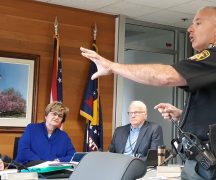
Martinez pointed out that the graduation ceremony was not only held to honor those who complete programs, but also to recognize organizations, trade groups, and community services for partnering with the Wood County Jail on this program.
“Today is about recognizing the hard work, dedication, and accomplishments of the individuals who successfully completed programs through the IGNITE initiative. These achievements represent more than certificates – they represent growth, opportunity, accountability, and the willingness to create a better future,” he said.
Martinez listed off community partners in the project, including Bowling Green State University, Penta Career Center, Carpenters Union Local 351, Harbor, NAMI Wood County, Guidestone, and Wood County Adult Probation.
“These partnerships are what make IGNITE successful. They bring education, career training, mental health support, and hope into our facility. This ceremony is proof of what can happen when a community comes together and invests in people, even during some of the most difficult times in their lives,” Martinez said.
“To all the graduates here today – be proud of what you accomplished. This is a step forward, and I encourage you to continue building on the progress you have made,” he added.
Two-way learning street
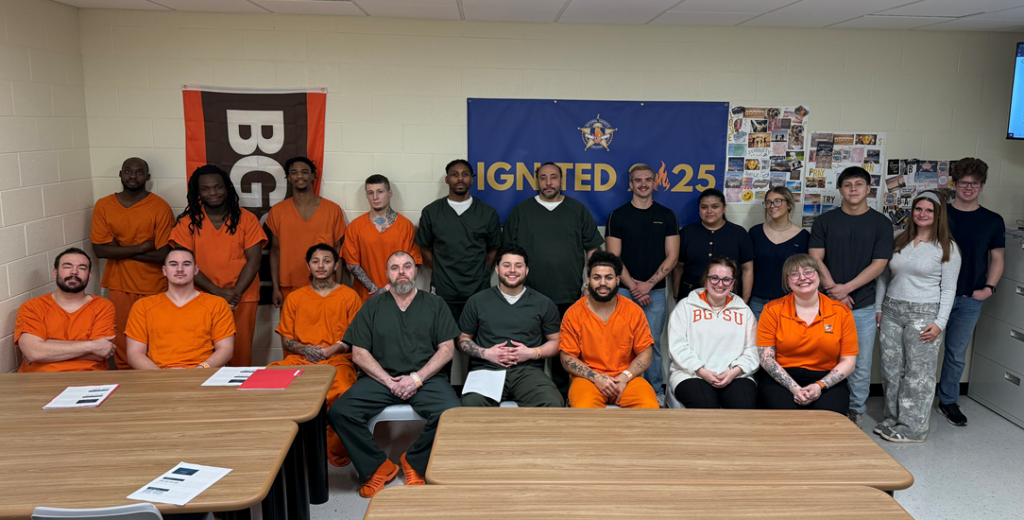
This past semester, the IGNITE project brought together BGSU students with the inmates over a series of several weeks. The students presented informational sessions on community services and reentry programs available upon inmates’ release – intended to provide inmates with resources that may assist with successful reintegration into society.
Eight inmates participated in all sessions, with a final college-level exam administered by Dr. Samanta Kopf-Apple, covering the material presented throughout the course. The professor was surprised with the exam results and congratulated the inmates on their performance and dedication to the program.
When inmates are released, some re-enter a world where they have lost their jobs, their housing and their sense of identity.
The BGSU students were divided into teams to address issues the inmates may face upon re-entering society, such as:
- Finding employment after incarceration. Many employers report they will hire people with records, but that isn’t always the case.
- Family reunification and parenting after jail.
- Finding housing, clothes, food and churches.
- Financial obligations – fines, child support, etc.
- Mental health services, health care, Medicare, Medicaid.
- Transportation and mobility barriers, such as lack of public transportation, license suspensions.
- Civic integration and voters rights.
- Substance use and recovery.
- How to get needed documents
- Public assistance like SNAP, Social Security, disability.
At the end of the semester, the students presented reports to their class about their experiences. Meeting with the inmates in the jail began as an uncomfortable situation for some – with the students and inmates coming from different worlds.
BGSU student Sophia Bartony wrote about her experience.
“The Wood County Jail’s IGNITE Program is something I did not fully understand until I saw it firsthand,” she wrote. “Through this program, participants have access to resources such as education, career preparation, and support systems designed to support a successful transition after release. However, what stood out the most was not what was offered, but how it was received.”
“As part of the BGSU partnership, I was given the opportunity to present research directly to the inmates participating in the program. Standing in that classroom, in front of the inmates, it became clear that this was not just a requirement or a way to pass time. The level of inmate engagement shifted my perspective – questions were genuine, conversations were active, and there was an obvious interest in the material being presented.”
“Being part of the first group of students involved in this program allowed me to understand both personal and educational perspectives,” Bartony wrote. “I realized the impact this experience had on me. It gave me a rare, firsthand opportunity to step into an environment I had never seen before and see how education and communication function in a correctional setting. What I expected to be a simple presentation for class credit turned into something much more meaningful, showing how education can work in real time to bridge gaps and create opportunities.”
During the student classroom presentations at the end of the semester, Wood County Sheriff Capt. Rebecca McMonigal told the students they made an impact on the inmates.
“You all are part of something special – to give inmates the confidence in themselves to get out in the community and be successful,” she said.
Most inmates are accustomed to negative interactions with others outside the jail, McMonigal said. “This had a huge impact. They talk about this on the regular,” she said.
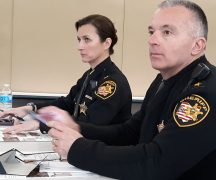
Lt. Brittany Brown, with the sheriff’s office, noted how the BGSU participation in the program helped the students see the human side of those serving time – and that people can be one mistake away from being in the inmates’ shoes.
“Criminal justice needs changes,” and this can be a start, Brown said.
Kopf-Apple said the partnership with the IGNITE program helped humanize inmates for students and for some created a “desire to be the change in the justice system. It was a really great experience,” she said.