By JULIE CARLE
BG Independent News
Pemberville-born Elizabeth Bowlus enlisted in the Women’s Army Corps (WAC) and used her college degree in library science for military administration in London and Paris during World War II.
Carl Eschedor, a German-American farmer from Wood County, spent more than a year as a prisoner of war on a potato farm in Germany, where his German background led him to act as an interpreter.
Albert Lowell Randall was a podiatrist who enlisted in the Army and served for 44 months in a medical unit in North Africa, Italy and Okinawa before returning to establish a long-running practice in Bowling Green.
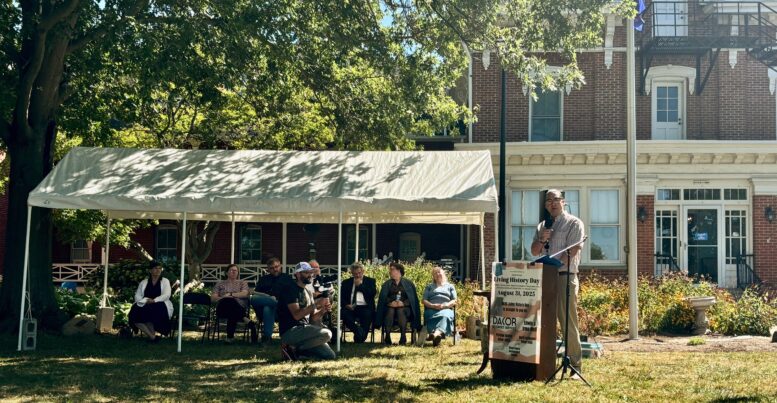
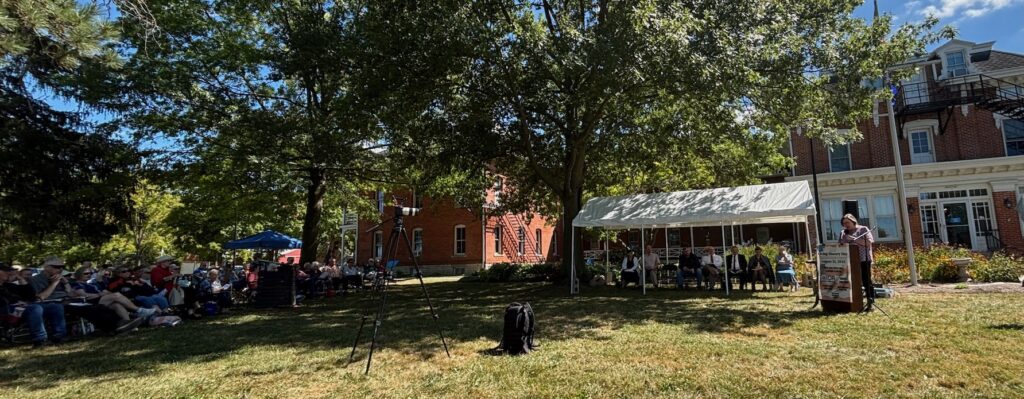
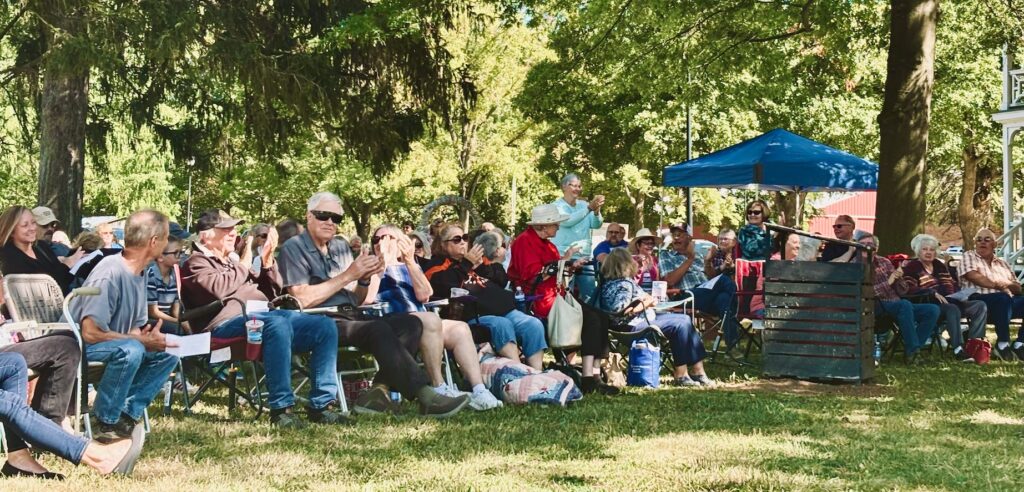
They were three of the eight individuals portrayed by current Wood County residents Wendy Guion, Geoff Howes, and Anderson Lee, respectively, during the Wood County Museum’s 22nd Living History Day.
The other residents whose stories were told included:
Elizabeth Dunipace, portrayed by Erin Marten, was a nurse who enlisted in the Army and served in challenging field hospital conditions in the south Pacific, including Oahu and the Kwajalein Atoll.
Tom Edge portrayed Louis Gilles, a soldier who served as a truck driver for superiors in Europe.
Harold “Buck” Gonyer, portrayed by Jeff Schooley, was an Army veteran who served in the 97th Division across Europe and Africa.
Judy Guion-Utsler shared the story of Ruth Hoffman, a young woman from Philadelphia who later moved to Bowling Green with her husband Wes. She supported the war effort on the home front by working for the Pennsylvania Railroad, a nontraditional job for women at the time.
Carrie Schwartz, portrayed by Ann Deutschman, was a mother from North Baltimore whose five sons all served in different branches of the military during the war. In recognition of her family’s service, she was chosen to christen a Liberty ship in Baltimore in 1942.
The focus for this year’s event was World War II, to coincide with the museum’s “We’ll Meet Again: Remembering World War II” exhibit.
The war didn’t define the individuals, but it did shape their lives.
Randall and Lee: Grandfather-Grandson shared interests
Lee, who shared an interest in acting with his grandfather Albert Lowell Randall (who was known as Lowell since Albert was his father’s name) was honored to share “Doc Randall’s” story.
His family had run a local bakery in Bowling Green for many years, so he knew early on that he did not want to continue the family business. Instead, after graduating from Bowling green High School and Columbia Junior College, he earned a Doctor of Podiatry from the Ohio College of Podiatry in June 1942. A month later, he enlisted in the Army and was assigned to a medical unit.
During the 44 months he served, 39 were spent overseas in such exciting places as North Africa, Italy and Okinawa.
“I remember well working as a medical assistant on GIs who were battered up on the Anzio beachhead,” he said.
Among his noteworthy memories was meeting silver screen actress Marlene Dietrich. She was traveling with a USO troop and asked to see Randall for treatment.
“She was very well known for those famous curvy legs of hers. And boy, that was the first thing all my buddies wanted to know about,” Randall said. “The trouble was, she only came to me about a throat ache, and I never saw those famous legs.”
He corresponded regularly with his mother and wife, Dorothy, whom he had married in 1934. One letter from his mother told him about the Bowling Green Red Cross volunteers making boxes of surgical bandages and sponges to send to troops overseas. “After a long, tiring day helping in surgery, my roommate and I were refilling our sponge supply. And guess what? There was a label on the box indicating the sponges had been prepared by the Red Cross of Wood County through Bowling Green. What are the chances this box of sponges makes it to the same medical unit I was working on in Italy?”
In letters to his wife, Randall wasn’t allowed to tell her (or anyone) where he was stationed. The letters were heavily censored to prevent any secret information from being intercepted by the enemy.
“But I found a way around that,” he said. “Dorothy and I had a system: the first letter of the first sentence would correspond to a marking on a map she had back home representing a city. That way, she could simply look up that letter on her map, and she would have a rough idea of where I was serving.”
He admitted having some “difficult experiences along the way that stayed with me.” But he did not regret his service or ever let it overshadow his life. He and Dorothy settled in Bowling Green, “were blessed with four children, sons Al, John and Tom, and daughter Vicky.”
He practiced for 36 years, recalling that his first patient was Mrs. Helen Conklin, wife of the former Bowling Green State University Dean of Students.
“While taking care of people’s feet as my job, it was not my whole life,” he said. He was an avid runner, outdoorsman and pilot. He was also supportive of the arts and painted pictures of barns and bridges. “I passed this love onto my daughter Vicky, who has been a lifelong artist.” He was also a proud founder of the Black Swamp Players.
Elizabeth Bowlus’s Women’s Army Corps experience
Elizabeth Bowlus grew up in a family with her parents Henry and Bertha (Bowser) Bowlus, sister Josephine and three brothers. While she developed a lack of confidence compared to her beautiful sister Josephine, she went on to complete degrees in education and library science at Oberlin College.
After several years in various education and administrative jobs, she quit and enlisted in the Women’s Army Corps (WAC). She learned that her brothers and father also enlisted in the military to serve the country in World War II.
She took her basic training in Georgia and was in Texas for a six-week administrative training school and office work, “which came in handy during and after the war,” she said.
After a bout with high blood pressure, she was eventually sent overseas via the Queen Elizabeth. “It took us six days because we were chased by a submarine that wasn’t friendly,” she said. “We had to go farther north and finally landed in Scotland because the German bombers couldn’t get high enough to drop their bombs on the base because of the mountains.”
She was first assigned to the Air Force headquarters, also Eisenhower’s headquarters, in Bushy Park, Teddington, London. There she was in a “perfectly suited” job because of her knowledge of the Dewey Decimal System. She made some of her best friends while in London, and they would get their hair done at a salon that was under a bridge.
“We would often hear planes overhead that sounded like so many washing machines. If the buzzing stopped, we were to run for shelter. One time we were running, and a soldier grabbed me and threw me into the shelter,” she said. “I never knew his name, but I think he saved my life that day.”
She served in the WAC for three years. “I like to think that I made. Difference, however small in the war,” she said.
Bowlus recalled a letter that was sent to her father from WAC headquarters in 1943. “It said she had proved in her job at the Special Services Office that women are as efficient, if not more so, in the Army jobs than the soldiers, she said. “I was proud of that, and it proved to be true in my civilian life as well.”
Upon returning home to Pemberville, she taught for several years in the Lake School District and for 25 years worked with her brother, Tom, in his family practice. She also helped start the Pemberville Library and the Mental Culture Club, a group that continues to explore the ways that women can be educated by learning about the world.
Carl Eschedor’s German background proved useful
“Can you imagine the irony of being a German American and going off to war against the German people? Can you imagine the irony of growing up a farm boy and winding up spending a good portion of your wartime farming?”
Those were the words that introduced the central conflict and theme of Carl Eschedor’s war experience.
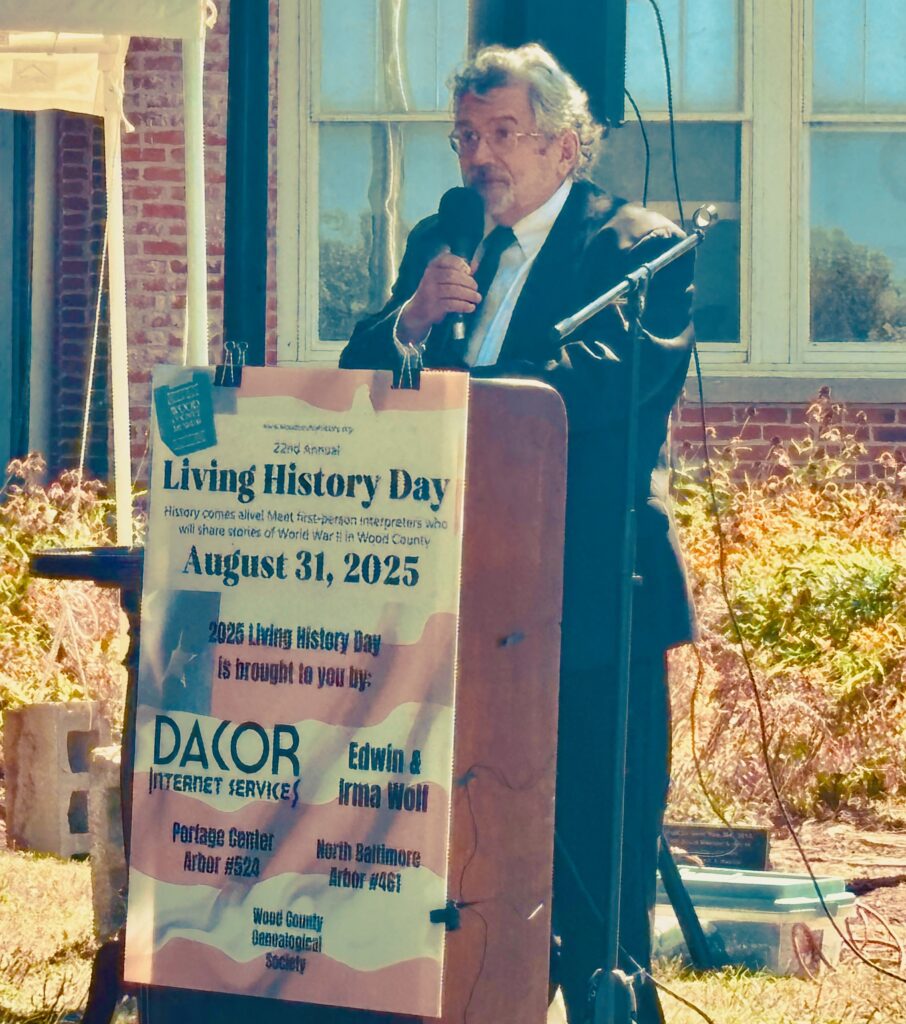
He was born in Wood County and grew up on a farm, and as part of a close-knit German community, including both sets of grandparents who came to the United States from Germany. His parents sent him to a German school until he was 14 to make sure he knew his rich heritage
“When I enlisted in the army in October of 1941, it wasn’t easy going off to fight a war where the enemy soldiers were German,” he said. “Could it be possible that someone in my sight was a distant cousin? “
His first taste of battle didn’t come until Nov. 8, 1942, in Algiers, where they were stationed until Feb. 1, 1943, when they left for the Tunisian front. German Gen. Evan Rummel, commander of the forces in Tunisia, began a series of attacks on his western front. On Feb. 14, Eschedor’s unit suffered heavily, resulting in a retreat from the fighting and the capture of many Americans, including Eschedor.
Eventually, he ended up at a prison camp potato farm in Germany.
“Perhaps you can now see the irony I spoke of earlier,” he said. “Here I was a German-American farm boy, being put to work on a prison camp farm in Germany.”
He was there, working on the potato farm for the final year and a half of the war.
He befriended four men who came from different units at different times and from different parts of the U.S. “If it weren’t for the war, we would probably never have met, but our shared ordeal would bind us together in ways no one else could imagine.
One of the friends drove a wood-burning tractor, another took care of about 200 sheep, one spent his days as a woodsman, and another spent his days turning potatoes into alcohol. Eschedor’s job became acting as an interpreter for the other prisoner and serving as a liaison between the Americans and the Germans.
Eschedor was part of the 850-mile death march and was then caught by the Russians and then liberated.
He returned home and to farming. “In some ways, it felt as if I had never really left farming,” he said. “We had not only survived, we had thrived and found a friendship that endured.”
A little more than a year later he married his wife, Lucille, and settled on his Van Tassel farm, where they raised three daughters.
“In a way, farming and my heritage brought me through the war and continued in so many ways to be a vital part of my life,” he said.
Elizabeth Dunipace: Lived through challenging field hospital experiences
Elizabeth Dunipace wasn’t born in Wood County but ended up here after marrying a soldier, who was from Bowling Green. They met while stationed in the South Pacific.
For many years after serving in the war as an Army nurse, she refused to talk about it. Not until 1995, when she was invited to the War Memorial Service in Cleveland, did she want to remember those days. “Veterans from all 88 counties were present, and I was the only woman there,” she recalled. “I was 78, and it had been 52 years since I enlisted. Though I forgot for so long, it seemed like it was just yesterday.”

She had been working as a unit nurse in Columbus when she heard a plea for nurses to serve in the war.
“I had always considered myself a patriotic person who loved my country and my community,” she said, explaining her reason for enlisting.
During training at Camp Breckenridge in Kentucky, she was asked where she would prefer to serve in Europe or the South Pacific. “I eagerly answered Europe, and by Christmastime, I was on my way to the South Pacific,” she laughed.
The first assignment was on Oahu in a hospital that was formerly a school for Hawaiian royalty. They took care of casualties that were flown in from all battle sites. She admitted it was depressing, but she knew they were getting wonderful care.
The gorgeous flowers and perfect weather made the Honolulu experience nice, she said. But after a blackout, the camp was placed on alert and moved to an area in the southern part of Oahu, where they lived in tents similar to those on M.A.S.H.
“We had to use our helmets to bathe and to wash our clothes,” she said. “Every morning, we checked our shoes to see if there were any scorpions in them.”
They learned to set up and take down the hospital tents when enemies attacked. They anxiously awaited being placed on active duty. They were sent to the 38th Field Hospital in the Kwajalein Atoll in the Marshall Islands.
She didn’t like the plane they were scheduled to fly on for the 15-hour flight. “Is there some other way to get me to where we are going without getting on that plane?” she asked.
The lieutenant responded: “Would you like to be the first nurse court martialed in World War II?”
Dunipace got on the plane but didn’t say anything the entire trip.
At their destination, the hospital was nothing more than canvas tents and wooden tables. Day and night, the wounded came in from Japan, broken and bleeding. They worked 20 to 25 hours straight, sometimes without light, few supplies, and no way to clean anything.
“We had to decide who would live and who we felt had no chance,” she said. “Every time we would have to make that decision, we would say a prayer for that man, comfort him the best we could, and move on to the next patient. That was just the way it was.”
One good thing came out of the war for Dunipace. Oahu was where she met her future husband, Jim Dunipace. They settled in Bowling Green, Jim’s hometown. She returned to nursing at Mercy Hospital in Toledo, and she always remembered her time in the war. “It was my desire to let those who lost loved ones in World War I know that we did the very best we could in caring for those loved ones under those existing conditions.”
Louis Gilles: Driver of the higher-ups
Louis Gilles was born Feb. 9, 1923, to Herbert and Elizabeth Gilles, who were both from Germany. He grew up on Lime City Road, where he learned to ride a bike.
After graduating from Perrysburg High School, Gilles worked at Libby Owens Ford, where his father was/ He signed up for the Army in the draft and was sent to California for training. There, he learned to drive trucks.
“One day, he drove back to the base with his supervisor next to him and soldiers in the transport trailer. As they traveled through some steep mountains, the brakes went out on a down slope. Speeding faster and faster, Gilles kept the truck on the road and found an incline to slow the truck to a stop. Everyone survived and returned to the base safely.
“That’s probably why I was chosen to be one of the drivers,” he said
His job in Europe was to drive his superiors where they needed to go, including Gen. Dwight Eisenhower.

He also had his share of adventures, including a time when he and other soldiers were pinned down by the Nazis.
“We were in a meadow, and they were stationed up on a high elevation blocking us from the only exit,” Gilles said. “Their plan was to starve us out and pick up the pieces later.”
However, the American soldiers were resourceful and found plenty of food in the meadow. “The Nazis left when they realized we weren’t going to die for them.”
After the war, Gilles returned to LOF and decided he liked working with the glass. “In fact, that gave me the opportunity of a lifetime,” he said.
He was on a team that was hired by the National Bureau of Standards to preserve the original Constitution and other important documents. He helped make the cases for the documents with LOF’s Thermopane glass. The process took many trials and errors before they constructed the cases for the documents, which also included the Declaration of Independence and the Bill of Rights.
No place like home for Harold Gonyer after traveling the world
Born on April 23, 1924, to Harvey and Bernice Gonyer, Harold “Buck” Gonyer got to see a lot of the world during his service in World War II.
“I liked seeing new parts of the world as I served my country, but I spent most of my life right here in Wood County, and there is no place like home,” he said.
He and his brother, Bill, worked at Stone Co. in Waterville until the U.S. got involved in World War II, and they both enlisted. Harold Gonyer served in the 389th Field Artillery Battalion, 97th Division in Europe that traveled to Africa, Tunisia, Italy, France, Germany and Austria. Bill worked elsewhere, so they didn’t get to see much of one another.
Once he returned home, he married Donna and they had two sons, James and Terry.
“I was honored to become a lifelong member of the VFW in Bowling Green, but I didn’t talk to my boys about the war all that much,” he said. “At first, they were too young, but as they grew, I didn’t want to tell them about the battles and the fighting.”
He told them some of the less intense moments. But he also told them about the time he burned his hands, which saved his life.
During a battle, shells were fired. He saw one coming toward him.
“I didn’t want it to hit me, so I thought fast, reached out and grabbed it out of the air with both hands,” he said. “I regretted it right away. Those shells were very, very hot and gave me third-degree burns.” He was hospitalized for three months.
One of his jobs was to drive the corporal places, but with his hands injured, he couldn’t drive. Someone else took his place. The first time the replacement drove, a gun was fired and hit him in the stomach. “That could have been me if I hadn’t burned my hands,” he said.
His life after the war was full. He worked several jobs and retired from Henry Filtration Systems in 1984.
Ruth Hoffman supports the war effort at home
Ruth Hoffman was one of those people who worked in the United States during the war, but who made a difference in the war effort.
“I never picked up a gun during the Second World War, but I was one of the. millions of American women who supported the war effort on the home front and I’m glad our stories are also being told,” she said.
She was born in 1924 in Philadelphia, Pennsylvania. She had a nice childhood and loved listening to Buck Rogers on the radio, she recalled. “I even asked my family if they could get me a flying belt,” she said with a laugh.
When that didn’t happen, she started climbing everything in sight. “Little did I know that I was preparing for experiences during the war,” she said.
The attack on Pearl Harbor occurred two days before her 17th birthday. “Suddenly, the young men in my schools started disappearing, enlisting in the military and being sent overseas,” she said.
Hoffman was asked if she wanted to work at the Pennsylvania Railroad. They were looking for a young woman willing to work in the switch tower.
“I had thought of enlisting myself, but I really wanted to be in the WAVES (Women Accepted for Volunteer Emergency Service), where the minimum age was 25,” she said.
She started working in the largest freight distribution center in the world, and did a lot of different jobs, depending on what they needed. She was apprehensive about taking on some of the responsibilities, but soon felt comfortable enough to hop onto a moving train just to say hello to the engineer, she said.
He was a bit startled when this young woman appeared out of nowhere and said that he wouldn’t be able to stop the train.
“I assured him that I would be just fine jumping off, and I did,” she said. “People often ask me how I was treated, especially by the men, and I’m proud to say that I received equal pay for my work. I proved to everyone that I belonged there, and the men treated me accordingly,” she said.
One day, when she arrived at work, her boss asked if she could be photographed at the switch. She agreed but didn’t give it much thought.
“A few months later, however, the railroad launched a new campaign, ‘Miss Molly Pitcher,’ to show how women were contributing to the war effort,” she said. “And there I was in my letter jacket wearing a handkerchief on my head, representing so many women who worked to support their country.”
She didn’t know she was going to be featured, and no one asked permission, “but it was nice to have our work recognized.”
She first became a physical education teacher after graduating from Temple University and later earned a Master of Library Science from the University of Washington. She married the love of her life, Wes Hoffman, who was a lieutenant colonel in the Air Force. His work took them to England, and then in 1965, he was offered the opportunity to lead the ROTC program at BGSU. She worked at the University Library for 20 years before she retired and stayed active in the community.
“I never forgot my wartime experiences. They taught me that I was capable of anything that women are capable of, anything they taught me above all else to never stop climbing,” she said.
Carrie Swartz: Christening a ship was a mother’s reward
Carrie Swartz led the life of a housewife and mother since 1905. Married to Charles A. Swartz, they moved to North Baltimore in 1918. He worked for the Baltimore and Ohio Railroad in Deshler and then North Baltimore.
Charles was working, and she was busy keeping house and participating at church.
“And then December 7, 1941, came and changed everything,” she said. “All five of my boys ended up serving their country during the war.”
Howard was drafted in January 1942, and Dwight in February. Robert enlisted in the Navy and Oliver was in the Naval Reserves. David, who already had a civilian pilot’s license, chose the Army Airfield.
“Imagine my surprise when I received a telegram from J.M. Willis, vice president and general manager of the Bethlehem Fairfield Ship Building Company,” she said. “They asked me to christen one of the Liberty ships that would be launched on July 4, 1943.”
She traveled to Baltimore to christen the Liberty ship, “Luther Martin,” all because her five boys were serving the country in World War II.
“How could I refuse?” she thought.
Son Oliver and his wife accompanied Carrie and Charles to Baltimore for the christening. They were treated royally with pictures taken of them with the president of the railroad, shopping, a meal and a tour of the Baltimore and Ohio facilities.
The party of 19 Packards and one Cadillac headed to the shipyard on Saturday. They watched the launch of the first two ships before it was her turn.
“I got to smash the champagne bottle on the Luther Martin and after the ceremony we were taken to the Belvedere Hotel for a luncheon, where I was presented a corsage, and my most prized presentation was a sapphire diamond pin from the ship building firm, engraved on the box was the sponsor of the steamship Luther Martin, July 4, 1942.”
“I am thankful that my five boys chose to serve their country, but I am very happy that all five of them came home in one piece and we were able to return to our normal lives,” she said.