By JAN McLAUGHLIN
BG Independent News
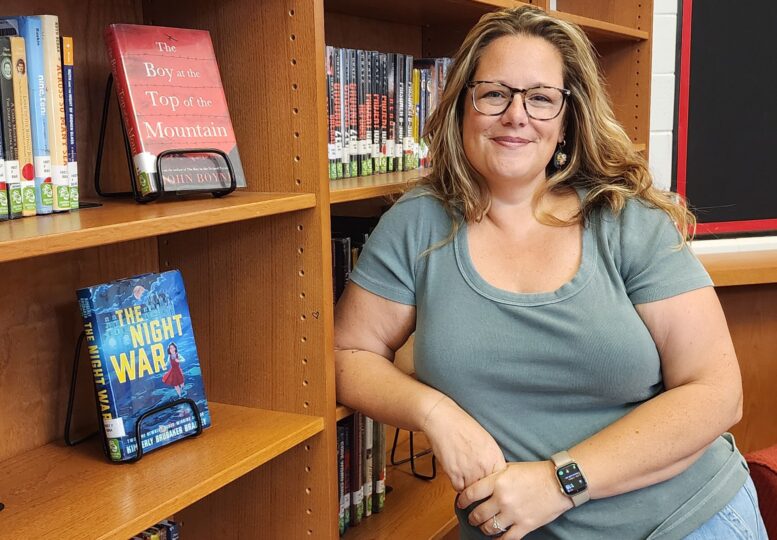
As an educator, Heather Fallis knows that history with its blemishes removed is not really history at all.
So when the library media specialist at Bowling Green Middle School heard about an opportunity to learn a piece of American history not normally covered in textbooks, she jumped at the chance.
At no expense to BG City Schools, Fallis went to school herself this past summer at George Washington’s estate of Mount Vernon. The seminar focused on enslavement during the time of Washington – and the first president’s role in the practice.
“This is hard history,” Fallis said. “So we can critically look at, and remember, where we’ve been in history.”
In a time when educators in some areas of the U.S. are being cautioned to not focus on the negatives of America’s past, the Mount Vernon seminars encourage teachers to be true to history.
The seminars there can do that without fear of repercussions from the government because the site receives no federal funding and is managed by the Mount Vernon Ladies Association. The organization believes in telling history as it was – not trying to whitewash it.
And that includes sharing details about Washington that may make people uncomfortable now.
“George Washington was a fallible character,” Fallis said. After all, he was human, she added.
As a young man, Washington accepted slavery, but after the Revolutionary War, he reportedly began to question the practice. He avoided the issue publicly, believing that bitter debates over slavery could tear apart the fragile nation.
His vast agricultural estate relied on enslaved people to prosper.
“It ran on slavery,” Fallis said. “They were the backbone.”
“No one at Mount Vernon is saying Washington was a horrible person. He was a product of his times,” she said.
But that bit of history is rarely acknowledged. While Thomas Jefferson’s practice of enslaving people has been openly addressed, Washington’s history has largely gone unmentioned.
“He was an incredibly brilliant man, trying to advance agriculture” at a time when the prevalence of tobacco was shifting to wheat, Fallis said of Washington.
A chart of those living on Mount Vernon in the late 1790s shows how the estate operated on the backs of enslaved people. Of the 275 people at the homestead, five were members of the Washington family, 17 were hired servants and their families, and 253 were enslaved people.
The economics of slavery was a “huge motivating factor,” Fallis said. The Washingtons kept meticulous records that assign a monetary value to each of the enslaved people on the estate, she said.
“This is actual history,” she said.
In his later years, friends of the first president reportedly tried to convince him to free his slaves. But he did not. When he died in 1799, his will cited that his slaves should be freed – but only after his wife, Martha, died three years later. Even then, the majority on the estate remained enslaved since Martha did not release her slaves in her will.
Many of the descendants of those enslaved at Mount Vernon have traced their history back to the estate, and hold huge reunions there, “reclaiming history,” Fallis said.
It’s good for students to realize that the nation’s founders weren’t perfect, Fallis said. Those lessons are “appropriate discourse.”
“They like to realize we’re not the only ones that are flawed,” she said.
Fallis worries that educators are feeling the pressure to ignore the parts of American history that aren’t pretty.
“I have a lot of concerns about what happens when we whitewash history,” she said. Refusal to acknowledge the past makes it more likely to repeat it, she added. “Reflecting on those choices makes a country stronger, not weaker.”
“When we stop looking, it gets really dangerous,” Fallis said. “We want to make sure we’re preserving history for all people who have a stake in it.”
Those concerns are shared by the Mount Vernon Ladies Association, which was founded in 1853 by Ann Pamela Cunningham of South Carolina, and is the oldest national historic preservation organization as well as among the oldest patriotic women’s societies in the U.S.
Through historic preservation of a national symbol, the Mount Vernon Ladies’ Association hoped to transcend or “heal” the sectional divisions that were deepening over the issue of slavery in the U.S.
Today, the MVLA continues its original mission, relying solely on private contributions, and is overseen by a board of regents made up of women from 27 states. https://www.mountvernon.org/george-washington/slavery