
By JULIE CARLE
BG Independent News
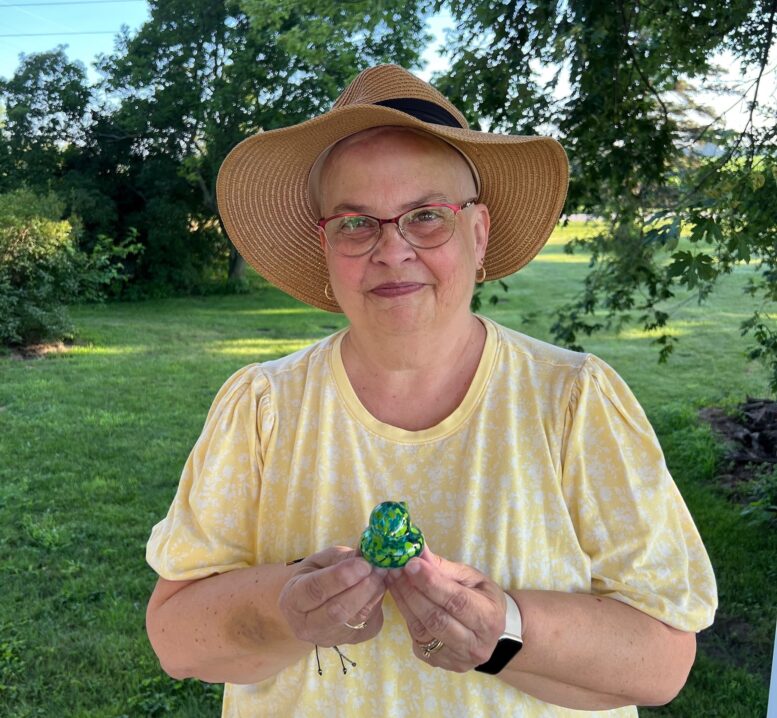
May 3, 2023, changed Kathy Thomas’s life forever, but not her spirit.
She had driven her bus route, gone to the grocery store, taken the groceries into the house and put them away. But she doesn’t remember carrying them into the house and putting them away.
She also doesn’t remember her husband, Roger, coming in and talking with her.
The next thing she remembers is waking up in the hospital after being transported by Life Flight to St. Vincent Medical Center in Toledo. Doctors thought she had had a stroke or an aneurysm, but they couldn’t find anything wrong, so they sent her home.
Another seizure and a cardiac episode two months later in early July sent her back to the hospital. But it wasn’t until the end of July 2023 when she received the official diagnosis: glioblastoma, the most aggressive form of brain tumor.
She had been admitted to the hospital and an MRI showed a spot on her brain that had been seen previously, was visibly growing within a couple days. Neurosurgeon Dr. X. Sean Xin presented two options: biopsy or surgery to remove it.
Because he could do the surgery soon or not until October or November, Thomas researched him and learned he was one of the top neurosurgeons in the area. Instead of going for a second opinion or waiting until later in the fall, she chose to schedule the surgery as quickly as possible.
Thomas was confident she was in good hands with Dr. Xin for the long, grueling surgery.
Xin said he was able to successfully remove the majority of her tumor through an advanced surgical procedure, which allowed her to maintain good neurological function.
The “magic number” for removal of the tumor is 70%. “Anything less than 70% is pointless,” he said. “If you do 80 or 90 or 95%, every incremental percentage removal, people live longer.”
There is a process called super maximal resection that removes all the “white stuff” inside and also some of the “darker stuff” around where it corresponds to the cells on the periphery, Xin said.
“If you can remove 99% or 100% of the ring-enhancing tumor…you have fewer tumor cancer cells left,” he added. “Then you give radiant chemo to maximize what’s called cytoreduction. You remove as much tumor cells as possible so that what’s left over can be killed by the chemotherapy. There’s a higher chance of giving you remission.”
One of the issues with brain cancer is that it is very tough to treat, Xin said.
“There’s a lot of research, but not a lot of new, good medicines for that,” Xin said. “It’s difficult to find chemotherapy that works.”
After the surgery, Thomas’s tumor was tested and definitively diagnosed at glioblastoma with the outside graded at 4 and the inside at 3, she said.
With that diagnosis, Kathy and Roger asked about her prognosis.
But Xin is a firm believer that the first news anyone wants to hear is not, “You’re only going to live so long.” His message to the Thomases and to his patients is, “Hey, we’re going to take care of you. There’s hope. There’s treatment. We don’t know how it’s going to go, but we are here to hold your hand.”
Too often, doctors are relying on life expectancy numbers based on information from 2005.
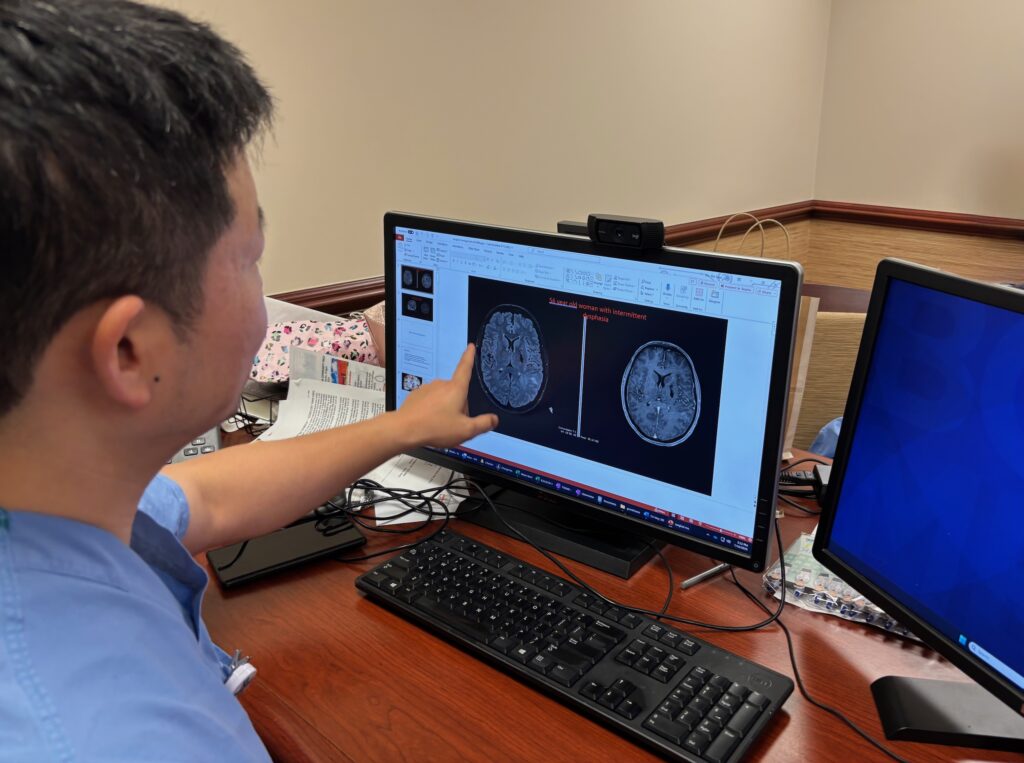
“We’re in 2025, so 20 years later, people still like to quote 15 months because that was a big day when they came up with that number,” thanks to the success of a new drug at the time plus chemotherapy, Xin said. “However, between then and now, there’s been a lot of new advances in medicine, in surgery, and people are living longer. The instruments are better, the technique is better and a neurosurgeon who was alive 20 years ago doing brain surgery is a better neurosurgeon 20 years later because of training and what we understand.”
In addition to surgery, Thomas underwent radiation and chemotherapy under the guidance of medical oncologist Dr. Mohamed Ayoubi.
“Five days a week, I went to Mercy (Cancer Center) at Perrysburg to get radiation, and then I would do my chemo pills at night,” Thomas said. “On Monday and Tuesday, I was good. The rest of the week I had an upset stomach.” She took a medication to deal with the upset stomach and an antibiotic to prevent infections since the chemotherapy would destroy the good cells, she explained.
She did six months of that treatment as prescribed, and then was told she needed another six months.
“I was like, ‘You’ve got to be kidding me,’” she recalled “That was devastating to know that I wasn’t done. That light at the end of the tunnel wasn’t there yet.”
The doctor was concerned that the chemo was making her sick, so he took her off the chemo, but added regular MRIs every three months to watch the tumor area.
“Everything was good. They were always happy to see me come in,” she said. “I was like their shining sunshine that came in—always upbeat and never upset about anything.”
Thomas’s treatment included the innovative tumor treating fields (TTF), that was developed about 10 years ago, Xin said. TTF has been shown to be effective at extending life at least four additional months.
Optune was the brand name of Thomas’s TTF wearable device, but she named her first one “Fred” after Fred Flintstone and subsequent ones “Barney” and “Bam Bam.”
The treatment delivers low-intensity electrical currents to disrupt cell division in cancer cells, particularly rapidly dividing tumor cells.
Thomas had to shave her head to wear the adhesive patches to target the currents to the brain tumor and carry the portable device during the treatment, which was most effective if worn at least 18 hours per day.
“Do I like wearing the Optune on my head? No. Some days I just don’t want to put it on. But do I like wearing it? Not really. Do I know I have to wear it? Yeah. Because I honestly believe that it is keeping the tumor from coming back,” she said. “And I said, ‘If this is what I have to do to stay alive, this is what I’ll do.’”
She believes in making the best of the situation that God put her in. “If this is what God intended for me, then this is my life,” she said stoically. “I live for my kids—Jacob and Ben.”
Her faith has sustained her throughout life’s ups and downs, she said. Her doctors and medical care team have said that her positivity and faith amaze them all “because most people would have quit by now.”
Attitude is very important,” Xin said. At more than two years out from the initial surgery, past the projected expectancy, “Kathy is doing very well.” She required additional tests and surgery in August
“Her attitude is a real plus for her and her health,” Xin said. “I hope she continues to do well for a long time.
