By JULIE CARLE
BG Independent News
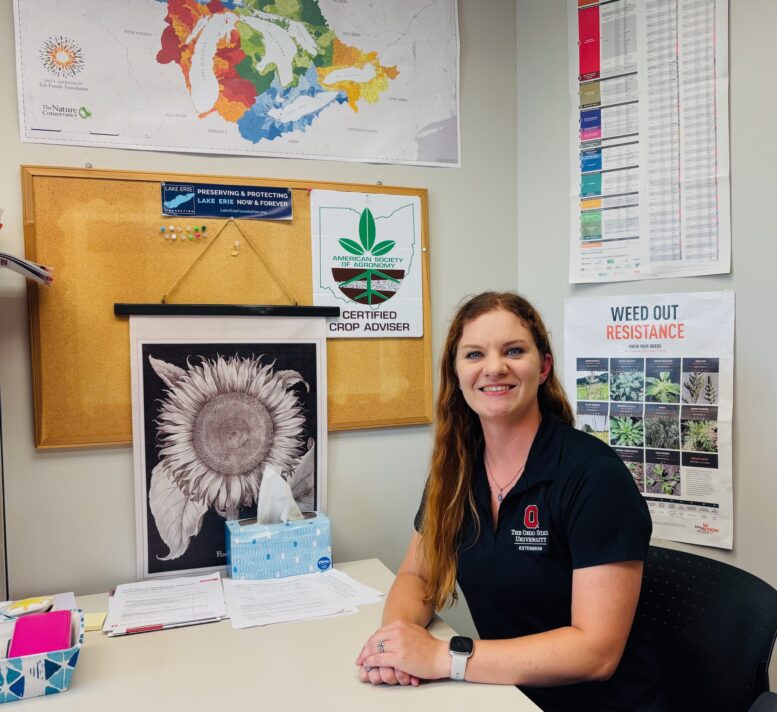
Amber Emmons knows agriculture plays a part in the water quality of the Lake Erie Basin.
As a water quality associate with the Ohio State University Extension Service, Emmons is part of a team dedicated to bridging water quality research and on-farm practices.
She also knows that everyone in the region contributes to water quality issues in the lake.
“I know people like to blame one problem or the other, farmers or water treatment plants, but it’s coming from everyone,” she said. “We’ve seen data where everybody’s contributing a little bit of nutrients, even general landowners.”
Nitrogen, potassium and phosphorus—the nutrients in fertilizers that can feed algal blooms in the lakes—can also come from home septic tanks, grass clippings that go into private septic or public sewer systems, or lawn fertilizers that find their way onto driveways or sidewalks.
Her focus is on helping farmers reduce nutrient loss from farm fields, but it’s not solely an agricultural problem. She also wants the public to recognize that maybe they have nutrients that are leaving their property and making it into the waterways.
Path to water quality work
Emmons did not grow up on a farm, but throughout high school worked on a produce farm near her home in Glandorf, Ohio.
Her actual path to water quality work came through 4-H and internships she did with OSU Extension while she was studying agriculture at Ohio State University.
“I loved my internship. I liked getting to talk with people and going out and asking ‘What’s your problem? What do you want to learn about? Are you trying to research something?” she said. “I got to do a little bit of everything.”
And best of all, there’s no sales pitch.
“I like to be completely neutral,” she said, instead of having to “tow a company line” in a corporate position. “If you want to talk bad or good about something, I can give you opinions and university recommendations based on research.”
After receiving her bachelor’s degree in agronomy and a minor in soil science from OSU, she knew she needed a master’s degree to work in extension. She attended the University of Kentucky and earned a master’s degree in weed science and was ready to pursue an extension career in agronomy or a related area.
The tri-county water quality associate position was the first one she saw and applied for in January 2022. She made it through the interview process and was offered the water quality associate position to start after graduation in April 2022.
She could use her agronomy skills and work in an area close to her home in the Glandorf area.
Emmons’s experiences in extension allowed her to see the county aspect and the state specialist perspective. “Because the position is about going to farms and talking to farmers, being able to communicate and talk to people is important,” she said.
Water quality: A complex issue
Now, with three years of extension work under her belt, Emmons has used her work in soil health and best management practices to further her knowledge and experience in the area of water quality. Emmons is also working on a doctoral degree at Ohio State.
While many people assume she tests water because of her job title, the job is actually more focused on education and research. The closest she gets to water testing is monitoring water in the Little Auglaize Watershed, which is the source of drinking water in Delphos, Ohio.
She gives water quality presentations to schoolchildren and the general public, but the majority of her time is spent working with farmers.
“We’re expected to do some on-farm research with farmers and also have some extension teaching events,” she said. In a given year, she typically has a couple of trials underway with farmers.
Currently, she has farmers lined up to look at end-of-season nitrogen. The goal is to convince farmers to do research that doesn’t require much extra effort from the farmers.
“They have to grow corn and tell me how much nitrogen they put on it,” she said. ”I pull a soil sample in the fall. We look at how much nitrogen was left over to try and calculate how much money they left in the field,” because reducing nutrient losses can provide an economic benefit for farmers, especially when nitrogen costs are high.
Emmons also takes into consideration the practices they used: what kind of manure, if any, they put on; whether they used a commercial fertilizer, or or had did they have a cover crop.
Though extension is not directly involved with the H2Ohio program, which is Gov. Mike DeWine’s data-driven water quality plan to reduce harmful algal blooms. Extension might help farmers who are enrolled in H2Ohio or Natural Resources Conservation Service programs.
Farmers might need help selecting cover crop species or education to understand where the nutrients are going or how to keep from losing those nutrients, she said.
The water quality team has collected about three years of data from the Western Lake Erie Basin, Emmons said.
Current research is finding reductions in nitrogen and phosphorus leaving fields, though weather may have contributed to the positive results.
The water quality team has looked at individual tile outlet samples from farmers, taken river samples and other water samples, and found that most farmers have realized the anticipated 40% reduction of nutrient losses.
“If we had different weather—two, three, four inches of rain— we maybe would see something different,” she said.
The biggest runoff issues come when there are heavy rains.
“At that point, there’s not much anyone can do. It’s going to flood. You’re going to lose sediment, and water is going to run away,” she said. “We can even look at a trend line in the last 20 to 40 years, and the amount of nutrients makes a downward line on the graph. So, we’re doing something right.”
The more farmers who are willing to get involved in the research over time, the more that can be understood.
Emmons has found that communicating with farmers and presenting hard data is the most effective way to build trust and demonstrate the impact of their practices.
With August dedicated to Water Quality Awareness, Emmons and the water quality extension team hosted presentations and a water quality field day that focused on two-stage ditches, an in-channel practice that reduces wetness in fields, makes the banks more stable and reduces downstream exports of nutrients and sediments.
“If I can show you a number and show you a change in that number over time, that is way more believable than if I’m just trying to tell you, ‘Hey, I promise we’re doing better,’” she said. “I know people want an answer now, but sometimes a five- or 10-year study is going to give you a better answer than a one-year study,” Emmons said. More years of evidence help build a reliable understanding of which conservation practices were most effective across different weather patterns.