
By JULIE CARLE
BG Independent News
Bowling Green State University welcomed the inaugural cohort of its new hybrid occupational therapy doctorate program to campus.
Classes started on August 25, but this is the first time the group of 36 students has come together in person. The two-week intensive, hands-on lab instruction on campus is part of the curriculum model, said Dr. Jason Hughes, program director and assistant professor.
During the two-year hybrid doctoral program, students are learning on their own time through faculty-led synchronous and asynchronous classes on Zoom. However, twice a semester, they travel to campus to interact and work side-by-side with their peers and the faculty.
“Students live all over the country and come to Bowling Green for laboratory immersion,” Hughes explained. “They are coming to lab to implement all the things they’ve been reading about, talking about, writing papers about, and all those things they’ve been tested on.”
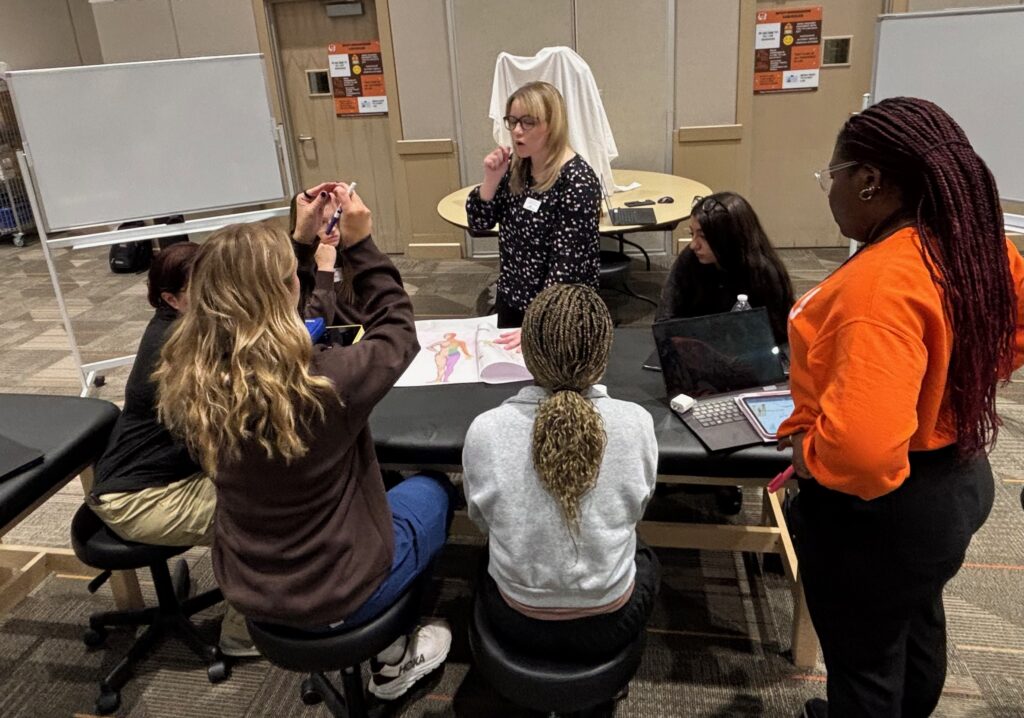
The first week on campus (Sept. 22-26) was spent learning the foundations of an occupational therapy lab. On Monday, they shifted to lessons in functional anatomy.
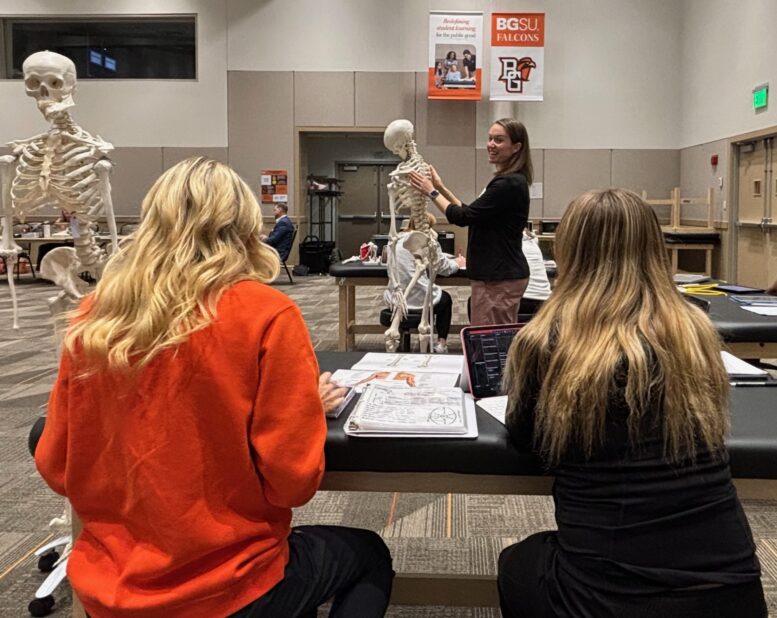
The students were sitting by replica skeletons, studying the muscles of the arms and trying to absorb all the information shared during their first on-campus, clinical labs.
“Anatomy is hard, but you’ve got to know it” for occupational therapy, said Noah Zebrak, who is from the Cleveland area. “I enjoy studying anatomy, but it’s definitely a struggle. We are here for a doctorate, so it’s supposed to be hard.”
As a collegiate soccer player who was always interested in the body and exercise, Zebrak graduated with an exercise physiology undergraduate degree and wanted to go into healthcare. He helped his grandmother, who struggled with congestive heart failure, get back on her feet. The experience motivated him to focus on an occupational therapy career.
“I didn’t want to just sit at a desk. I wanted to make a difference,” he said.

After looking at several doctoral OT programs, Zebrak chose the BGSU for its flexibility. “This accelerated hybrid program is two years, which is quicker than most programs, which take three years,” he said. “This gets you out in the field a year earlier, making more money earlier than most programs.”
The online and in-person format also allows students to work to make money, do their studies on their own time and still earn a degree in two years, he said.
The format works well for the population enrolled in the program, Hughes said. “Twenty-six percent of the cohort reports being from a small town or rural area and 26% are nontraditional students over the age of 26,” he said. Additionally, 33% identify as first-generation college students.
“With this delivery model, our hope is to increase access to education for these students,” he said. “In turn, we hope they continue to be able to reside in their small towns to increase access to occupational therapy care.”
The demand for occupational therapists has been on the rise for years, from children all the way up through older populations.
More than 11,000 people reach the age of 65 on a daily basis. By 2030, everyone in the Baby Boomer generation will have turned 65, accelerating the need for more health care professionals.
The goal is often to be able to age at home, he said. Occupational therapy can allow people to remain independent and living at home for longer instead of going into a nursing facility.
The need for occupational therapy has also increased in younger populations as more children are diagnosed on the autism spectrum. As more people participate in occupational therapy, “it is becoming better understood and better accepted,” he said.
“Occupational therapy is about occupations, and occupations are activities of daily living,” Hughes said.
“For older adults, daily living includes medication management, getting in and out of the shower safely, getting dressed, participating in the community and being able to navigate getting to appointments and church,” he said.
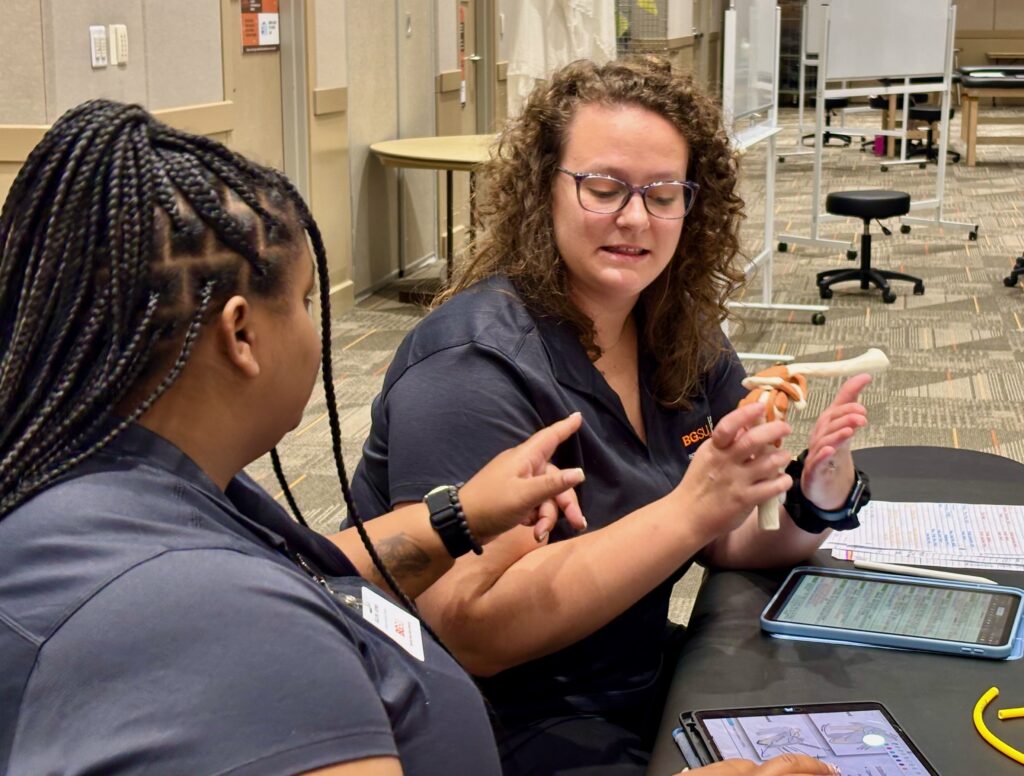
OT student Akciré Jones has a long history with therapy services after watching her grandmother receive speech, physical and occupational therapies. She loves the idea of helping people with the all-encompassing skills they need to do in daily living versus working on one specific task like getting a knee to work better through physical therapy.
“We’re going to make sure you have those functional things that you actually want to be able to do to live,” she said.
For children, daily living is about play, sharing, eating, communicating, crawling and bedtime routines, Hughes said.
Kennedy Moore, a 2025 BGSU applied health science graduate, knows firsthand the benefit of occupational therapy. When she was four years old, she had a stroke and went through occupational therapy to help with fine and gross motor skills, improving her abilities to participate in everyday activities.
“It made such a difference in my life that I’ve come full circle,” Moore said. She was able to shadow the OT who helped her recover as a child and knew it was a path she wanted to pursue. “It is a calling. Now, I want to be able to help others the way she helped me.”
Zebrak is still deciding what type of occupational therapy he wants to go into. He likes acute outpatient care of a hospital setting, but said he’s open to pediatric and geriatric care. The two field experiences and the capstone project that provide hands-on work in the field will help narrow down his path.
“The faculty have been amazing,” he said. They have been welcoming and readily available, especially in the online portion of the program. “They’ve done a great job connecting everyone and always being open for meetings, talking or to support us emotionally.”
