
(Written by Shaun Reeves of the Lincoln House Inn and edited and adapted by Geoff Howes of the Historic Preservation Commission)
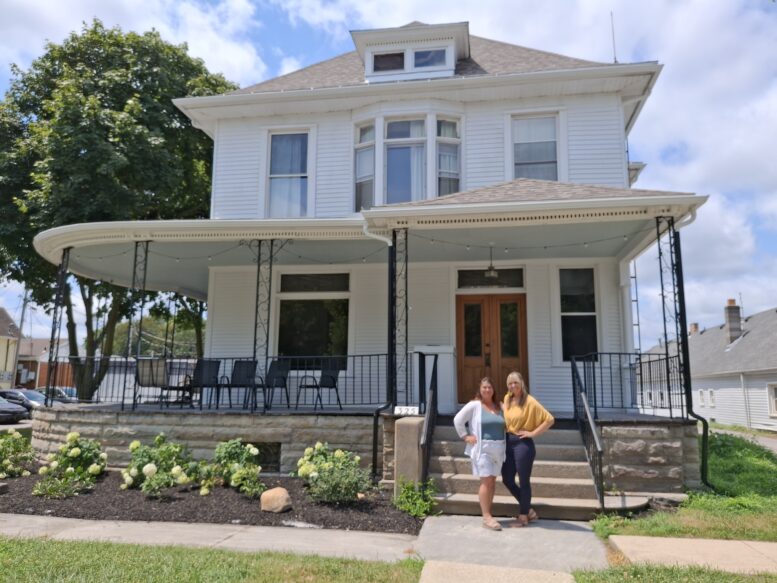
The Bowling Green Historic Preservation Commission has selected the Lincoln House at 325 North Main as its Historic Building of the Month for October in honor of the grand opening of the Lincoln House Inn with a Halloween party on Oct. 25 from 6 to 11 p.m.
See details of this ticketed event on the website: https://thelincolnhouseinn.com/lincolnhouse-events/grand-opening-halloween-party/
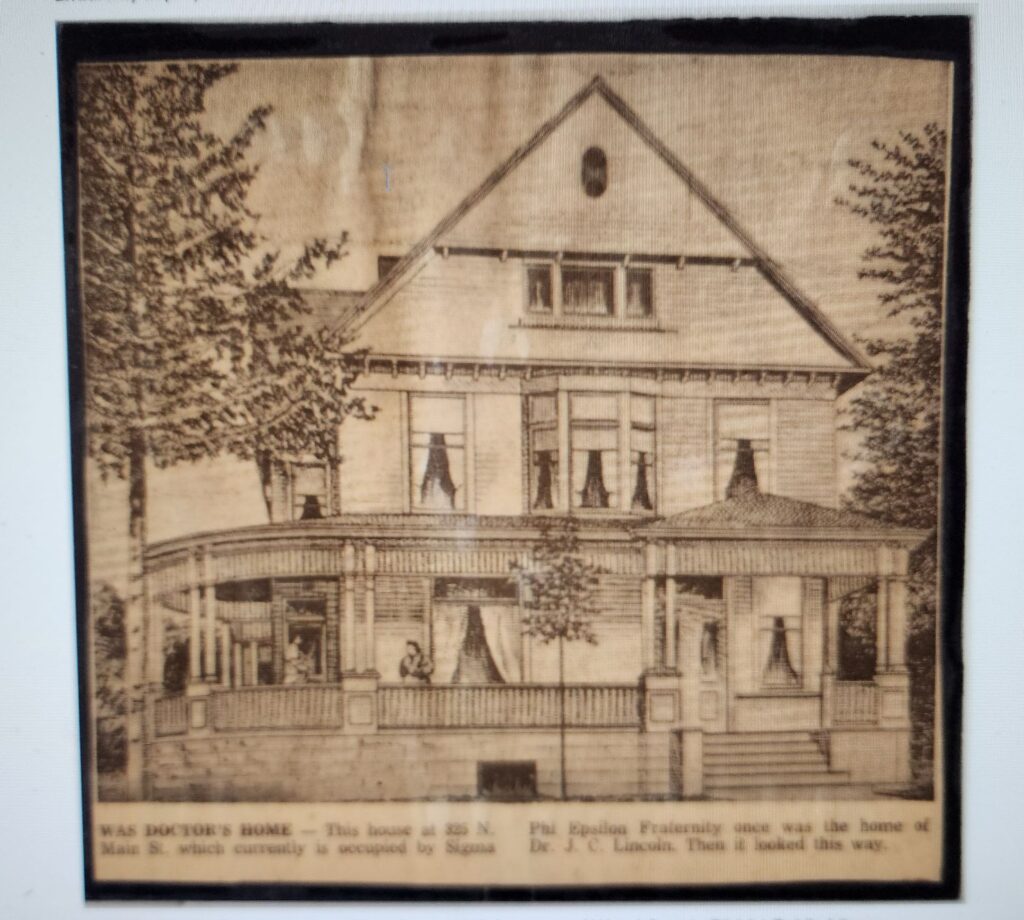
This American Foursquare style home was built around 1895 by Dr. J.C. Lincoln and his wife Nettie for a hefty price of $14,000 (over $500,000 in today’s money). But in July of 1895, the Daily Sentinel reported that “Dr. Lincoln’s elegant new home on North Main Street, no doubt the most elegant frame residence in Wood County, is a mass of ruins.” A fire had started in the attic, consumed the second story, and caused the roof to collapse.
The home was rebuilt with a new upstairs and a new hip roof, perhaps more suited to its foursquare style than the original gabled roof. The American Foursquare style became popular in the late 19th and early 20th centuries. The name refers to the square footprint and simple layout, typically with four rooms on each floor, a large porch, and a hip roof.
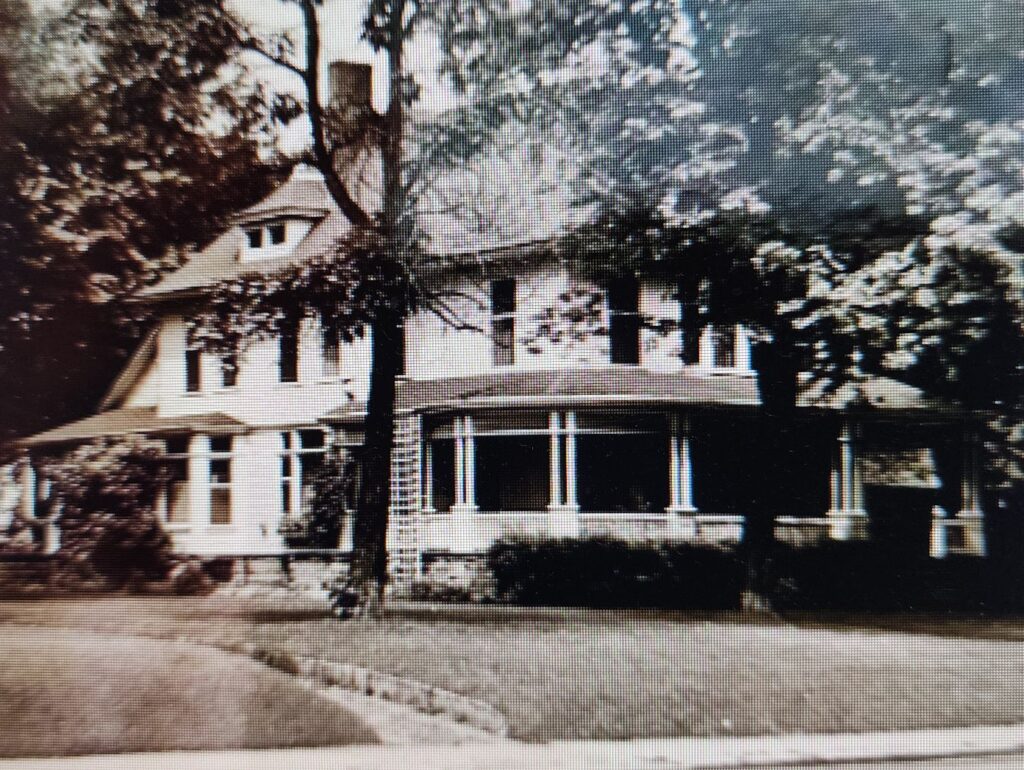
Many features of that rebuilt house are still visible today. Although the wooden porch posts and railings were replaced with wrought iron in the 1970s, original columns can still be seen on the north end of the porch. The lead glass windows over the large porch window and the front doors are original, as is the wooden siding still visible on the porch. The porch light fixture is also original, as is the brass door plate.
Inside the house, some banisters have been replaced, but the remaining original posts feature carvings of Masonic symbols. (Dr. J.C. Lincoln was a member of Wood County Masonic Lodge No. 112 as well as the Independent Order of Odd Fellows.) Pocket doors separate the foyer from the parlor room. Original high ceilings, woodwork, and lead glass can still be seen.
There are two beautifully preserved fireplaces in the Lincoln House. In the formal living room downstairs is a fireplace with relief carvings in mahogany, an original beveled mirror, and bluish-green glazed tiles. The carvings and tiles most likely came from the J. & J. Low Art Tile Works of Massachusetts, whose popularity peaked in the 1890s. In an upstairs bedroom there is a fireplace whose olive-colored tiles were probably made by the same company.
In the kitchen there are two original built-ins that still contain some of the Lincolns’ books, tools, and items used in Dr. Lincoln’s practice, although the cabinets and floors were replaced with modern fixtures in the 1960s.
Joseph C. Lincoln was born on May 22, 1844, in Albany, New York. He and his older brother Charles served in the Civil War and in 1862, Joseph was wounded at the Battle of Fair Oaks. In 1871, he received an M.D. from Rush Medical College in Chicago. He moved to the Fostoria area to practice medicine, where he met his first wife, Emma Norris. They married in 1873 and moved to Bowling Green.
Dr. Lincoln played vital roles in the Bowling Green community. In addition to his medical practice, he owned a prosperous drugstore in the Lincoln Block at the corner of North Main and East Wooster. He was the first secretary of the Wood County Medical Society and an active Republican who served on City Council and the Board of Education. Later, President Benjamin Harrison appointed him as a veterans’ medical pension examiner, and in 1896, Wood County Republicans endorsed him as a nominee for Congress.
The Lincolns had two children, John and Eudora. Their mother Emma died, probably of tuberculosis, just before Christmas of 1883. She is buried in Oak Grove Cemetery. In 1895, Dr. Lincoln met and married Nettie Willard of Memphis, Tennessee.
Nettie Willard was born in Memphis on Oct. 21, 1863, to Charles and Elizabeth Willard. In 1883, 20-year-old Nettie came to Bowling Green to teach. She married Dr. J.C. Lincoln in 1885, which in those days meant she had to stop teaching. She often hosted groups of Bowling Green’s prominent women and gave private lessons in painting and French.
J.C. Lincoln’s daughter Eudora, known as “Dora,” graduated from high school in 1895 and married Samuel C. Harvey in 1901. The couple welcomed their daughter Helen in 1902. Dora died in 1907 in her father’s home, where her funeral was held. Dr. Lincoln and Nettie then raised their granddaughter, Helen.
After Helen grew up, Nettie spent most winters in California at The Laguna Beach Art Colony, where she mastered the plein air style of painting. Nettie’s will bequeathed three of her paintings to BGSU, the public library, and the Women’s Association of the First Presbyterian Church. Shaun Reeves, the current owner of the house, located her painting “Rocky Shores,” which now hangs again in the Lincoln House, thanks to the Presbyterian Women.
Nettie Lincoln was one of the 11 founding members of Bowling Green’s Shakespeare Roundtable, established in 1906 and still meeting today. It is the longest operating women’s club in Wood County, and some members started what is now the Wood County Public Library (see Historic Building of the Month for September 2025). She was a board member of the Wood County Library and a member of the Society of Women Artists in Toledo. Nettie Lincoln’s papers are preserved in the BGSU Center for Archival Collections.
Dr. Lincoln died in 1926, and Nettie died in 1947. Both are interred in Oak Grove Cemetery. After Mrs. Lincoln’s death, the house was purchased in 1948 by Sigma Psi Omega (later Sigma Phi Epsilon) and served as a fraternity house until 1961, when Mr. and Mrs. Ivan Stearns acquired it. The Stearns lived on the first floor and turned the second floor into a cooperative residence for BGSU students. In 2014, Mary Parkinson and Marcus Dumas bought the home, which continued to house students, sororities, and fraternities.
In 2024 Shaun Reeves purchased the house, intending to turn it into “The Lincoln House Inn,” to memorialize the influence of the Lincolns in Bowling Green and provide a place where the community can stay, gather, and grow. The remodeling of the gardens, the exterior, and the interior are well underway in preparation for the grand opening on Oct. 25. https://thelincolnhouseinn.com
Would you like to nominate a historic building or site for recognition? You can do this through the city website at – https://www.bgohio.org/FormCenter/Planning-13/Historic-BuildingSite-Nomination-Form-83
You can learn more about the Historic Preservation Commission by attending their meetings (the fourth Tuesdays of each month at 4 p.m.) or by visiting their webpage at https://www.bgohio.org/436/Historic-Preservation-Commission
